

Fish & Coral Food
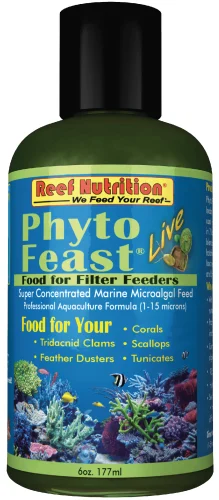
Reef Nutrition Phyto-Feast Live Marine Microalgae 6oz
$16.99
- Ships any business day
- Products we use on our own reefs
- Questions? Ask a reef keeper
Share
Product details
Product details
Reef Nutrition Phyto-Feast Live Marine Microalgae 6oz is a refrigerated live marine microalgae food designed for aquarium livestock. It’s supplied as fresh, harvested microalgae each week and used as a phytoplankton-style feed to support nutrition for filter-feeding organisms and animals that consume microalgae from the water column. This “Live” version uses the same algae as Phyto-Feast, but is handled for improved short-term cell viability, so it can be an effective everyday option when you want fresh live algae in your tank.
Features:
- Live marine microalgae harvested and shipped fresh each week for better short-term cell viability
- Contains a blend of important marine microalgae species: Pavlova, Isochrysis, Thalassiosira weissflogii, Tetraselmis, Nannochloropsis, and Synechococcus
- Helps provide nutritional diversity from phytoplankton pigments, lipids, and other naturally occurring microalgae components
- Before use, invert and/or shake; larger cells such as Tetraselmis may settle at the bottom
- For best results, consider turning off the skimmer before adding and returning it later (a short “vacation” window is commonly used)
- Start with a small daily dose and adjust if your tank doesn’t “clear” the water within about an hour
Specifications:
- Product name: Reef Nutrition Phyto-Feast Live Marine Microalgae 6oz
- Form: Live marine microalgae (phytoplankton food)
- Volume: 6oz
- Included microalgae (species named on label): Pavlova, Isochrysis, Thalassiosira weissflogii, Tetraselmis, Nannochloropsis, Synechococcus
- Dosing (new users): Start with 1 drop per gallon each day (1 teaspoon per 100 gallons)
- Dosing (common mature-system range): 1–5 drops per gallon each day (1–5 teaspoons per 100 gallons)
- Skimmer tip: Turning off the skimmer when dosing is commonly recommended; returning after about 2 hours is noted as a typical approach
- Storage: Refrigerate; avoid freezing
You might also like
-
 Fish & Coral Food
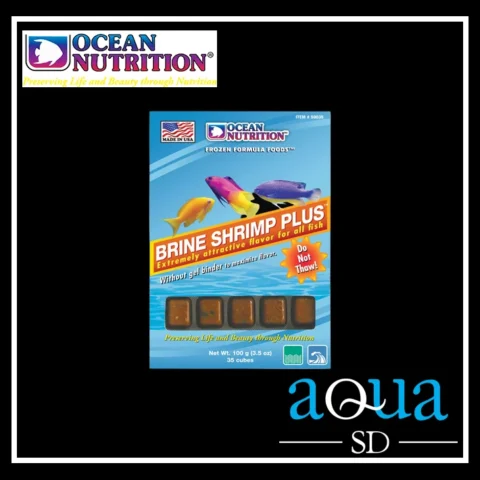
Ocean Nutrition – Brine Shrimp Plus (100g)
Price range: $9.99 through $12.99 Choose size This product has multiple variants. The options may be chosen on the product page -
 Fish & Coral Food
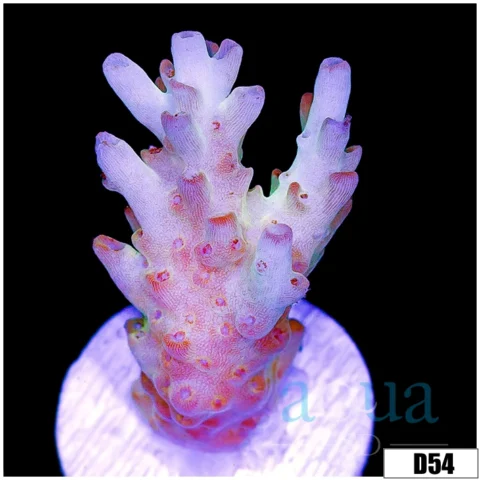
Frozen Glaze Acropora
$131.99With code FALL70: $24.00 Add to cart -
 Fish & Coral Food
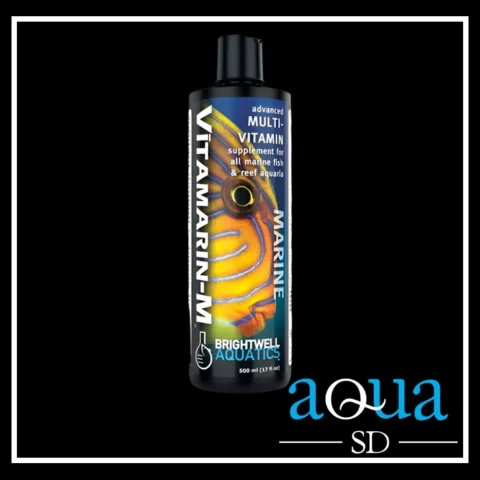
Vitamarin M (250ml, 500ml) Multi-Vitamin
$22.99 Add to cart -
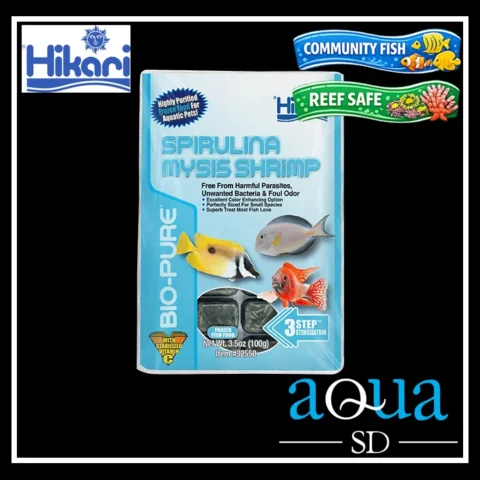 Fish & Coral Food
HIKARI Bio-Pure® Frozen Spirulina Mysis Shrimp
$7.99 Add to cart