

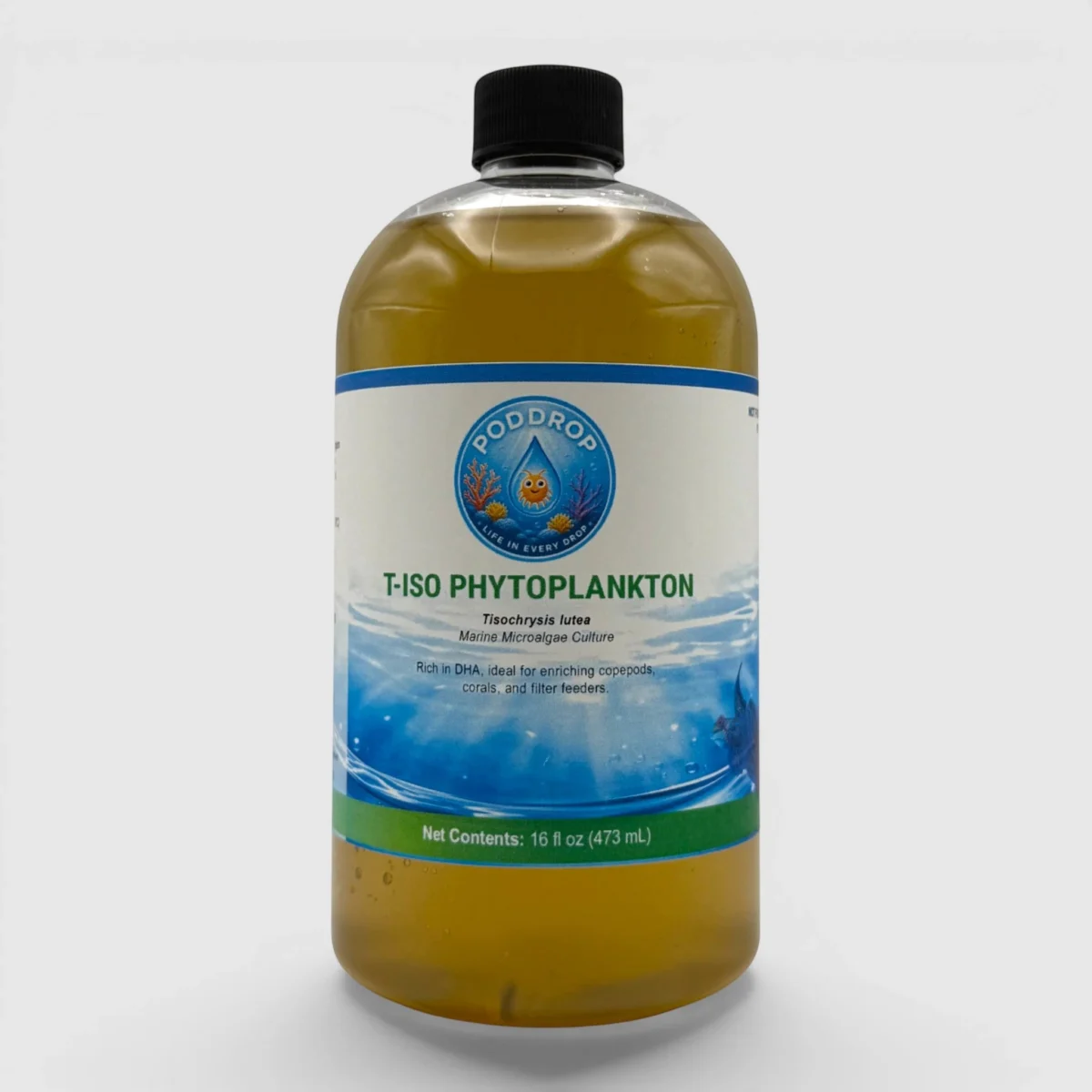
Tisochrysis lutea Phytoplankton Culture: Using Live Phyto for Your Reef
You will be able to store a live phytoplankton culture, dose it to feed corals and filter feeders, and propagate it to maintain a continuous supply.
Feeding · Intermediate tutorial · About 15 minutes · Beginner friendly
The key habit: Store your phytoplankton in the fridge immediately, swirl or agitate the bottle at least every other day, and dose only what your reef can consume in an hour or two to avoid fouling the tank.
Shop the Tisochrysis lutea Phytoplankton Culture
In this guide
- What is Tisochrysis lutea and why it matters
- Storage: how long it keeps and what to do with it
- Direct feeding: dosing phytoplankton into your tank
- Making your own culture: propagating at home
- Mistakes to avoid
- What you notice and what to check
- Your care log
1. What is Tisochrysis lutea and why it matters
Tisochrysis lutea is a golden-brown unicellular marine phytoplankton that forms a key link in your reef's food chain. Unlike powder foods that break down quickly, live phyto cells can persist for a while in reef conditions without immediately fouling the tank, making it an especially "clean" source of nutrition for your reef.
It feeds corals, tridacnid clams, electric scallops, porcelain crabs, sea fans, and other filter-feeding marine life. The microalgae is easily consumed by rotifers, copepods, and other microorganisms, enriching the entire food chain and creating a more balanced and self-sustaining marine ecosystem.
2. Storage: how long it keeps and what to do with it
Gather before you start
- Container or bottle to store surplus phytoplankton
- Refrigerator
- Water bottle or jar with secure lid
1. Store immediately upon arrival: Most live phyto products are shipped cold and should be refrigerated immediately upon arrival.
2. Keep it cold and in darkness: Keep live cultures refrigerated between 39–46°F (4–8°C) to slow metabolism and extend viability, and limit exposure to light.
3. Swirl regularly: Swirl or agitate the bottle daily to keep cells in suspension. If you do not shake the stored bottle daily, cells will settle to the bottom of the bottle and smother each other and die.
4. Watch the shelf life: Isochrysis cultures typically last around 2–4 weeks in good condition when stored in a refrigerator in dim conditions and do not freeze. Gentle swirling every few days is recommended. Use within 21 days of arrival.
5. Check for signs of decline: If the bottle smells wrong, separates unusually, or shows signs of decline, performance may no longer match label quality.
3. Direct feeding: dosing phytoplankton into your tank
Direct feeding means adding phytoplankton straight into your tank to be consumed by your corals and invertebrates.
1. Turn off water movement: Turn off the return pump, wait 2–5 minutes before feeding, and leave the return pump off for 30 minutes to allow corals, copepods, inverts, and filter feeders to consume the cells.
2. Dose the right amount: Feed 10–15 ml per 10 gallons of water daily. Start with the lower end and watch your corals' response.
3. Observe consumption: Pour a small amount of dense culture directly into the tank after turning off your protein skimmer and observe whether the water clears within an hour or two, which indicates organisms are consuming it. If the water stays cloudy, you have dosed too much.
4. Frequency: Add phytoplankton directly to your aquarium water 2–3 times a week.
4. Making your own culture: propagating at home
Once you have the hang of feeding, you can grow your own supply to save money and always have phyto on hand.
Gather before you start
- 1–2 clean bottles or containers (1–2 liters each)
- Saltwater (1.019–1.026 specific gravity)
- F/2 fertilizer or phytoplankton growth medium
- Timer and light source (LED or fluorescent; avoid heat-producing incandescent bulbs)
- Air stone and pump (optional but helpful)
- Bleach solution (1 part bleach to 10 parts water) for sterilization
1. Sterilize your equipment: Every piece of gear that will touch your culture needs to be sterilized. A quick soak in a bleach solution (1 part bleach to 10 parts water) followed by a thorough rinse with RODI water does the trick. Let it all air dry completely.
2. Mix your culture water: Prepare saltwater at 1.019–1.026 specific gravity. Do not use established tank water since it will contain bacteria that can contaminate the culture.
3. Dilute your starter: Make saltwater and dilute your culture in half; pour half of the culture to be harvested into a bucket with the fully dissolved saltwater.
4. Add nutrients: Add 1.5 ml of f/2 fertilizer into each two-liter bottle (or 3 ml into each one-gallon bottle).
5. Provide light and aeration: A steady photoperiod of 16 to 18 hours of light per day is the sweet spot for rapid growth. Gentle aeration or bubbling keeps cells in suspension.
6. Harvest after 7–10 days: The sweet spot for harvesting is usually somewhere between 7 and 10 days. If you wait too much longer, you risk a culture crash as the population runs out of resources. The best way to manage this is the "split and restart" method. Pour half of the cultured phytoplankton into fresh saltwater (this becomes your new growing culture). The other half can be used to dose your reef tank(s) or stored for future use.
7. Maintain regularly: Continue to add f/2 weekly (and give the culture a gentle shake).
8. Keep a backup: One of the simplest insurance policies against culture crashes is to keep a small backup bottle in the refrigerator. Cold temperatures slow cell division almost to a standstill, essentially putting the culture into suspended animation.
5. Mistakes to avoid
Freezing the culture: Do not freeze live phytoplankton; freezing will rupture the cells and kill them.
Overdosing: You can dose more than the recommended amount, but be careful as you can remove more nitrate, phosphate and silicate than you think. Excess phytoplankton decays and fouls your tank water.
Not shaking before feeding: Give the storage bottle a gentle swirl once a day. This keeps the phytoplankton from settling into a dense sludge at the bottom, where the cells can die off and start to foul the culture.
Forgetting to turn off flow: Without turning off your return pump and skimmer, the phytoplankton will be removed before your corals and invertebrates can consume it.
What you notice and what to check
| What you notice | What to check next |
|---|---|
| Phyto bottle appears darker or cloudier over a few weeks | Store in the fridge; check storage temperature is 39–46°F; age may exceed shelf life; swirl daily to resuspend cells |
| Water remains cloudy 2+ hours after dosing | You may have added too much; reduce next dose and monitor consumption more carefully |
| Culture has sulfurous or foul smell | Culture is likely contaminated or expired; start fresh with a new bottle or backup culture |
| Your corals do not extend polyps after feeding | Turn off return pump longer (full 30 minutes); increase dose slightly; or check that corals are filter feeders suited to phyto |
| Visible green or brown color fades from culture | Cells may be settling; swirl bottle vigorously; or phyto may be degrading and should be replaced |
| Corals or invertebrates seem more colorful over weeks of feeding | Phyto is working; you can maintain this dose or observe if you need to feed more often |
Your care log
Started direct feeding on: ______ Tank volume: ______ gallons
Storage location: ______ Fridge temperature: ______ °F
Dosing amount: ______ ml Frequency: ______ times per week
Expiration date on bottle: ______ Last shaken on: ______
Culture propagation started on: ______ (if applicable)
Lighting (hours per day): ______ Light source: ______
Notes:
______
Sources
Checked October 23, 2026.
- Frags2Fishes, "Tisochrysis lutea (T-iso)", https://frags2fishes.com/aquarium-supplies/live-cultures/phytoplankton/tisochrysis-lutea-t-iso/
- ReefCo Aquariums, "Tisochrysis Lutea: The Microalgae Superfood Your Aquariums Needs", https://reefcoaquariums.com/blogs/news/tisochrysis-lutea-the-microalgae-superfood-your-aquariums-needs
- RL Utah Aquatics, "Tisochrysis lutea (T-iso)", https://rlutah.com/products/tetraselmis-lutea-t-iso
- GetPodDrop, "Tisochrysis lutea Live Phytoplankton", https://www.getpoddrop.com/products/tisochrysis-lutea-live-phytoplankton
- Nano-Reef Community, "Culturing Phytoplankton For Reef Aquarium Food", https://www.nano-reef.com/articles/advanced/culturing-phytoplankton-for-reef-aquarium-food/
- GetPodDrop, "How to Culture Phytoplankton for Your Reef Tank", https://www.getpoddrop.com/blogs/blog/how-to-culture-phytoplankton
- Little Creatures Zooplankton and Aquaculture, "Tisochrysis galbana (Isochrysis lutea)", https://littlecreatureszooplanktonandaquaculture.com.au/blogs/articles/tisochrysis-galbana-isochrysis-lutea
- Reef Bum, "How To Grow Live Phyto – Step by Step Guide", https://www.reefbum.com/instructional/how-to-grow-live-phyto-step-by-step-guide/
- Pod Your Reef, "How Long Does Phytoplankton Last? (Shelf Life & Benefits of Live Phyto for Reef Tanks)", https://www.podyourreef.com/blogs/care/how-long-does-phytoplankton-last-shelf-life-amp-benefits-of-live-phyto-for-reef-tanks
- Algagen, "How Long Do Phytoplankton Cultures Last?", https://algagen.com/blogs/marine-fish-nutrition/how-long-do-phytoplankton-cultures-last
- Sustainable Aquatics, "Phytoplankton Storage", https://sustainableaquatics.com/phytoplankton-storage/
- NotaFeesh, "Tisochrysis lutea", https://notafeesh.com/products/tisochrysis
- RL Utah Aquatics, "How to feed our Phytoplankton, Rotifers & Pods to your aquarium", https://rlutah.com/blogs/news/how-to-feed-our-phytoplankton-rotifers-pods-to-your-aquarium
- Copepods For Sale, "Phytoplankton Reef Tank Care & Boosting Tips", https://copepodsforsale.com/phytoplankton-reef-tank-care-boosting-tips/
- Biology Insights, "How to Culture Phytoplankton at Home for Your Aquarium", https://biologyinsights.com/how-to-culture-phytoplankton-at-home-for-your-aquarium/