

Tiger Sand Snail Care: Sand Bed Setup, Feeding and Acclimation
After reading this guide, you'll know how to set up and maintain a sand bed that lets your Tiger Sand Snail thrive and clean your aquarium.
Invertebrate care · Detailed tutorial · About 8 minutes · Beginner friendly
The key habit: The Strawberry Conch is incredibly hardy and self-sufficient, provided its single most important requirement—a proper substrate—is met. Set up your sand bed first, then add your snail to an established tank.
Shop the Tiger Sand Snail – Conomurex luhuanua
In this guide
- What the Tiger Sand Snail is and where it lives
- Tank size and sand bed requirements
- Tank mates and temperament
- Feeding your Tiger Sand Snail
- Water parameters and stability
- Acclimation and introduction
- Signs of good health
1. What the Tiger Sand Snail is and where it lives
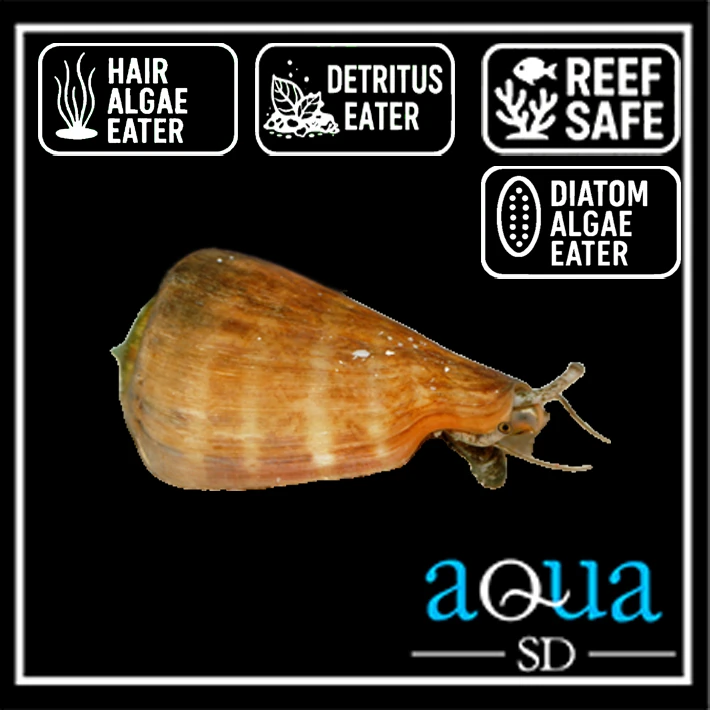
The Tiger Sand Snail, commonly known as Conomurex luhuanus or the Strawberry Conch, is a medium-sized sea snail with a stunning shell featuring intricate patterns and striking orange, brown, and cream colors. In the wild, it is found in sandy habitat among corals in the Indo-Pacific region. The Tiger Sand Conch spends much of its time burrowed under a sandy substrate, which is why it needs a very different setup than glass-cleaning snails.
2. Tank size and sand bed requirements
The minimum tank size is 20 gallons. More importantly, the Tiger Sand Snail needs a fine to medium-grain sandbed of at least 1-2 inches deep to sift for food and feel secure. It cannot survive on a bare-bottom or coarse gravel substrate.
A sandbed is a non-negotiable requirement. It thrives in tanks with sandy substrates, as it spends much of its time burrowing or grazing on algae. A well-established aquarium with stable water parameters is essential for its health and longevity.
3. Tank mates and temperament
This species is peaceful toward fish, corals, shrimp, snails, and other non-predatory aquarium inhabitants. It is extremely peaceful and safe with all reef-safe fish, corals, and invertebrates. Its hardened operculum provides some defense against inquisitive tank mates.
However, it can face threats from hermit crabs attempting to take its shell. Providing extra empty shells can help mitigate this competition.
4. Feeding your Tiger Sand Snail
The Tiger Sand Snail is a self-sufficient scavenger. It will find all the nutrition it needs by sifting through a mature sandbed, consuming algae, diatoms, and organic waste. In the wild, it feeds on algae, detritus, and organic matter found in the sand. In captivity, it can be sustained on a diet of natural algae growth, supplemented with algae wafers or blanched vegetables like spinach and zucchini.
In brand new or exceptionally clean systems, its diet can be supplemented with high-quality sinking pellets or wafers, but this is rarely necessary. Care should be taken to ensure it has enough food and space, especially in tanks with other algae grazers.
5. Water parameters and stability
Temperature should be 75–80°F, specific gravity 1.024–1.026, pH 8.1–8.4, and alkalinity 8–12 dKH. It is sensitive to high nitrate levels and does not tolerate copper-based medications. It requires stable salinity and temperature.
Marine inverts demand stable specific gravity (1.024-1.026), tropical reef temperatures (76-80°F), and zero ammonia / nitrite at all times. The snail must go into an established tank with a mature sand bed and algae growth; it cannot be one of your first inhabitants.
6. Acclimation and introduction
Gather before you start
- Acclimation container or bucket (not copper)
- Airline tubing and airstone
- Thermometer
- Container to collect old tank water during drip
Acclimation is important with invertebrates. Maintain stable salinity and introduce the conch gradually when aquarium and transport-water conditions differ. Use a drip acclimation method over 1–2 hours to match the snail's water to your tank water.
- Float the shipping container in your tank for 15–20 minutes to match temperature.
- Set up drip acclimation. Run airline tubing from your tank, through the shipping container, with one drip per second.
- Drip for 1–2 hours until the container water is largely replaced with tank water.
- Use a net to transfer the snail to the tank. Do not pour shipping water into your tank.
- Place on the sand bed in a shaded area. Leave the lights low for 24 hours so the snail can adjust in safety.
- Resume normal lighting after 24 hours once the snail has begun grazing or showing activity.
7. Signs of good health
| What you notice | What to check next |
|---|---|
| Snail is active and grazing across sand | Water parameters stable; adequate food and space available |
| Snail is hidden or withdrawn and not feeding | Temperature, salinity, and ammonia—any swings can stress inverts |
| Shell looks dull or pitted | Calcium and alkalinity levels; may need buffer or supplementation |
| No activity after placement; snail closed in shell | Normal in first 24 hours; if longer than 48 hours, check for copper in water history |
| Snail moving slowly or less frequently | Check for nitrate spikes and ensure adequate algae growth or supplemental feeding |
Your care log
Placed on: ______ Tank size: ______ Sand depth: ______ (at least 1-2 inches)
Temperature: ______ Specific gravity: ______ pH: ______ Alkalinity: ______
First observed grazing: ______ Supplemental feeding started: ______ (if needed)
Sources
Checked October 17, 2026.
- Top Shelf Aquatics, "Tiger Sand Conch," topshelfaquatics.com/products/tiger-sand-conch
- Live Aquaria, "Orange Lip Conch Snail," liveaquaria.com/products/orange-lip-conch
- SaltWater Fish, "Strawberry Conch," saltwaterfish.com/product-strawberry-conch-54756
- Reeflings, "Strawberry Conch (Conomurex luhuanus)," reeflings.com/species/conomurex-luhuanus
- SaltWater Aquarium, "Sand Sifting Strawberry Conch (Conomurex luhuanus) – Cleanup Crew," saltwateraquarium.com/sand-sifting-strawberry-conch-conomurex-luhuanus-cleanup-crew/
- Live Rock and Reef, "Tiger Sand Snail – Conomurex luhuanus," liverocknreef.com/catalog/snails-and-conchs/tiger-strawberry-sand-conch-conomurex-luhuanus-11632.html
- Koralli Farmi, "Conomurex luhuanus Cyano and diatom eater," korallifarmi.fi/en/products/sand-sifting-strawberry-conch-conomurex-luhuanus-m
- Fast Aquatics, "Cerith Snail care guide (Cerithium sp)," fastaquatics.com/species/cerith-snail/
- Wikipedia, "Conomurex luhuanus," en.wikipedia.org/wiki/Conomurex_luhuanus