

Safari Yuma Care: Gentle Light, Low Flow and Patience
You'll be able to settle your new Safari Yuma (Ricordea yuma) slowly, place it in gentle light and flow, and spot early signs of stress before they get worse.
Coral care · Detailed tutorial · About 8 minutes · Beginner friendly
The key habit: Pick one spot with low to moderate light and gentle flow, then leave it alone. Yumas do best in stable water and settled conditions, and they don't like being moved around.
The Safari Yuma has sold: shop similar Mushrooms →
In this guide
- What a yuma is and how it grows
- Light
- Water flow and placement
- Feeding
- Water parameters
- Acclimation and dipping
- Fragging (and why to wait)
1. What a yuma is and how it grows
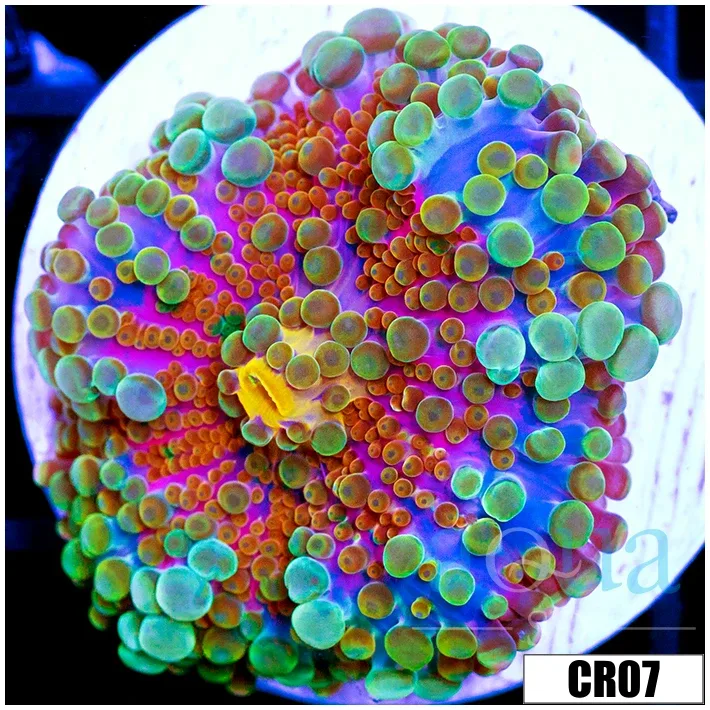
The Safari Yuma is a Ricordea yuma, often called a yuma mushroom or Ricordea yuma mushroom. It's a corallimorph, which is a relative of mushroom corals rather than a true stony coral. It's a soft, disc-shaped polyp covered in rounded, bubble-like bumps [1,4]. It comes from the Indo-Pacific [2,14]. Its Caribbean relative is Ricordea florida [11].
Yumas are photosynthetic. Tiny algae living in their tissue (zooxanthellae) supply much of their energy [2,14]. Individual polyps grow to about 3–8 cm and slowly form clusters [1]. They mostly reproduce by splitting: the mushroom pinches in at the center and slowly divides into two [3,11]. Hobbyists have also seen yumas leave pieces of their foot behind, and those pieces grow into babies [16].
An honest note for beginners: Sources disagree on how easy yumas are. One farm rates them beginner-level [4], and another rates its yumas from easy to moderate [13]. One retailer calls them intermediate and better suited to an established, stable tank [1]. Another farm says they can be sensitive and doesn't recommend them for beginners [2]. Keeping your water stable and handling the yuma gently are what all these guides agree on.
2. Light
Sources give different light levels, so start low and increase slowly:
- One care profile lists medium light, about 75–150 PAR [1].
- One coral farm says yumas often do better in more intense light than Florida Ricordea and suggests middle to high light. It defines medium as 50–150 PAR and high as anything over 150 [2].
- Another guide suggests lower to moderate light for new yumas and warns they can react badly to being moved quickly into bright light [6,7].
- Several sources say yumas take more light than most other mushrooms, but total shade and extreme brightness should both be avoided [3,4].
What this means for you: Start your yuma in lower light. One experienced keeper uses low light and mild flow for the first month, then raises the light gradually [10]. If the yuma keeps stretching upward or "trumpeting" (curling into a cup shape), it's probably looking for more light [3,8]. Move it up in small steps, not all at once.
3. Water flow and placement
Flow: Most sources say low flow [1,2,3,4]. One farm lists its orange yuma as moderate to low [13]. Flow that's too strong can stop the yuma from opening fully. It can even knock it loose and blow it around the tank, possibly into a pump [2,4]. Aim for just enough flow to keep debris from settling and to gently lift the edges of the disc [4,8].
Placement:
- Place it low to middle in the tank, on rock or in a rocky pocket [1,3,4].
- Choose the spot carefully, because yumas are sensitive to being moved around too much [8].
- Give it space. Sources disagree on how aggressive yumas are. One calls them peaceful, with no stinging sweeper tentacles [1]. Others call them semi-aggressive with a mild sting and say they shouldn't touch other corals [3,4]. Either way, keep them away from aggressive LPS corals that could sting them, and don't let faster-growing corals overgrow or shade them [1,6].
- To control spreading later, put it on its own small rock or a removable piece of rubble [7].
4. Feeding
Feeding is optional. Yumas get much of their energy from light, though they can be fed small morsels and may benefit from regular feeding [2,5]. Sources suggest:
- Small particle foods such as phytoplankton, "marine snow" particle foods and the occasional newly hatched baby brine shrimp [12].
- Meaty foods such as mysis or brine shrimp, a few times a week at most, sized to the polyp [5].
Target feeding, step by step
- Turn off the pumps so the food stays put [5].
- Place a small piece of food on the disc. Use smaller pieces for smaller yumas [5].
- Wait for the yuma to close around the food, then turn the pumps back on [5].
Don't overfeed. Extra food hurts water quality [3,5]. Keepers report that some yumas never seem to eat [10]. One keeper skips feeding for the first month. If a yuma ignores food after that, they wait another month before trying again, because repeated attempts can stress it [10]. For more on this, see the shop's tutorial "How to Feed Corals Without Overfeeding Your Reef."
5. Water parameters
Stability matters more than any single number. Sudden changes in salinity, temperature, alkalinity or nutrients can cause shrinking, detaching, melting or fading [6].
| Parameter | Range the sources give |
|---|---|
| Temperature | 75–80°F (24–27°C) [15] |
| Salinity | Specific gravity 1.023–1.025 [15] |
| Alkalinity | About 8 dKH (one experienced hobbyist's rule of thumb) [9] |
| Calcium | About 400 ppm (same source) [9] |
| Magnesium | None of the sources checked gave a figure for yumas. Keep it steady at your tank's normal level. |
| Nitrate | 1–5 ppm [5]; one hobbyist uses 0–10 ppm [9] |
| Phosphate | Close to 0.01 ppm, but not zero [5] |
Ammonia and nitrite should be zero [9]. Test regularly and change water regularly [15]. The shop's tutorials on salinity, temperature, alkalinity dosing and water changes cover how to keep these steady.
6. Acclimation and dipping
Shipping is stressful, so careful acclimation matters [2]. New yumas need extra patience [6].
Gather before you start
- A clean container or the shipping bag, plus a clip to hold the bag in the tank
- A turkey baster or pipette
- A thermometer
- Coral dip, if you use one, plus the instructions on its label
- A spot you've already chosen: low, gently lit and with gentle flow
- Your care log (below)
Steps
- Float the bag in your tank to match the temperature [9].
- Add tank water slowly. Use the baster to add small amounts of tank water to the bag over time [9].
- Dip if you choose to. None of the sources checked gave yuma-specific dip instructions. Follow your dip's label exactly, and see the shop's tutorial "Coral Dipping and Quarantine: A Careful Workflow for New Frags."
- Place it in lower light and gentle flow [6,10]. Allow time to adjust to your lights (photo-acclimation), not just your water [9].
- Leave it in place. Don't keep moving it [8]. Hold off on feeding for the first few weeks [10], then raise the light gradually if needed [10].
7. Fragging (and why to wait)
The easiest way to get more yumas is to let them split or drop babies on their own. One keeper reports babies after about six months, without cutting [10]. A tip from one guide: let the yuma attach to rubble on its own, then move the rubble once it has spread [7].
Some experienced hobbyists cut yumas straight through the mouth, and some report the pieces doing fine [10]. However, fragging needs care. The soft tissue is easily damaged, and the cut pieces need clean water, gentle flow and time to heal [7]. If you do try it later, use a sharp, sterile blade and keep water quality steady while the pieces recover [11 is general Ricordea advice; see also 15]. For a beginner, it's best to wait until the yuma has been settled and healthy for a long time.
What you notice and what to check
| What you notice | What to check next |
|---|---|
| It stretches upward or trumpets for days | It may want more light. Move it up gradually, not in one jump [3,8]. |
| It won't open fully, or it comes loose and drifts | The flow is probably too strong. Find a calmer spot [2,4]. |
| It shrinks, fades or detaches | Check for recent changes in salinity, temperature, alkalinity and nutrients [6]. |
| It loses its shape and seems to "melt" over several days | Yumas can get "melting syndrome." The cause isn't known; possible causes include an unknown germ or the switch to aquarium lighting [14]. Check your water and any recent lighting changes. |
| It ignores food | Some yumas rarely eat. Wait about a month before trying again [10]. |
| It pinches in the middle or grows a second mouth | That's usually normal splitting [3,11]. |
| It's touching another coral | Make more space. Yumas can sting or be stung [1,4]. |
Your care log
Placed on: ______ Spot in tank (height / rock): ______
Light (PAR): ______ Flow (gentle / moderate): ______
Temperature: ______ Salinity: ______
Alkalinity: ______ Calcium: ______ Magnesium: ______
Nitrate: ______ Phosphate: ______
Dip used (product / time): ______
Light increased on: ______ New PAR: ______
First feeding tried on: ______ Food: ______ Did it eat? ______
Splits or babies noticed on: ______
Notes: ______
Sources
Checked October 8, 2026. Reference addresses are plain text.
- Eastwood Aquarium, "Ricordea (Ricordea yuma) — Care Guide", https://eastwoodaquarium.com.au/coral-profiles/ricordea
- Tidal Gardens, "Nuclear Ricordea yuma Mushroom", https://tidalgardens.com/wysiwyg-nuclear-ricordea-yuma-mushroom.html
- Reef Casa, "Ricordea Yuma", https://reefcasa.com/coral-care/mushroom-corals/ricordea-yuma/
- Frag Box Corals, "Yuma Coral", https://fragbox.ca/coral-care/yuma-coral/
- Algae Barn, "ORA Purple and Green Ricordea Yuma Coral", https://www.algaebarn.com/shop/corals/soft/mushrooms/ora-purple-and-green-ricordea-yuma-coral/
- Extreme Corals, "Ricordea Coral Care Guide: How to Grow Colorful Ricordea Mushrooms in Reef Tanks", https://www.extremecorals.com/blog/enhancing-your-aquariums-biodiversity-with-ricordea-corals.html
- Extreme Corals, "Ricordea Mushroom Care Guide: Lighting, Flow, Feeding and Placement Tips", https://www.extremecorals.com/blog/care-requirements-of-ricordia-in-home-reef-aquariums.html
- Reef2Reef, "Ricordea Yuma care", https://www.reef2reef.com/threads/ricordea-yuma-care.943396/
- Reef2Reef, "Ricordea Yuma care and trials tribulations", https://www.reef2reef.com/threads/ricordea-yuma-care-and-trials-tribulations.41013/
- Reef2Reef, "Ricordea Yuma care and trials tribulations" (page 2), https://www.reef2reef.com/threads/ricordea-yuma-care-and-trials-tribulations.41013/page-2
- Saltwater Aquarium Blog, "Ricordea Care: The Flower Mushroom Corals", https://www.saltwateraquariumblog.com/ricordea/
- Fishkeeper, "Ricordea", https://www.fishkeeper.co.uk/fish/marine/soft-corals/ricordea
- The Reef Farm, "Orange Yuma Mushroom (Ricordea Yuma)", https://reeffarm.com/product/orange-yuma-ricordea-yuma/
- Wikipedia, "Ricordea yuma", https://en.wikipedia.org/wiki/Ricordea_yuma
- TheSea.org, "Ricordea Yuma", https://thesea.org/ricordea-yuma/
- BAReefers, "Ricordea Yuma Baby + Dead Acros", https://bareefers.org/forum/threads/ricordea-yuma-baby-dead-acros.19228/
Notes for you before publishing:
- Weak numbers: The alkalinity and calcium values come from one hobbyist on a forum. Temperature and salinity come from TheSea.org, which isn't a strong source. I couldn't find any source that gives a magnesium figure for yumas. I hit my search limit before I could look for better sources, so you may want to check these values first.
- Fix in the fragging section: It contains a leftover note to myself ("11 is general Ricordea advice; see also 15") that shouldn't be published. Change the citation to just [11,15].
- "Beginner friendly" label: The format requires it, but sources disagree on whether yumas suit beginners. The guide says so in section 1.
- Shop tutorial links: I didn't have the addresses for your existing tutorials, so I mention them by title only.