

Reef Tank Sand Bed Setup: Choosing and Installing Your Substrate
Equipment care · Detailed tutorial · About 10 minutes · Beginner friendly
The key habit: Decide your sand depth before you buy—choosing between a thin aesthetic layer, a standard 1–2 inch shallow bed, or a deep sand bed for specific livestock changes everything about setup, maintenance, and water quality.
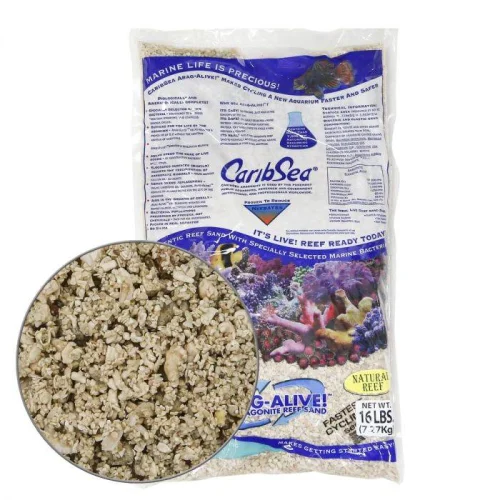
Shop the CaribSea Arag-Alive Natural Reef 16lb
In this guide
- Understanding substrate types and their role
- Choosing your sand depth
- Gathering your materials
- Rinsing dry sand properly
- Placing sand in your tank
- Early maintenance and expectations
- Troubleshooting sand bed issues
1. Understanding substrate types and their role
The substrate is what covers the bottom of the aquarium. In a reef tank, it does more than look good. Aragonite sand is the most commonly recommended aquarium sand in the hobby. Aragonite is a naturally occurring form of calcium carbonate with a crystalline structure; dissolves slowly to replenish calcium and alkalinity, and is ideal for reef aquariums and marine fish-only tanks, buffering pH upward and maintaining calcium carbonate levels critical for reef chemistry.
Crushed coral is a coarse, chunky option made from calcium carbonate; excellent at buffering pH. The grain size you choose matters: aragonite sand is available as a fine-grained product that looks like the prototypical sand. Coarse marine sand stays in place under powerheads and wavemakers and still supports beneficial bacteria.
Sand also supports your biological filter. A thicker layer of sand acts as a biological filter, helping consume organic matter left behind in the sand. Tanks with sand will experience a faster, more stable cycle presumably because of more robust biofiltration.
2. Choosing your sand depth
Your sand depth decision is critical and will shape your entire tank maintenance routine.
Shallow Sand Bed (SSB). Most aquariums are recommended at 1" – 2" deep to maintain that natural appearance, support the biofilter, and remain easy to clean without trapping a lot of waste. A Shallow Sand Bed is usually around 2.5cm to 5cm deep, purely for aesthetics and a little biodiversity, and is much easier to keep clean and is the most common choice for beginners.
Deep Sand Bed (DSB). A Deep Sand Bed is usually 10cm or deeper and is designed to house anaerobic bacteria that help process nitrates. Some species of Wrasse, Jawfish, Gobies, Garden Eels, and Sand Sifting Sea Stars will require deeper sand beds, sometimes up to 6 inches or more. However, they require specific maintenance and can be a "nitrate factory" if not handled correctly.
Avoid the middle ground. Many experienced hobbyists warn against sand beds between 1 inch and 4 inches, as they can trap detritus without offering the benefits of either approach [1].
3. Gathering your materials
Gather before you start
- Your chosen substrate (dry or live sand)
- A 5-gallon bucket or large container
- A faucet with strong flow, or a garden hose
- A strainer or fine mesh (helpful for catching sand)
- A gravel vacuum or siphon (for future maintenance)
- Saltwater or RO/DI water (for final rinse if using live sand)
- A plate or bowl (for pouring water gently into the tank)
4. Rinsing dry sand properly
Dry sand must be rinsed before use; live sand does not.
For dry sand: When you buy new aquarium dry sand or gravel it is highly recommended that you rinse it first. Even if it says it was pre-washed, it will still carry some dirt which can cause a cloudy mess in your water.
- Fill a bucket 1/3 full Cut the bag of sand open and fill a bucket 1/3 full with substrate.
- Rinse under running water Turn on the water to maximum output so that it vigorously jets into the sand without sending the sand or gravel boiling over the edges down your drain. Move your fingers through the substrate, stirring and lifting into the water jet as you fill it up.
- Empty and repeat It may take 10 or more rinses before the sand is clean and the water remains clear. Rinse until the water looks like watered down milk. Do not wait until the water runs clear!
- Drain and prepare Drain water as best you can without pouring substrate down the drain, and then pour into an empty aquarium.
For live sand: New live sand should not be rinsed with fresh water before putting it into an aquarium for the first time, this will kill off the beneficial bacteria. However, some hobbyists rinse live sand gently in pre-mixed saltwater to remove excess sediment [1]. If utilizing live sand, rinse it in a small bucket of premixed saltwater and discard the dirty saltwater after rinsing. Follow your product's instructions on the bag.
5. Placing sand in your tank
The order matters: place rock on glass first, then add sand.
Place rock directly on the glass first. Never build your aquascape on top of sand. Burrowing fish and inverts can destabilise it.
- Pour gently Slowly pour your saltwater directly onto the plate. This breaks the force of the water, preventing it from kicking up a massive cloud of dust. Pour onto a plate or bowl sitting on your rockwork or hardscape.
- Spread evenly Distribute your sand across the bottom to your target depth, keeping it even.
- Wait for clarity Expect temporary cloudiness. Fine dust and minor bacterial blooms are normal and usually clear within 24–72 hours.
6. Early maintenance and expectations
You should lightly clean your sand bed with a siphon and gravel vacuum to remove detritus weekly. In larger tanks, just clean a portion of the sand (roughly 25%) each week so as not to disturb the entire sand bed each week.
For the first week, expect your water to be slightly cloudy from fine particles and bacterial activity. This is normal and will clear as your filter works and particles settle.
7. Troubleshooting sand bed issues
| What you notice | What to check next |
|---|---|
| Water stays milky for days | You skipped rinsing dry sand, or rinsed too briefly. Sand clouds easily with high flow—reduce flow temporarily or turn off powerheads. |
| Sand blows around in high-flow areas | Your sand grain is too fine for your flow rate. Switch to coarser sand, or reduce flow in those zones. |
| Bare spots appear as sand shifts | Your rock needs to rest on the glass, not on the sand. Rock weight can settle over time; check stability weekly. |
| Foul smell from the sand bed | Detritus is trapped—increase siphoning frequency or consider your livestock bio-load and feeding schedule. |
| Green algae blooms around sand | Normal in new tanks. Ensure protein skimmer is working, limit light hours to 6–8 per day during cycling, and perform water changes. |
Your care log
Tank size: ______ gallons
Chosen sand depth: ______ inches
Sand type & quantity: ______
Installation date: ______
Rinsing method used: ______ (dry / live)
First siphon cleaning scheduled for: ______
Notes on water clarity at 24 hours, 48 hours, 72 hours:
______
______
______
Sources
Checked October 23, 2026.
- Bulk Reef Supply, "Aquarium Sand Bed Calculator", https://www.bulkreefsupply.com/reef-calculator/aquarium-sand-bed-calculator
- Saltwater Aquarium Blog, "Aquarium Sand: Choosing a Saltwater Aquarium Substrate", https://www.saltwateraquariumblog.com/aquarium-sand-pick-right-substrate-saltwater-aquarium/
- Petco, "Aquarium Substrate: Complete Guide for Fish Tanks", https://www.petco.com/pet-education/fish/habitat-guides/aquarium-substrates
- Simple Reefs, "Rock or Sand First? How to Add Sand to a Reef Tank the Right Way", https://simplereefs.com/how-to-add-sand-reef-tank/
- Bulk Reef Supply, "How To Clean Sand And Gravel In An Aquarium", https://www.bulkreefsupply.com/content/post/md-2020-09-how-to-clean-sand-or-gravel-for-the-aquarium
- Reef2Reef, "Beginner Topic – Reef2Reef FAQ #1: Substrates", https://www.reef2reef.com/ams/reef2reef-faq-1-substrates.537/
- Quantum USA, "Aragonite", https://quantumusa.us/blogs/saltwater-glossary/aragonite
- Manta Systems, "Choosing the Right Substrate for Your Saltwater Aquarium", https://www.mantasystems.net/a/blog/post/Sand-Selection
- AquaCorals, "Steps to Setup", https://www.aquacorals.com/index.php/how-to-setup/steps-to-setup
- Reeftopia, "Sand Bed Calculator", https://reeftopia.com.au/resources/sand-bed-calculator/