

Red Leg Reef Hermit Crab Care: Tank Setup, Shells and Feeding
Learn how to set up your tank for a Red Leg Reef Hermit Crab, supply the shells it needs, and maintain the water conditions for a long-lived cleanup crew member.
Red Leg Reef Hermit Crab Care: Tank Setup, Shells and Feeding
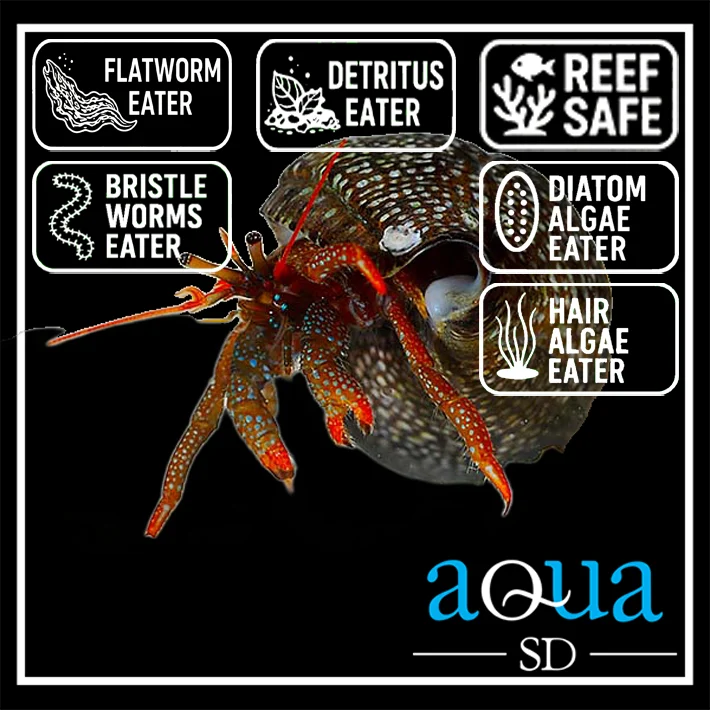
Red Leg Reef Hermit Crab care begins with understanding that these Caribbean natives are favorites for their hardy nature and algae-eating habits, with their small size and peaceful temperament making them excellent choices for reef community tanks, particularly for controlling nuisance algae and scavenging detritus. Success with your new hermit crab rests on one critical priority: providing empty shells.
Invertebrate care · Detailed tutorial · About 8 minutes · Beginner friendly
The key habit: Hermit crabs regularly outgrow their shells or seek replacements for comfort and protection. A lack of suitable shells is one of the leading causes of aggression in captive hermit crabs.
Shop the Red Leg Reef Hermit; Pac. – Paguristes sp.
In this guide
- What you need to know about Red Leg Hermit Crabs
- Tank setup and water parameters
- The shells your crab will need
- Feeding habits and diet
- Acclimation from bag to tank
- Signs of good health
- Compatibility and tank mates
1. What you need to know about Red Leg Hermit Crabs
In the wild, Red Legged Hermit Crabs tend to be found on the sandy areas adjacent to coral reefs, rather than amongst the reef itself. These small hermit crabs, about 3 centimetres or 1.2 inches across, have a bright red body with deep red antennae and yellow or yellowish-orange eyestalks. Unlike their shells, which they borrow and change, the hermit crab's soft abdomen is vulnerable and needs protection.
Scarlet hermit crabs are known for "switching shells" as they grow. This can happen as often as once a month, to as little as once a year depending on the subspecies and age of the hermit. They are very hardy and require minimal care in a well-established system.
2. Tank setup and water parameters
Hermit crabs need a minimum tank size of 10 gallons. Provide a mix of rock and sand substrate — hermit crabs need both hard surfaces for grazing and sand beds for foraging and resting. Hermit Crabs should be added to established aquariums with plenty of rockwork with, cracks, caves and crevices for grazing.
Maintain stable water conditions. Hermit crabs prefer a water temperature in the 72 to 78°F range, a pH between 8.1 and 8.4 and a specific gravity (salinity) between 1.023 and 1.025. Like all aquarium inhabitants, the hermit crab requires high water quality and a clean tank in order to thrive. Saltwater crabs are sensitive to copper traces in the water so copper treatments should not be used in tanks with hermit crabs.
3. The shells your crab will need
Empty shells are not optional—they are essential. Provide an ample number of empty shells of various sizes. It is advisable to keep an assortment of different size empty snail shells in the aquarium when maintaining this species (or any hermit), as they are very fussy about the space they have inside their selected shell and are always looking for something better/slightly roomier!
A hermit crab will moult from its exoskeleton in order to grow. As they gain size, they will moult and need to be supplied with a regular choice of slightly larger empty snail shells to accommodate their growth. Hermit crabs need calcium to maintain strong exoskeletons and successfully molt. If your tank does not already include a calcium supplement as part of your reef maintenance routine, consider adding one to support molting.
4. Feeding habits and diet
In the home aquarium, Paguristes cadenati is best kept in an established reef system with ample algae supplies. These small hermit crabs have a voracious appetite for detritus and algae. In fact, they are particularly fond of nuisance algae of the filamentous, hair, and slime varieties, as well as cyanobacteria.
They will eat almost anything, including fish food and invertebrate diets. If algae levels are insufficient, supplement their diet with dried seaweed and other marine foods. Feed once or twice a week depending on amount of Hermit Crabs vs. amount of available food for them to forage on their own.
5. Acclimation from bag to tank
Gather before you start
- A clean container or bucket that has held only aquarium water
- A thermometer to check temperatures
- A small amount of airline tubing and an air valve (if using drip acclimation)
- Tongs to gently move the crab to your tank
Temperature Acclimation: Float the bag to match the temperature. Drip Acclimation: Slowly drip your tank water into their container. Float the bag in your tank for 15–20 minutes. Drip acclimation is the best method. Slowly drip your tank water into their container over 30–45 minutes.
- Open the bag carefully. Cut the shipping bag and gently empty your hermit crab into a clean container, not directly into the tank. Place a lid loosely over the container for shade and to prevent climb-outs by mobile creatures such as crabs.
- Match the temperature first. Float the bag in your tank for 15–20 minutes. Check that the temperature in your container matches your tank.
- Drip your tank water slowly. Use a drip rate of 2-3 drips per second for hermit crabs. Slowly introduce your tank water into the container over 30 to 45 minutes. You can use an airline tube with a valve, or add water by hand in small amounts.
- Place in the tank without bag water. After acclimation, gently move your hermit to the rockwork or sand bed. Do not add the container water to your tank.
- Stay patient the first day. Hiding and not moving much during the first 48 hours is normal. A hermit getting ready to molt can sit still for hours, so leave it alone rather than poking it to check.
6. Signs of good health
Watch for activity and normal behavior. When selecting a Red Reef Hermit Crab, look for active individuals with intact legs and claws. A healthy hermit will spend its days foraging on rock and sand, moving between shells, and grazing on algae. Some hermits may be more nocturnal when first introduced.
A hermit that sits still for hours may be getting ready to molt, so leave it alone. Molting is natural and necessary for growth. If a crab leaves its shell outside of molting and appears to be exposed, check your water parameters immediately—this can indicate a water chemistry problem.
7. Compatibility and tank mates
Unlike some hermit crabs, most Scarlet Reef Hermit Crabs are very peaceful towards their tankmates. Red Reef Hermit Crabs are peaceful and generally get along well with other tank inhabitants. However, they may occasionally compete with other hermit crabs or snails for shells, so providing an assortment of empty shells is crucial.
Red Legged Hermit Crabs should never be kept alongside Blue Legged Hermit Crabs as they will fight. Large congregations of Red Legged Hermit Crabs can actually cause significant damage. Small snails & small polyps are at risk from these crabs, as are any other tiny invertebrates. Kept in sensible numbers (no more than 1 per 35 litres of water), and in tanks without snails, these crabs can be of some benefit.
What you notice and what to check next
| What you notice | What to check next |
|---|---|
| Hermit not moving for many hours | Water parameters (temperature, salinity, pH). Crab may be molting—leave undisturbed. Check salinity is not below 1.023. |
| Hermit outside its shell, not molting | Copper in tank water. Test tank water. Check ammonia and nitrite. |
| Hermit crawling constantly between shells | Not enough shell choices of the right size. Add more empty shells, varied sizes. |
| Hermit attacking snails or other crabs | Overcrowded tank or aggression for shells. Verify stocking level. Add more empty shells. |
| Red coloration fading, lethargy | Poor water quality. Test salinity, pH, ammonia, nitrite, calcium. Perform water change. |
| No algae left in tank, crab looking thin | Insufficient algae remaining. Supplement feeding with dried seaweed (nori), sinking pellets. |
Your care log
Tank size: ______ gallons
Date placed in tank: ______
Initial salinity: ______
Temperature: ______°F
Shells provided (types/sizes): ______
Feeding schedule: Every ______ days
Last calcium supplement added: ______
Notes on behavior: ______
Sources
Checked November 9, 2026.
- Fishkeeper, "Red Legged Hermit Crab-Paguristes cadenati"
- Fishkeeping, "Scarlet Reef Hermit Crab"
- Wikipedia, "Paguristes cadenati"
- ReefBay, "Reef Hermit Crab Care Guide"
- Liveaquaria, "Scarlet Reef Hermit Crab"
- SaltCorner, "Paguristes cadenati"
- Blue Zoo Aquatics, "Scarlet Reef Hermit Crab, Red Reef Hermit – Paguristes cadenati"
- Reeflings, "Red Reef Hermit Crab (Paguristes cadenati)"
- PJS Tropical Fish, "Crab Red Leg Hermit"
- RateMyFishTank, "Hermit Crabs in Saltwater Tanks"
- Algaebarn, "Acclimating Captive Bred Invertebrates"
- MySwaterfishStore, "Avoiding Common Hermit Crab Mistakes in Marine Aquariums"
- MySwaterfishStore, "How We Collect and Ship Hermit Crabs Safely"
- The Underwater Gardener, "How to Acclimate a Cleanup Crew"
- Gensou, "Hermit Crab Care Guide for Saltwater Aquariums"
- Quality Marine, "Scarlet Reef Hermit Crab"
- MySaltwaterfishStore, "Saltwater Hermit Crabs: The Ultimate Guide"
- ONEdersave, "Hermit Crabs in the Reef Tank"
- MySaltwaterfishStore, "Collection: Hermit Crabs"
- Saltwater Fish Shop, "Scarlet Reef Hermit Crab"