

Oithona colcarva Copepods: Tank Setup, Feeding and Acclimation
You'll learn what Oithona colcarva copepods are, how to acclimate them to your reef tank, keep them fed, and maintain the population.
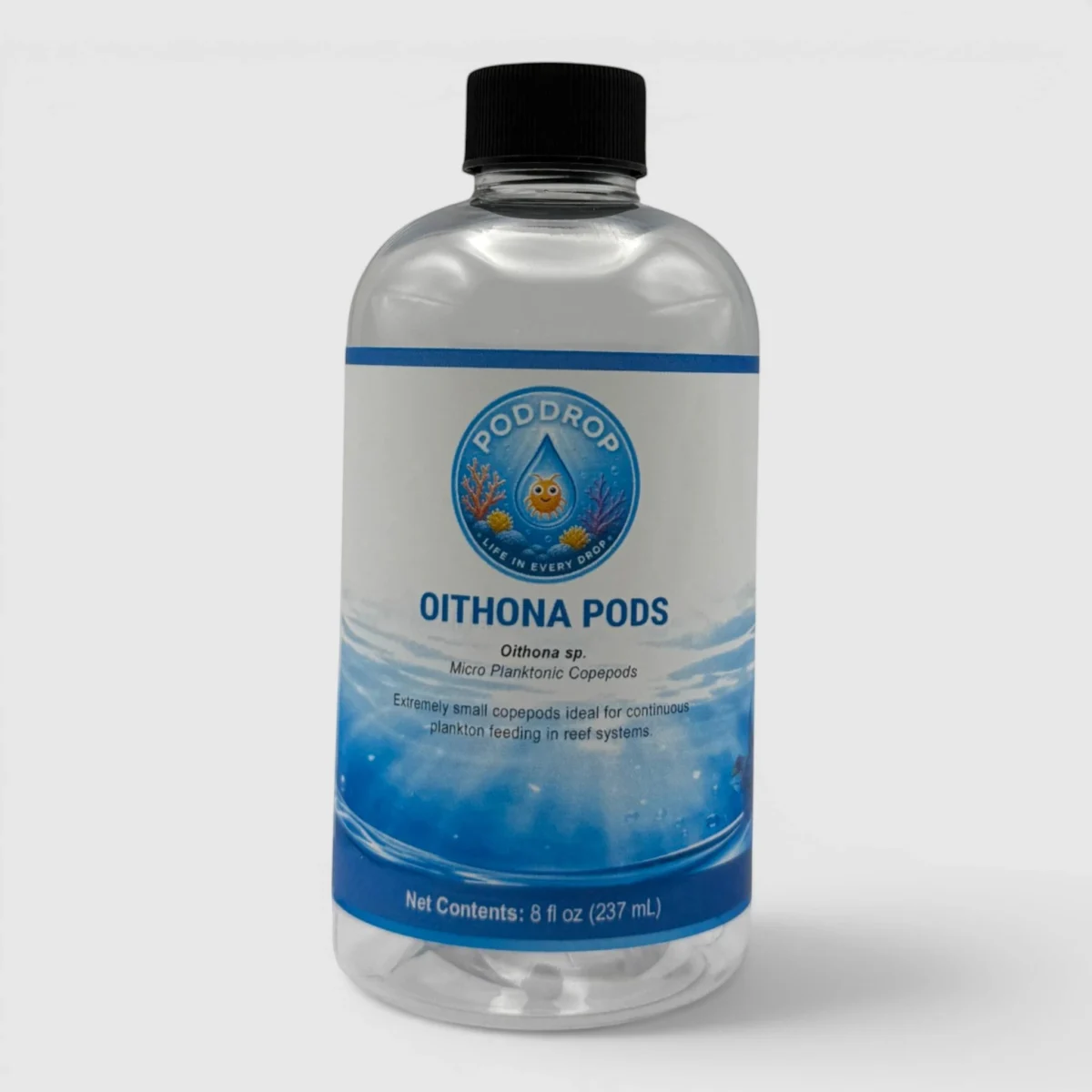
Feeding · Detailed tutorial · About 12 minutes · Beginner friendly
The key habit: Acclimate copepods slowly to your tank water, and feed them live phytoplankton every 2–3 days or when seeding; skip this and your population will crash within weeks.
Shop the Oithona colcarva Copepods
In this guide
- What Oithona colcarva are and how they fit your reef
- Tank setup and water parameters
- Acclimation and introduction
- Feeding your copepod population
- Recognizing a healthy population
- Common mistakes and how to avoid them
1. What Oithona colcarva are and how they fit your reef
Oithona colcarva are extremely small cyclopoid copepods gaining increasing attention in marine fish larviculture and advanced reef aquarium applications. Unlike larger substrate-dwelling copepods, Oithona colcarva are small, pelagic to semi-pelagic copepods that spend a lot more time suspended in the water column. These copepods exhibit unique "sit-and-wait" behavior, hovering motionless in the water column before rapid attack strikes.
In your reef, Oithona serves three purposes: feeding copepods during early larval culture stages of marine fish has proven to be advantageous for growth and survival of marine finfish larvae. For your tank, they become continuous live food for fish, corals, and filter feeders. They are also naturally control other microorganism populations while converting that biomass into high-quality fish and coral food.
2. Tank setup and water parameters
Oithona colcarva thrive in stable marine conditions. Oithona requires stable marine salinity for long-term culture success. Most species tolerate 25–40 ppt with optimal reproduction at 30–35 ppt.
Temperature and stability matter more than absolute numbers. Tropical species (O. colcarva) have optimal 24–28°C (75–82°F), tolerance 20–32°C (68–90°F). More important: sudden shifts in salinity or temperature are the single biggest cause of pod crashes. Acclimate new pods slowly (drip acclimation for 30–60 minutes) if your tank differs from the shipping bag by more than 1°F or 0.001 SG.
Your reef tank's existing setup—live rock, substrate, sump—is fine. Oithona do not need a separate culture vessel for your display; they reproduce in place if fed. However, if the pods are being added to the refugium, the macroalgae should already be in place. Tiny copepods seek shelter in the tangles of macroalgae.
| Water parameter | Target range |
|---|---|
| Temperature | 72–82°F (22–28°C) |
| Salinity (specific gravity) | 1.023–1.025 |
| pH | 7.8–8.4 |
| Ammonia | 0 ppm |
| Nitrite | 0 ppm |
| Nitrate | Below 20 ppm |
| Dissolved oxygen | Adequate aeration; Oithona tolerate slightly lower than other copepods due to intermittent swimming |
3. Acclimation and introduction
Gather before you start
- Your sealed bottle of Oithona colcarva copepods (keep refrigerated if not dosing immediately)
- A clean bucket or container
- An airline with a slow bubble rate (if drip acclimating)
- A turkey baster or soft pipette
- Dim lighting or night dosing when possible
Oithona arrive in phytoplankton—not sterile water—but they still need acclimation. Copepods are resilient but they are living organisms with their own water chemistry. Dumping them straight from the bottle into the tank without acclimation causes immediate osmotic stress that kills a significant portion of the culture before it ever has a chance to establish.
1. Check your tank readiness
Add copepods after the tank has cycled. If adding the copepods as soon as there is water in the tank, they may not survive any ammonia and nitrite spikes. New tanks should show 0 ppm ammonia and 0 ppm nitrite before adding any pods.
2. Float the sealed bottle
Float the sealed bottle in your display tank or sump for 15–30 minutes. This equalizes temperature and prevents thermal shock.
3. Begin drip acclimation
Start by floating the sealed bottle in your tank for ten to fifteen minutes to equalise temperature. Then open the container and begin drip acclimation — slowly adding small amounts of tank water every five to ten minutes over a thirty to sixty minute period until the culture water volume has roughly doubled.
4. Dose your tank
Reduce the flow of your tank by reducing the speed of your circulation pumps and/or return pump. Dim or turn off the lights on your display tank. Add the contents of the bag directly to your display tank and sump. Wait at least 20–30 minutes and turn the circulation back on. Better: dose at night when fish predation pressure is lowest.
5. Where to place them
Maximize survival by pouring copepods into low-flow, shaded areas such as rock crevices in the display tank, refugium zones with macroalgae, or sump chambers away from mechanical filtration.
4. Feeding your copepod population
Oithona thrives when three conditions stay consistent: gentle suspension, continuous microalgae availability, and stable water quality. Food availability is the biggest point of failure. Oithona can survive lean periods, but reproduction drops quickly when phytoplankton density is low or intermittent.
Feeding schedule
A regular schedule of 2–3 additions per week will keep the population well-fed and actively reproducing. High-quality phytoplankton strains like Nannochloropsis or Isochrysis are fantastic choices, especially for gut-loading the pods with nutrients that will eventually be passed on to your fish and corals.
Dosing amount
Reef tank dosing for established copepod populations requires 5ml per 10 gallons 2–3 times weekly. If your population is new or sparse, you may dose a bit more for the first month; as you see more pods, taper back.
Timing and method
A light, daily dose directly into your refugium is a great way to provide a constant food source without fouling your display tank's water. Avoid overdosing; if cloudiness develops, reduce dosing by half and allow water clarity to return.
5. Recognizing a healthy population
When Oithona take hold, you'll notice changes. You may notice adults at night and increasing numbers within one to two weeks. Expect gradual population growth; visible swarms take time as nauplii mature and reproduce under stable conditions. With proper acclimation, a phytoplankton food source, and no predation pressure, copepod populations typically become visible on the glass within two to four weeks and reach noticeable density within six to eight weeks.
Look for: copepods clinging to rocks and glass at night, especially in dim refugium light; small white or tan specks suspended in the water; responsive feeding when you dose phytoplankton (cloudiness should reduce within hours as they graze).
6. Common mistakes and how to avoid them
Mistake: Skipping acclimation or rushing it
Never pour chilled copepods directly into warm tank water — this can severely reduce survival. Always float and drip-acclimate.
Mistake: Adding to an uncycled tank
Copepods are sensitive to ammonia and nitrite. Wait until your tank has fully cycled.
Mistake: Starving the population
Many crashes blamed on "temperature" are really starvation plus bacterial bloom. When the algae runs out, waste bacteria can take over, oxygen falls at night, and the culture spirals. Dose phytoplankton consistently 2–3 times per week.
Mistake: Running high turbulence
Oithona need gentle movement, not a vortex. Gentle suspension matters because you want the animals encountering food and each other without getting pinned to surfaces or smashed by turbulence. An air line with a rigid tube and slow bubbles is usually enough in small vessels. If you see foam, aggressive splashing, or pods collecting in dead zones, you are already selecting for poor outcomes.
Mistake: Forgetting about water quality
Water quality is the quiet killer. Because Oithona is often kept in small volumes, ammonia spikes and biofilm accumulation hit hard. Keep up with your regular tank maintenance.
What you notice and what to check
| What you notice | What to check next |
|---|---|
| Copepods disappear after dosing | Water is too turbulent; check flow rate and air stone placement. Alternatively, no phytoplankton survival; verify phyto arrived alive and is being consumed. |
| Tank water becomes cloudy and doesn't clear | Over-dosing phytoplankton; reduce dose by half. Check for bacterial bloom; do a 10–20% water change. |
| Few or no copepods visible after 4 weeks | Temperature or salinity swung during acclimation; verify tank parameters match ranges. Ammonia or nitrite spike during introduction; test water. Population starving; increase phyto dose to 5 ml per 10 gallons 3× weekly. |
| Copepods visible at night but not during day | Normal behavior; they hide in rocks and substrate during bright light. Observe at dusk or in dim refugium light. |
| Phytoplankton clears quickly after dosing | Copepods are actively feeding; maintain dose schedule. |
| Fish or corals stop hunting for copepods | Population may have crashed; check phytoplankton supply and water parameters. Or predation simply exceeded reproduction; boost copepod dosing for 4–6 weeks. |
Your care log
First dose date: ______ Tank volume: ______ gallons
Acclimation time: ______ minutes Water temperature at acclimation: ______°F Salinity (SG): ______
Phytoplankton type: ______ Dose schedule (ml, frequency): ______
Week 2 observation: ______ Week 4 observation: ______
Signs of thriving population (check when observed):
- ☐ Adults visible on rocks/glass at night
- ☐ Small nauplii (juveniles) spotted
- ☐ Fish or corals actively hunting
- ☐ Phytoplankton clearing within 2–4 hours of dose
Sources
Checked October 28, 2026.
- Broach, J.S., Cassiano, E.J., and Watson, C.A., "Baseline culture parameters for the cyclopoid copepod Oithona colcarva: a potential new live feed for marine fish larviculture," Aquaculture Research, 2017, onlinelibrary.wiley.com/doi/abs/10.1111/are.13271
- PodDrop, "Oithona species – Micro-planktonic copepods for larval fish & nano reef systems," getpoddrop.com/pages/oithona-colcarva
- PodDrop, "Oithona copepods for reef tanks: culture or buy?," getpoddrop.com/blogs/blog/oithona-copepods-culture-for-reef
- Algae Barn, "How often should I add copepods to the reef tank?," algaebarn.com/blog/copepods/how-often-should-i-add-copepods-to-the-reef-tank/
- PodDrop, "A complete guide to reef nutrition copepods for your aquarium," getpoddrop.com/blogs/blog/reef-nutrition-copepods
- Pod Your Reef, "How do I acclimate my copepods?," support.podyourreef.com/article/14-how-do-i-acclimate-my-copepods
- Little Creatures Zooplankton and Aquaculture, "How to dose live copepods in your reef tank: complete guide," littlecreatureszooplanktonandaquaculture.com.au/blogs/our-dosing-instructions/how-to-dose-copepods-in-a-reef-aquarium-complete-guide
- Algagen, "Copepods in tank: complete guide for thriving reefs," algagen.com/blogs/copepods/copepods-in-tank-complete-guide-for-thriving-reefs
- Algagen, "How to add copepods to a new reef tank," algagen.com/blogs/copepods/how-to-add-copepods-to-a-new-reef-tank
- Florida Reef Labs, "Buying live copepods online: your ultimate guide to thriving reef tanks," floridareeflabs.com/post/buying-live-copepods-online-your-ultimate-guide-to-thriving-reef-tanks
- Copepods for Sale, "When to add copepods to a new reef tank," copepodsforsale.com/when-to-add-copepods-to-a-new-reef-tank/