

Nannochloropsis oculata Phytoplankton Culture: Setup, Growth and Harvest
You will learn how to set up, maintain, and harvest your own Nannochloropsis oculata phytoplankton culture to feed copepods and filter feeders.
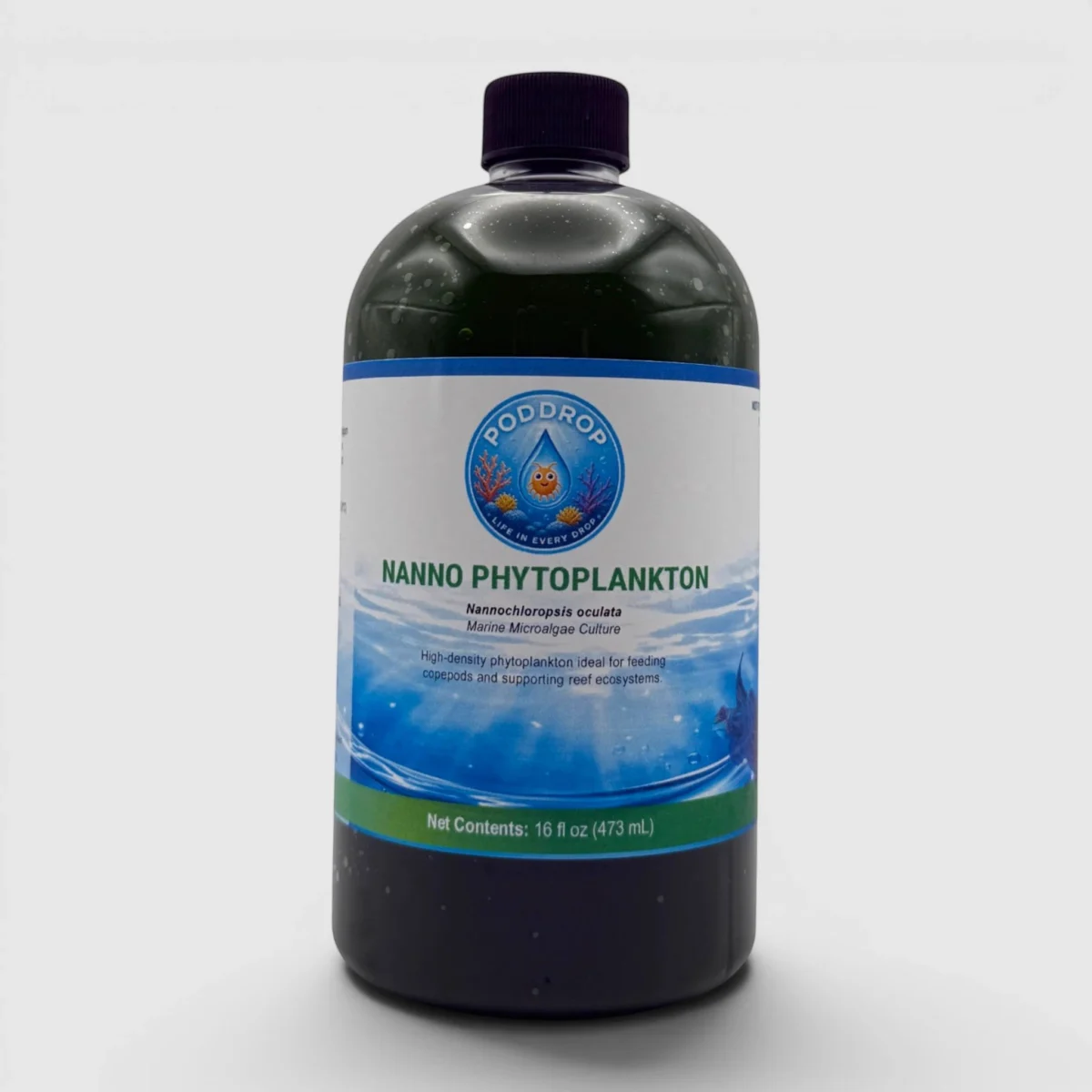
Nannochloropsis oculata Phytoplankton Culture: Setup, Growth and Harvest
Nannochloropsis oculata phytoplankton culture is different from copepod or rotifier culture in one important way: light is the primary driver of growth, not food. Nannochloropsis oculata is a photosynthetic organism that uses light energy to convert nutrients and carbon dioxide into new cells.
Feeding · Detailed tutorial · About 10 minutes · Beginner friendly
The key habit: Cleanliness is critical with phytoplankton because you are creating an environment where a single species of microalgae should dominate. Any contamination introduced during setup can compete with or overwhelm your Nannochloropsis before it establishes.
Shop the Nannochloropsis oculata Phytoplankton Culture
In this guide
- What you need before you start
- Setting up your culture container
- Providing light for growth
- Aeration and water parameters
- Monitoring and harvesting
- Storage and ongoing care
- Troubleshooting common issues
1. What you need before you start
Gather before you start
- Clean culture container (2–5 liters is ideal for beginners; clear glass or plastic)
- RODI saltwater at 1.018 to 1.023 salinity
- Nannochloropsis oculata starter culture (your purchased bottle)
- Guillard's F/2 nutrient medium, which provides the essential nutrients required for healthy cell division and high-density harvests
- Cool white or daylight-spectrum LED strip or fluorescent tube positioned 10 to 15cm from the container
- Timer for lighting control
- Air pump with airline tubing and air stone
- Container for storage (sealed, dark bottle)
Sterilise the culture container before first use. Rinse thoroughly with hot water or use a light bleach solution (rinse very well), then allow to dry completely.
2. Setting up your culture container
1. Fill the container with prepared saltwater. Use RODI saltwater at 1.018 to 1.023 salinity. Measure out 2.5 liters for a standard starter setup.
2. Add F/2 nutrient medium. Add 1ml of fertilizer per litre of culture volume. For a 2.5-liter culture, add 2.5 ml. This supplies the nitrogen, phosphates, trace metals, and vitamins the cells need to divide rapidly.
3. Pour in your starter culture. Use 250 ml of starter culture, giving 2.75 litres of total culture volume. Pour it gently into the prepared saltwater.
4. Set up aeration. An air pump and airline provide the continuous aeration that keeps cells suspended, prevents settling, and supplies the carbon dioxide that Nannochloropsis requires for photosynthesis. A simple aquarium air pump is sufficient for cultures up to five litres.
3. Providing light for growth
Unlike copepod and rotifer cultures, phytoplankton absolutely requires a dedicated light source. A cool white or daylight-spectrum LED strip or fluorescent tube positioned 10 to 15cm from the container, running 16 hours on and 8 hours off on a timer, is the simplest and most effective setup.
Do not place your culture containers on the window—direct sunlight will overheat and kill the culture. Don't use incandescent light bulbs for lighting, as they may heat the culture too much. A desk lamp with an LED or fluorescent bulb works well.
4. Aeration and water parameters
Aeration: Aeration is vital for keeping the algae suspended and ensuring that nutrients and carbon dioxide are evenly distributed throughout the culture. Continuous aeration using an air pump is recommended to prevent settling and promote gas exchange, which maintains consistent oxygen levels.
Temperature: Nannochloropsis oculata will thrive under room temperature, about 20 °C (68 °F) is adequate. Keep your culture away from heaters and cold drafts.
Salinity: Maintain RODI saltwater at 1.018 to 1.023 salinity.
5. Monitoring and harvesting
Week 1–2: Growth phase
Over 5 to 7 days, the water will darken. That's your phytoplankton multiplying. The culture starts pale and gradually shifts to a dark green color.
Harvest timing:
Harvest when the culture is dense, dark green throughout. Don't let it grow too dense, since cell shading, nutrient depletion, and cell lysis (death) all start to set in once the culture peaks.
Harvesting steps:
1. Prepare a clean bucket with fresh saltwater. Fill it with the same salinity as your culture (1.018–1.023).
2. Pour half your culture into the bucket. This creates your new diluted culture to continue growing.
3. Clean the original container. Rinse it thoroughly with hot water (no soap or chemicals).
4. Pour the diluted culture back into the clean container. Set it up again under light and aeration.
6. Storage and ongoing care
Refrigerate harvested phytoplankton at 4–8 °C in a clean, sealed container. Harvested phyto stays viable for several weeks in the refrigerator.
Ongoing maintenance:
Phytoplankton cultures are the lowest-maintenance of the three culture types. The culture looks after itself between harvests. Always clean your culture container between harvests. Never top up an existing culture.
Culture splitting:
Split cultures weekly to avoid crashes. This prevents nutrient depletion and keeps your backup fresh.
7. Troubleshooting common issues
| What you notice | What to check next |
|---|---|
| Culture remains pale after 10 days | Check light intensity and duration; ensure light runs 16+ hours daily |
| Culture turns cloudy or foul-smelling | Contamination has occurred; discard and start fresh with a new bottle of starter |
| Water looks orange or brown instead of green | Wrong species introduced; start a new culture |
| Cells settle to the bottom | Aeration is too weak; increase air flow or check for blocked air stone |
| Rapid die-off after peak density | Culture was harvested too late; harvest when first dark green, not darker |
| Foaming on the surface | Harvest is overdue; perform a partial harvest and restart the cycle |
Your care log
Started on: _______________
Container volume: _____________ liters
Light cycle: 16 hours on / 8 hours off
Temperature: _____________ °C
Salinity (S.G.): _____________
First harvest on: _______________
Culture color at harvest: _____________
Notes: _________________________________________________________________
Sources
Checked November 3, 2026.
1. Reef Phyto, "How to Culture Phytoplankton at Home"
2. Aquaculture Kings, "How to Culture Nannochloropsis (Nanno) Phytoplankton"
3. Nano-Reef Community, "Culturing Phytoplankton For Reef Aquarium Food"
4. Shrimp and Snail Breeder, "How to Culture Phytoplankton"
5. Reeflings, "Nannochloropsis oculata"
6. Reef Phyto, "Phytoplankton Liquid Starter Culture – Nannochloropsis Oculata"
7. Aquaculture Kings, "Guillard's F/2 Phytoplankton Fertiliser"
8. Aquaculture Kings, "How to Culture Copepods at Home"
9. Lizplants, "How to Grow Nannochloropsis"
10. Algae Depot, "PHYTO-FUEL® – Guillard's F/2 Fertilizer Formula"