

Leaving Your Reef for Vacation
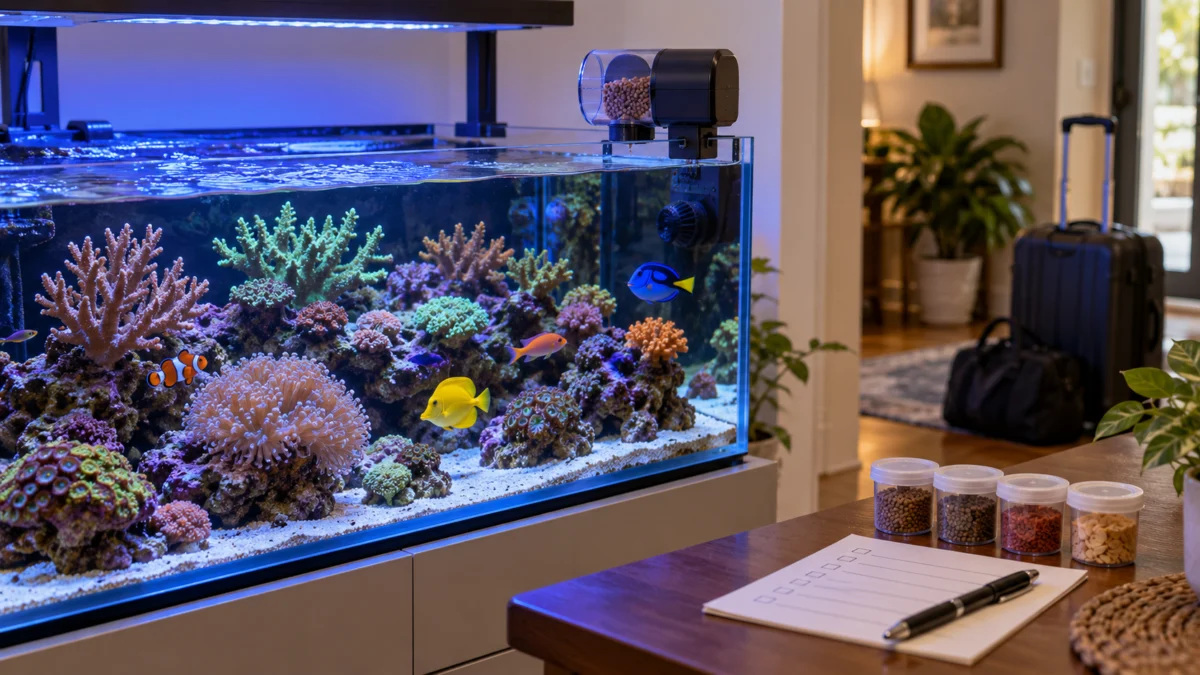
Reef keeping • Detailed tip
Leaving Your Reef for Vacation: A Seven-Day Preparation Plan
Prepare a reef aquarium for travel with tested routines, measured feeding, clear sitter instructions, reservoir planning, and an emergency handoff.
About 4 minutes • Practical steps, troubleshooting & checklists
Original AI-generated editorial illustration.
In this guide
- Seven days before: identify the daily dependencies
- Five days before: test the feeding plan
- Three days before: complete routine maintenance
- Two days before: rehearse the caretaker visit
- One day before: verify monitoring and access
- Departure-day checklist
- A simple daily sitter card
- When you return
The best vacation plan makes the aquarium predictable and the caretaker’s job straightforward. A tank that depends on daily improvisation is harder to leave than one with a tested routine, clearly labeled supplies, and someone who knows when to contact you.
The timeline below is an organizational example. Adapt it to your animals, equipment, and trip length. A heavily fed system or a reef with demanding dosing needs requires a more involved plan than a lightly stocked aquarium.
Seven days before: identify the daily dependencies
List what you actually do every day: feeding, checking temperature, replenishing freshwater, observing pumps, or adding measured supplements. For each task, decide whether tested equipment handles it or a caretaker performs it. Do not assume a newly purchased feeder or controller will work correctly without observation.
Estimate how long reservoirs, food, and collection capacity last in normal use. For example, if measured evaporation averages 0.6 gallon daily, seven days represents about 4.2 gallons of replacement water. Add an appropriate planning margin, but do not defeat an ATO’s safeguards by connecting an unlimited supply. Arrange a safe refill if the existing reservoir is insufficient.
Five days before: test the feeding plan
Run an automatic feeder through its actual schedule while you are home. Observe the amount dispensed and whether food reaches the livestock rather than the overflow. Confirm that moisture does not interfere and that the feeder remains securely mounted.
If a person will feed, prepare labeled portions by day and session. Include a demonstration. “One small pinch” is easily interpreted differently by different people. Account for species that require frequent or specialized feeding; a generic reduction plan will not suit every animal.
Three days before: complete routine maintenance
Perform ordinary maintenance early enough to observe the restart. Clean or replace scheduled mechanical filtration, inspect essential pumps, and check additive supplies. Verify salinity and other relevant parameters using the normal procedure.
Avoid introducing a new dosing strategy, changing the aquascape, or making a large livestock purchase immediately before leaving. These changes create unfamiliar behavior just when you lose the ability to investigate it in person. If new equipment is necessary, allow sufficient time to test it rather than treating installation as proof of readiness.
Two days before: rehearse the caretaker visit
Walk through the exact visit together. Show what normal sounds, water levels, and equipment displays look like. Label freshwater and mixed saltwater distinctly. Mark appropriate reservoir and operating levels, and show the person which supply belongs where.
Keep the instructions short enough to follow while standing beside the tank. A photograph of a normal sump can be more useful than a paragraph describing it. Ask the caretaker to perform the routine once so unclear steps surface before departure.
One day before: verify monitoring and access
If using alerts or a camera, check them from outside the home network. Confirm that the alert reaches someone who can respond. A remote notification is useful only when there is a practical response path; internet or power loss may also interrupt the monitoring.
Confirm entry arrangements, a backup contact, and the location of essential supplies. Review existing power-outage instructions. Tell the caretaker which observations require an immediate call and what, if anything, they are authorized to do before reaching you.
Departure-day checklist
- Reservoirs filled appropriately; tubing and lids secure.
- Feeding portions or programmed feeder checked.
- Essential pumps operating; temperature independently checked.
- Skimmer collection capacity adequate and overflow protection understood.
- Additive containers sufficient; established dosing left consistent.
- Instructions, emergency contacts, and labeled supplies visible.
A simple daily sitter card
| Task | Instruction to customize |
|---|---|
| Observe | Check normal fish behavior, water movement, temperature, and floor dryness. |
| Feed | Use only the labeled portion for this visit. |
| Check reservoirs | Compare with the marked level; refill only by the demonstrated procedure. |
| Report | Send a photo and note anything unusual. |
| Escalate | Call for leaks, stopped circulation, temperature alerts, or distressed livestock. |
When you return
Observe the aquarium before making adjustments. Review the sitter’s notes, reservoir use, and alerts. Test relevant parameters if conditions suggest a change. Do not compensate for suspected missed feeding or dosing by adding several days’ worth at once.
Write down both the routine and the decision boundary: what the caretaker should do independently, what requires a call, and whom to contact if you cannot respond. A rehearsed handoff matters as much as automation.
References & further reading
- Vacation equipment and preparation
- Vacation planning questions
- Automatic feeder programming example
- Monitoring and preparation for equipment problems
Tropical Fish & Coral • Tips & Tutorials