

Indo Blue Balls Bounce Mushroom Care: Light, Flow and Placement
Indo Blue Balls Bounce Mushroom Care: Light, Flow and Placement
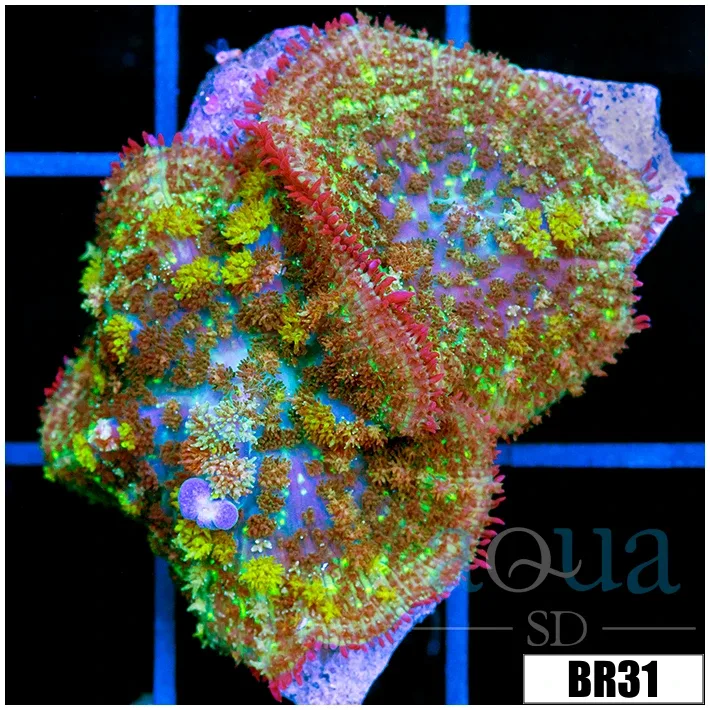
A bounce mushroom is a Rhodactis that grows swollen, bubble-like vesicles among its tentacles. When you set up your Indo Blue Balls Bounce Mushroom correctly, these distinctive "bounces" will stay full and colorful for years.
Coral care · Detailed tutorial · About 10 minutes · Beginner friendly
The key habit: Give it low light, gentle flow and stable water, then leave it where you put it.
Shop the Indo Blue Balls Bounce Mushroom
In this guide:
- What bounce mushrooms are and how they grow
- Lighting and PAR levels for healthy vesicles
- Water flow: why gentle flow matters
- Best placement in the tank
- Feeding: photosynthesis and optional supplements
- Water parameters and stability
- Acclimation after arrival
1. What Bounce Mushrooms Are and How They Grow
O.G Bounce Mushrooms begin as regular Rhodactis mushrooms, which are found all over the Indo-Pacific region. Bounce Mushrooms are almost never found in the wild and only "bounce" while in captivity. Mushrooms are a soft coral that are considered one of the easiest and hardiest in the aquarium trade.
Bounce mushrooms grow and split slowly, which is why a colored-up piece with visible vesicles holds its value. Those vesicles are the reason people chase them, and they are also the part that reacts first when something is off. After a move, or under too much light or flow, the bounces can shrink or deflate, then fill back out once the animal settles.
2. Lighting and PAR Levels for Healthy Vesicles
Rhodactis Mushrooms require lower light, therefore providing your Bounce Mushroom Coral with a PAR (Photosynthetically Active Radiation) value between 50 and 150 will give your coral enough lighting to flourish. Many expert keepers suggest an even lower range: Low to moderate lighting (40-100 PAR). Bounce mushrooms thrive in shaded or indirect light areas and are very forgiving of lower light levels.
If the lighting is too intense, your Bounce Mushroom Coral will not respond favorably, is likely to bleach, and may develop white scarring from oxide radicals in their tissues. Gradual acclimation to new lighting conditions helps prevent stress. Start your mushroom in the lowest light area of your tank and adjust only after watching it for several days.
3. Water Flow: Why Gentle Flow Matters
Although Bounce Mushroom Corals are not fussy, they should be exposed to low to moderate water flow. If the water flow is too strong, it can make your coral stressed and cause health issues. They also do best in low flow areas, as this will prevent the mushroom from being blown around excessively. Too much flow can even cause them to detach and be sucked into a powerhead.
Position your bounce mushroom away from the direct output of powerheads and wave makers. A gentle, indirect current is perfect—your mushroom should move slightly with the current, not flutter constantly.
4. Best Placement in the Tank
In a home aquarium they should be placed at the bottom of the tank where they will be protected from high light and flow. They do best in lower light areas with gentle flow, such as the sand bed or shaded rockwork.
You can glue or secure your mushroom on a rock, or place it on stable rockwork or sand where it won't roll or shift. Easy to keep alive, harder to keep bouncing. Once placed, avoid moving it—relocation causes stress and deflation.
5. Feeding: Photosynthesis and Optional Supplements
Like all mushrooms, O.G Bounce Mushrooms are photosynthetic and use aquarium lighting to meet their energy needs. Feeding is not required, but it can help. Feeding is optional but can improve growth and coloration. It lives on light and dissolved nutrients, and does better with some nutrients in the water than in a stripped, ultra-low-nutrient system.
If you choose to feed, broadcast feeding works best with reef roids or mysis. Target feeding is usually not required. Feed lightly once or twice a week, only after your mushroom is established and fully expanded.
6. Water Parameters and Stability
Stable water parameters are important for Bounce Mushroom health, color, attachment, and vesicle development. These corals are among the most forgiving when it comes to water parameters, making them a great choice for a wide range of reef tanks. They can tolerate moderate nutrient levels and do not require the same calcium demands as stony corals.
Keep your parameters in these ranges [1]:
| Parameter | Range |
|---|---|
| Temperature | 76–80°F |
| Salinity (Specific Gravity) | 1.025–1.026 |
| Alkalinity | 8–10 dKH |
| Calcium | 380–450 ppm |
| Magnesium | 1250–1350 ppm |
| Nitrate | 5–20 ppm |
| Phosphate | 0.03–0.10 ppm |
Stability matters more than exact numbers. Avoid sudden swings by doing regular water changes and testing weekly.
7. Acclimation After Arrival
Your bounce mushroom will likely arrive shrunken and possibly pale from shipping stress. This is normal and will reverse once it settles.
Gather before you start
- The shipping bag or container
- Your aquarium
- A drip line (vinyl tubing and a small airline valve work well)
- A container or bucket for water overflow
- Dim room lighting or the ability to reduce tank lights
1. Float for temperature: Float the bag for 15–20 minutes to equalize temperature. Open the bag or container at the water line so air exchange happens but nothing spills in.
2. Drip acclimate: Slowly mix tank water over 30–45 minutes. Use a drip line connected to a valve to let tank water drip into the bag at a rate of about one drop per second. This gradually acclimates the coral to your tank's salinity, pH, and alkalinity.
3. Start in low light: Start in a low-light area and increase gradually. After drip acclimation is complete, use a net to gently place your mushroom on its chosen rock or sand. Use dim lighting for the first few days, then slowly increase light over a week.
4. Give it time: Mushroom will most likely arrive shrunken. It may take a few days to color and open up due to stress. Do not move it or make adjustments during this time. Patience is the most important step.
What you notice and what to check
| What you notice | What to check next |
|---|---|
| Vesicles are shrunken or deflated | Check lighting (may be too high), flow (may be too strong), or tank stability (salinity, temperature). Give 3–7 days to recover. |
| Coral is pale or bleached | Reduce lighting immediately. Start at 40–50 PAR and increase slowly over weeks. |
| Mushroom appears to be melting or dissolving | Check water quality, salinity, and temperature. Ensure no high-flow powerheads are hitting it directly. |
| Vibrant color and fully expanded vesicles | Your care is working. Maintain lighting, flow, placement, and water parameters as they are. |
| Mushroom detached and floating | This is stress. Return it gently to its original spot and check flow direction and lighting. |
| Slow creeping or extending tentacles across the rock | This is normal. The mushroom may be exploring or growing. Space it 3–6 inches from other corals to avoid competition. |
Your care log
Placed on: ________________
Light (PAR): ________________
Water temp: ________________
Salinity (SG): ________________
Alkalinity (dKH): ________________
Calcium (ppm): ________________
Date fully expanded: ________________
Color at 30 days: ________________
Notes: ________________________________________________________________
Sources
Checked November 7, 2026.
1. Top Shelf Aquatics, "JF Sunkist Bounce Mushroom Coral"
2. The Underwater Gardener, "WYSIWYG Bounce Mushroom for Sale"
3. Reef Tank Advisor, "Bounce Mushroom Coral Care"
4. Extreme Corals, "Bounce Mushroom Coral Care Guide"
5. Vivid Aquariums, "JF Raunchy Red Bounce Mushroom Coral"
6. Frag Box, "OG Bounce Mushroom"
7. Saltwater Aquarist, "Bounce Mushroom Information & Care"