

How to Feed Corals Without Overfeeding Your Reef
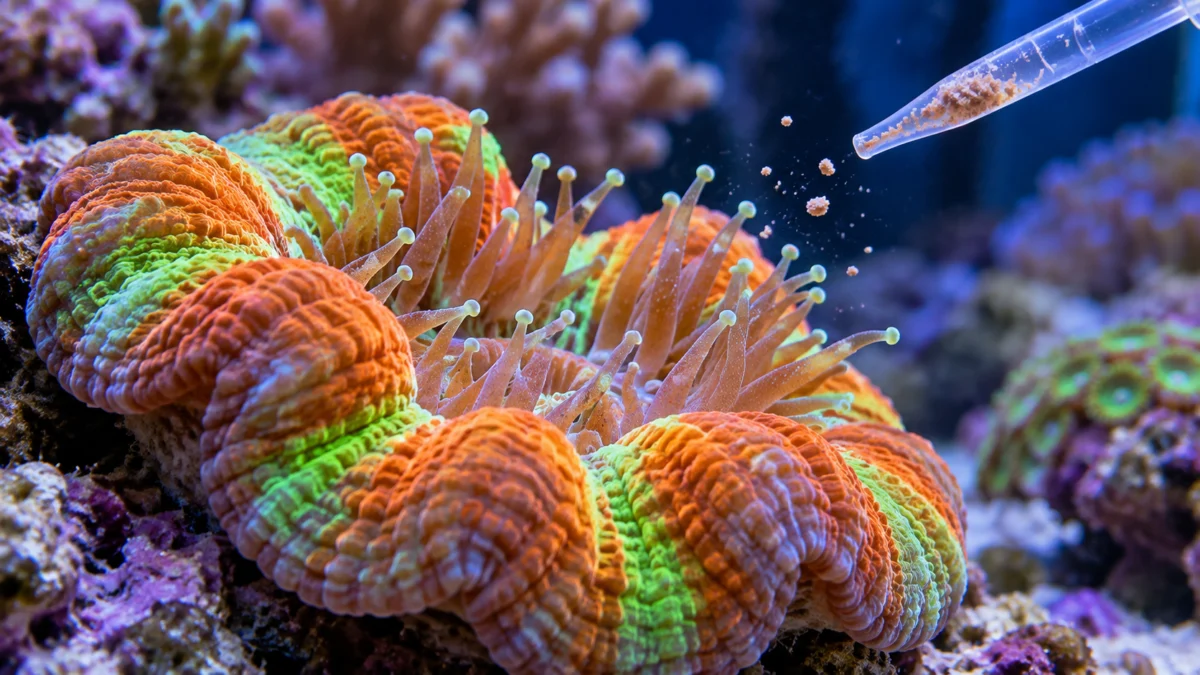
Match coral food to the animal, choose target or broadcast feeding, track portions, and use nutrient trends to refine your routine.
About 4 minutes • Practical steps, troubleshooting & checklists
Original AI-generated editorial illustration.
In this guide
- 1. Match the food to the coral
- 2. Choose a delivery method
- 3. Set up a controlled first session
- 4. Watch capture, not just polyp extension
- 5. Follow the waste trend
- An example feeding log
- Troubleshooting
Coral feeding is more useful when you can explain what you are feeding, which animals should capture it, and how the aquarium handles the leftovers. Adding a cloud of food because the tank looks hungry makes those questions harder to answer.
Many reef corals receive substantial energy through their symbiotic algae. That does not make all corals nutritionally identical. Non-photosynthetic species depend much more heavily on feeding and require a dedicated species-specific plan. The routine below is a starting framework for evaluating food delivery, not a universal prescription.
1. Match the food to the coral
Identify the coral and research the size and type of food it can use. A fleshy large-polyp coral may capture appropriately sized meaty particles or suitable pellets. Small-polyp corals generally need much smaller particles. Liquid nutritional supplements and particulate foods are different tools; do not assume they are substitutes just because both are marketed for reefs.
Read the label for preparation, storage, and dosing. Account for actual water volume where dosing is volume-based. Rock and sand displace water, so the aquarium’s advertised capacity is not necessarily its operating volume.
2. Choose a delivery method
Target feeding places a small amount near a selected coral using a pipette or baster. It is useful when you can see the animal capture food and want to minimize unnecessary distribution. Keep the tip clear of tissue and release food gently rather than forcing it into the mouth.
Broadcast feeding distributes fine food into moving water. It can reach many small-polyp animals, but you may not be able to judge exactly how much each captures. Food that circulates is not automatically food that is eaten.
3. Set up a controlled first session
Start with the product’s guidance and a conservative amount appropriate to the animals. Measure what you prepare. If mixing with aquarium water is recommended, use a clean dedicated container and prepare only what you need.
Use a timed feeding mode rather than shutting off the system indefinitely. Keep gentle circulation and adequate oxygenation. Return-pump or skimmer pauses should follow the equipment and food instructions, and you should verify that everything restarts. A useful practical habit is to set a phone timer even when a controller is meant to resume automatically.
4. Watch capture, not just polyp extension
Observe whether food stays within reach and is retained. If it immediately blows away, change the delivery position or reduce local flow within the coral’s needs. If fish or shrimp repeatedly steal it, consider a different feeding time. Some corals feed more readily after the main lights dim, but species and individual responses vary.
Do not keep adding food simply because a coral closes. Record the response and check its condition and environmental requirements. Feeding cannot compensate for inappropriate light, damaged tissue, or unstable water chemistry.
5. Follow the waste trend
Food adds material to the system even when animals consume it. Monitor nitrate and phosphate using consistent methods, and maintain mechanical filtration. An upward trend is a reason to evaluate portions, frequency, and export together—not proof that one product alone caused the change.
Keep the rest of the feeding routine steady while evaluating a new coral food. If you increase fish food, add a liquid supplement, and double particulate coral feeding in the same week, it becomes difficult to attribute either improvement or rising nutrients.
An example feeding log
- Session: Date, time, coral species, and food.
- Portion: Measured quantity, preparation, and delivery method.
- Observation: Capture, food theft, excess settling, and equipment restart.
- Weekly review: Nutrient results, photographs, and the next single adjustment.
Troubleshooting
No visible response: Check species suitability, timing, particle size, and coral health. Leftovers collect on the sand: Reduce the amount and improve delivery. Nutrients rise: Review the total feeding load and filtration. Good extension but no growth: Feeding is only one part of husbandry; compare conditions over time rather than escalating portions.
The most useful feeding session is one you can repeat and measure. A modest, well-delivered portion is easier to evaluate than a large unmeasured cloud.