

Green Mandarin Dragonet Care: Tank Setup, Feeding and Acclimation
Green Mandarin Dragonet Care: Tank Setup, Feeding and Acclimation
Green Mandarin Dragonet care begins with understanding that this peaceful, reef-safe fish needs a mature, pod-rich aquarium and careful, frequent feeding to thrive. Their peaceful personality and small adult size make them look beginner-friendly, but their feeding requirements demand preparation and observation.
Fish care · Detailed tutorial · About 7 minutes · Beginner friendly (advanced preparation required)
The key habit: Give the system many months to develop a dense microfauna population before introducing a mandarin, and plan for how that population will be sustained over the long term.
Shop the Green Mandarin Dragonet
In this guide
- What your Green Mandarin Dragonet is and where it comes from
- The case for a mature, established tank
- Building your tank: rockwork, sand, and flow
- The critical importance of copepods and other live food
- Acclimation and your first weeks
- Water parameters to maintain
- Tank mates and temperament
1. What your Green Mandarin Dragonet is and where it comes from
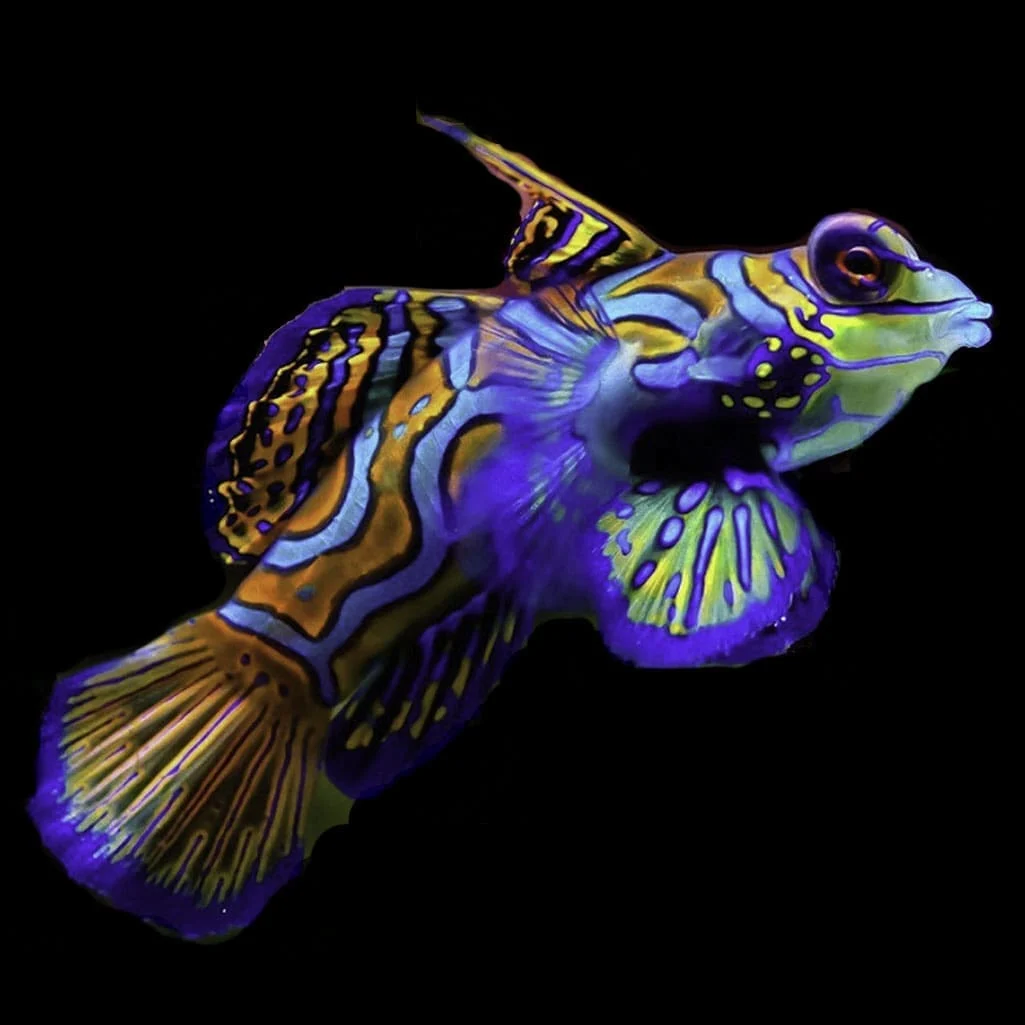
The Green Mandarin Dragonet (Synchiropus splendidus), also called Striped Mandarinfish, grows to only 2.5 inches, and reaches about 6 cm in the wild, where they are slow-moving bottom feeders rarely seen due to their small size. It is also commonly referred to as the Striped Mandarin Fish or Psychedelic Fish due to its vivid and almost surreal coloration. In the wild, feeding is continuous during daytime; the fish peck selectively at small prey trapped on coral substrate in a home range of many square meters. Despite their popularity in the aquarium trade, mandarinfish are considered difficult to keep, as their feeding habits are very specific.
2. The case for a mature, established tank
Tank size and age matter far more than tank volume alone. An established aquarium of at least 6 months to a year with abundant live rock (minimum 75 pounds in a 30-gallon tank) is typically necessary to support the microfauna population needed to sustain a single Mandarin Dragonet. A minimum of 30 gallons is commonly published, but tank age and sustainable prey production matter far more than nominal volume, and many keepers succeed only in larger, pod-rich systems. While the Green Mandarin Dragonet may be small enough to put in a small sized tank, it is best to put it in a tank 50-gallons or larger.
It is not recommended to add a Mandarin Dragonet to a new setup where there's no established food supply, or your fish could starve.
3. Building your tank: rockwork, sand, and flow
Housing should be built around a mature, biologically stable marine aquarium with abundant live rock that provides cover, hunting surfaces and a self-sustaining population of copepods and amphipods. Open areas of sand or rubble let the fish forage the way it does on the reef, though sand, crushed coral or bare bottom can all work provided the rockwork supplies enough feeding habitat. The Green Mandarin is most comfortable and happy in a reef habitat that has live sand across the bottom of the tank. The fish will become stressed if they can't burrow down into the sand to hide, especially if you have a community tank.
Moderate flow suits the species, and a secure lid, while not strictly required, is a sensible precaution. They prefer slower water flow and are picky eaters, so they don't do well when mixed into the chaos of an SPS-dominated tank or with gregarious and otherwise aggressive-feeding fishes.
A refugium is a valuable addition because it shelters and replenishes live food. An attached refugium growing chaetomorpha will provide a good source of pods for your fish. Periodically shake or stir up the chaeto to release some pods into your display tank.
4. The critical importance of copepods and other live food
Mandarin Dragonets are specialized micro-predators that feed almost exclusively on tiny live copepods and amphipods in the wild. The goby's preferred food is copepods. That's what the fish eat in their natural environment and is just about the only food they will readily consume in the tank.
The hardest part about keeping them is they need lots of live rock that will provide amphipods and copepods because they will hunt constantly for them throughout the day. An established tank with abundant live rock and a healthy pod population is essential. Supplement with live copepod cultures (Tisbe, Tigriopus) added regularly.
Captive-bred specimens may accept frozen cyclops, small mysis shrimp, and specialty dragonet pellets. Target feeding pods is a good idea too while trying to get them on standard aquarium foods like smaller pellets and thawed mysis shrimp, brine shrimp, etc. Feed multiple times daily if accepting prepared foods.
Gather before you start
- Drip acclimation kit or airline tubing and clamp
- Test kits for ammonia, nitrite, nitrate, salinity and pH
- A small flashlight or pod trap to check for existing copepod populations
- Live copepod culture (Tisbe or Tigriopus species) from a supplier
- Specimen observation notes to track feeding behavior over the first weeks
5. Acclimation and your first weeks
Check your tank's readiness before acclimating your fish. A healthy, mature tank should show visible pods, especially after lights out. You can also use a small pod trap or place a piece of filter floss in the tank overnight and check for pods in the morning.
1. Use drip acclimation. For sensitive species, a better method is the use of drip acclimation. This could be achieved by keeping the fish in the container in which it is sold and a small airline siphon started to drip water into the container, slowly changing the water parameters to that of the aquarium. Use a drip acclimation system when moving the fish from the bag to the quarantine. Match temperature, salinity, and pH slowly over 45 to 60 minutes.
2. Keep lights low for 24 hours. A newly bought Mandarin Goby must be acclimatized for 3 hours with low lights by adding the original tank water drop by drop via a thin pipe and clamp. Keep the aquarium lights off for the first full day to reduce stress.
3. Watch feeding behavior closely. Observe whether your mandarin is already eating prepared food. If you see the fish actively foraging on the rockwork, it is feeding on natural pods. If not, begin target feeding small prepared foods within 48 hours.
4. Do not overstock. Dragonet's do not generally do good in a tank with other fish of its kind. It is possible to pair two Mandarin Dragonets of opposite sexes, but then the issue is the possibility of not enough food to support the two.
6. Water parameters to maintain
Temperature: 75–82°F; pH: 8.1–8.4; Salinity: 1.023–1.026 specific gravity provide a complete range of accepted values. More specific targets: Temperature should stay between 76 and 80 degrees Fahrenheit.
Salinity: Between 1.020-1.025; Temperature: Between 24-26°C; pH: 7.9-8.3; Ammonia: Zero mg per litre; Nitrite: Zero mg per litre; Nitrate: Not to exceed 50 mg per litre; Carbonate hardness: Hard (8-12°dkH); Calcium: Between 380-450 ppm; Magnesium: Between 1250-1350 ppm [1]
Completing a 10% water change every two weeks and a monthly 25% water change will promote optimal conditions for your goby and prevent disease due to immune system compromise. Test the water to monitor the ammonia, nitrite and nitrate levels, together with pH and carbonate hardness every week, especially during initial set-up and after adding extra fish.
Salinity changes are especially dangerous. Replacing evaporated water with saltwater raises salinity quickly. It is also important to regularly monitor salinity and use reverse osmosis water replace any water lost through evaporation.
7. Tank mates and temperament
The Green Mandarin Dragonet is a peaceful, reef-safe fish, but use caution since some hobbyists have reportedly caught them nipping at coral polyps. They should do fine when kept with most other species except conspecifics – may fight with other male green mandarinfish.
Tank mates such as eels, lobsters, and large crabs are not best with dragonets, as they are possible predators of the dragonet if they are hungry enough. Green mandarins are slow, so if an eel or large crab got hungry enough, they could easily prey upon the dragonet.
What you notice and what to check next
| What you notice | What to check next |
|---|---|
| Fish foraging constantly on rocks | Copepod population is sufficient; continue feeding as is |
| Fish hiding and not foraging | Tank may lack copepods; test water parameters; add copepod culture |
| Labored breathing or lethargy | Ammonia, nitrite, or nitrate levels; temperature stability; contact water quality expert |
| Weight loss over weeks | Feeding response may be poor; increase target feeding frequency; consider species-specific pellets |
| Aggression from tank mates | Predatory fish present; re-evaluate compatibility; consider rehoming aggressor |
| Visible nodules on fins or body | Possible lymphocystis; improve water quality immediately; consult aquatic specialist |
Your care log
Tank established on: ______ Tank volume: ______
Mandarin added on: ______ Acclimation duration: ______
Initial copepod observation: ______ Live rock amount (lbs): ______
First feeding response: ______ Foods accepted: ______
Current temperature: ______ Current salinity (sg): ______ Current pH: ______
Copepod supplementation added on: ______ Frequency: ______
Notable behavior changes: ____________________________________________________________
Sources
Checked November 4, 2026.
[1] Top Shelf Aquatics, "Green Mandarin Dragonet Care Guide"
[2] Fishlore, "Green Mandarin Care – Synchiropus splendidus"
[3] Petco, "Mandarin Dragonet Care Guide: Tank Setup, Feeding & Habitat"
[4] Studio Scaped, "Green Mandarin Dragonet: Synchiropus splendidus Care Guide"
[5] Algae Barn, "How to Set Up an Aquarium for a Green Mandarin Dragonet"
[6] Reef Archive, "Mandarin Dragonet Care Guide – Synchiropus splendidus"
[7] Dallas North Aquarium, "Mandarin Dragonet Care: The Reef Fish That Makes You Earn It"
[8] [Aquariadise, "Mandarin Goby: [Synchiropus splendidus] Full Caresheet"](https://www.aquariadise.com/mandarin-goby/)
[9] OATA, "How to look after dragonets / mandarin fish"
[10] Fish Laboratory, "Mandarin Goby: Care, Tank Size, Food, Tank Mates & More"
[11] Aquarium Source, "Mandarin Goby Care: Tank Size, Mates, Food and Lifespan"
[12] Pod Your Reef, "Mandarin Dragonet (Synchiropus splendidus): A Scientific Guide"
[13] Saltwater Aquarium Blog, "Mandarin Goby, Synchiropus splendidus, in the Reef Aquarium"
[14] Aquarium Lab, "How to Care for Mandarin Fish: Tank Size, Diet, and Compatibility (2026)"