

Fritz Nitrite Test Kit: Testing the Nitrogen Cycle in Your Aquarium
Water quality · Detailed tutorial · About 7 minutes · Beginner friendly
The key habit: Test your water for nitrite when you set up a new aquarium and whenever anything disrupts your filter, since in a healthy, established reef aquarium nitrite should always remain at 0 ppm.
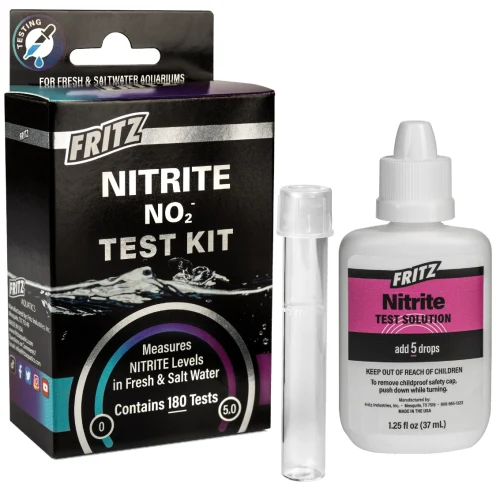
Shop the Fritz Nitrite Test Kit – 180 Tests (04002)
In this guide
- Why you need to test for nitrite
- Understanding the nitrogen cycle and nitrite's role
- When to test your water
- Setting up your first test
- Reading your results
- Troubleshooting high nitrite
- Keeping your kit fresh and ready
1. Why you need to test for nitrite
Nitrite is toxic to fish, and it appears in the aquarium during a specific stage of the nitrogen cycle. Toxic nitrite is produced by nitrifying bacteria in the biological filter as it breaks down ammonia. When you set up a new tank, nitrite will spike before beneficial bacteria can convert it into less harmful nitrate. This kit tests for harmful nitrite and measures levels from 0 to 5.0 ppm.
The Fritz Nitrite Test Kit gives you 180 tests, enough to monitor your tank during the critical cycling phase and for ongoing maintenance.
2. Understanding the nitrogen cycle and nitrite's role
Nitrite (NO₂) is the second stage of the nitrogen cycle. When fish produce waste or uneaten food decomposes, it releases ammonia (NH₃) into the water. Beneficial bacteria convert ammonia into nitrite, and a second group of beneficial bacteria then convert nitrite into nitrate (NO₃).
Nitrite is therefore an intermediate compound that should only be present while the biological filter is establishing itself or if something has disrupted the aquarium's nitrogen cycle. For all reef aquariums, the target is simple: 0 ppm.
3. When to test your water
Test for nitrite in these situations:
- During the initial aquarium cycling process: Testing daily or every other day helps track the nitrogen cycle's progress
- After adding new fish: More fish means more waste, which can increase nitrite levels
- Following filter maintenance or cleaning: Cleaning can disrupt beneficial bacteria populations
- After medication or antibiotic use: Some medications harm nitrifying bacteria, leading to spikes
- As part of routine maintenance: Weekly or bi-weekly testing ensures stable long-term water quality
4. Setting up your first test
Gather before you start
- Clean test tube (comes with kit)
- Aquarium water sample taken from mid-water depth, away from the filter intake
- The nitrite reagent bottle from your kit
- Color chart included with kit
- Well-lit area (natural daylight is best)
1. Collect your water sample. Fill a clean test tube with 5 ml of water to be tested (to the line on the tube).
2. Add the reagent. Add 5 drops from Nitrite Test Solution, holding dropper bottle upside down in a completely vertical position to ensure uniformity of drops added to the water sample.
3. Mix thoroughly. Cap the test tube and gently shake several times to mix solution.
4. Wait for the reaction. Wait five minutes for the color to develop.
5. Read the result. Read the test results by matching the color of the solution against those on the Nitrite Test Color Chart.
5. Reading your results
When you look at your sample, the color tells you the story:
- Colorless or very pale: 0 ppm – This is the healthy target, especially in an established tank.
- Pink or light red: Nitrite is present. During cycling, this is normal and temporary.
- Deep red: Higher levels. Cycling is in progress, or there is a problem in an established tank.
During the cycling phase of a new tank, in new freshwater aquariums, the nitrite level will gradually climb to 10 ppm (mg/L) or more. As the biological filter becomes established (in 4 to 6 weeks), nitrite levels will drop to 0 ppm (mg/L). (Saltwater tanks may cycle slightly differently but follow the same principle.) In an established pond or aquarium, the nitrite level should always remain at 0 ppm (mg/L).
6. Troubleshooting high nitrite
If your established tank shows nitrite above 0 ppm, the nitrogen cycle has been disrupted. The presence of nitrite indicates possible over-feeding, too many fish, or inadequate biological filtration.
To reduce nitrite: reduce feeding, perform partial water changes, add Fritz Complete water conditioner to neutralize any nitrite present, and add FritzZyme nitrifying bacteria.
Test again every day or two until the reading returns to 0 ppm. If you are cycling a new tank, patience is the best remedy—just avoid adding more fish until both ammonia and nitrite read zero.
7. Keeping your kit fresh and ready
The reagent bottles will last longer if you store them in a cool, dark place away from direct sunlight. Rinse the test tube with clean water after each use. Replace the kit if results become unclear or the reagent changes color without being used, as this signals the reagent has degraded.
With 180 tests, your Fritz kit should last through multiple tank cycles and months of routine monitoring.
What you notice and what to check next
| What you notice | What to check next |
|---|---|
| Setting up a new tank; ammonia is visible | Test nitrite daily—it will spike in a few days |
| Nitrite test shows pink color (positive) | Continue daily testing; nitrate should begin appearing soon |
| Both ammonia and nitrite read 0 ppm | Tank is cycled; safe to add fish slowly |
| Nitrite suddenly appears in established tank | Check feeding amounts and filter condition; do a partial water change |
| Nitrite is high and fish show clamped fins or gasping | Reduce feeding and do water changes immediately; retest daily |
| Tank is cycled and nitrite stays at 0 ppm | Test weekly or every two weeks for routine maintenance |
Your care log
Tank started: ______ Type (new/established): ______
First nitrite test date: ______ Result: ______ ppm
Date nitrite peaked: ______ Peak level: ______ ppm
Date both ammonia & nitrite hit 0 ppm: ______
Routine testing schedule: ______ Last test: ______ Result: ______ ppm
Sources
Checked October 23, 2026. Reference addresses are plain text.
- That Pet Place, "Nitrite & Nitrate Test Kit – 75 Tests", https://www.thatpetplace.com/nitrite-nitrate-test-kit-75-tests
- Bulk Reef Supply, "Pro Nitrite and Nitrate Test Kit – Bulk Reef Supply", https://www.bulkreefsupply.com/pro-nitrite-and-nitrate-test-kit-tropic-marin.html
- Live Aquaria, "API Nitrite Test Kit", https://www.liveaquaria.com/product/5103/?pcatid=5103
- NT Labs, "Aquarium Test Kit – Nitrite Test", https://www.ntlabs.co.uk/browse-products/indoor/aquarium-lab/nitrite-test/
- Fritz Aquatics, "Fritz Liquid Test Kits – Master Test Kit", https://fritzaquatics.com/products/master-test-kit/
- Exotic Pet Hub, "Test Nitrite and Nitrate in Your Aquarium for Optimal Health", https://exoticpethub.com/how-to-test-ammonia-nitrite-nitrate-in-aquariums/
- Reef Builders, "Beginners Guide To 'Cycling' A Saltwater Aquarium", https://reefbuilders.com/2018/03/17/beginners-guide-to-cycling-a-saltwater-aquarium/
- Charterhouse Aquatics, "Understanding Nitrite in a Reef Tank: Causes, Effects, and Solutions", https://charterhouse-aquatics.com/blogs/help-guides/understanding-nitrite-in-a-reef-tank-causes-effects-and-solutions
- The Beginners Reef, "How To Cycle Your New Reef Tank: Your Step-By-Step Guide", https://www.thebeginnersreef.com/fish-tank-nitrogen-cycle-step-by-step-explanation/
- Bulk Reef Supply, "How to Cycle a Saltwater Tank: Tips To Help You Succeed with Your New Aquarium", https://www.bulkreefsupply.com/content/post/how-to-cycle-a-saltwater-tank-tips-to-help-you-succeed-with-your-new-aquarium
- Gallery Aquatica, "How to Cycle a Reef Tank: The Complete Brisbane Guide to the Nitrogen Cycle", https://www.galleryaquatica.com.au/blogs/guides/how-to-cycle-a-reef-tank
- K & P Aquaculture, "Testing Your Tank", https://www.kandpaquaculture.com/testing-the-tank
- Manta Systems, "Understanding the Nitrogen Cycle: Essential Guide for Saltwater Aquariums", https://www.mantasystems.net/a/blog/post/understanding-the-nitrogen-cycle-essential-guide-for-saltwater-aquariums
- Reef Stable, "Nitrogen Cycle in Aquariums", https://reefstable.com/blog/nitrogen-cycle
- Reef2Reef, "A Beginner's Guide to Understanding the Nitrogen Cycle", https://www.reef2reef.com/threads/a-beginners-guide-to-understanding-the-nitrogen-cycle.658830/
- FishLore, "Aquarium Nitrogen Cycle – New Tank Syndrome", https://www.fishlore.com/NitrogenCycle.htm
- Freshwater Systems, "How to Cycle a Fish Tank", https://www.freshwatersystems.com/blogs/blog/how-to-cycle-a-fish-tank
- Wikipedia, "Fishless Cycling", https://en.wikipedia.org/wiki/Fishless_cycling
- Aquarium Science, "Aquarium Fish-in Cycling", https://aquariumscience.org/index.php/2-5-aquarium-fish-in-cycling/