

Does Every Coral Need the Same Feeding Schedule?
Does Every Coral Need the Same Feeding Schedule?
October 24, 2026 · Coral care · About 5 minutes
A feeding routine should fit the corals you keep and the aquarium they live in. Copying another reefkeeper’s schedule is a starting point for questions, not a guarantee of better growth.
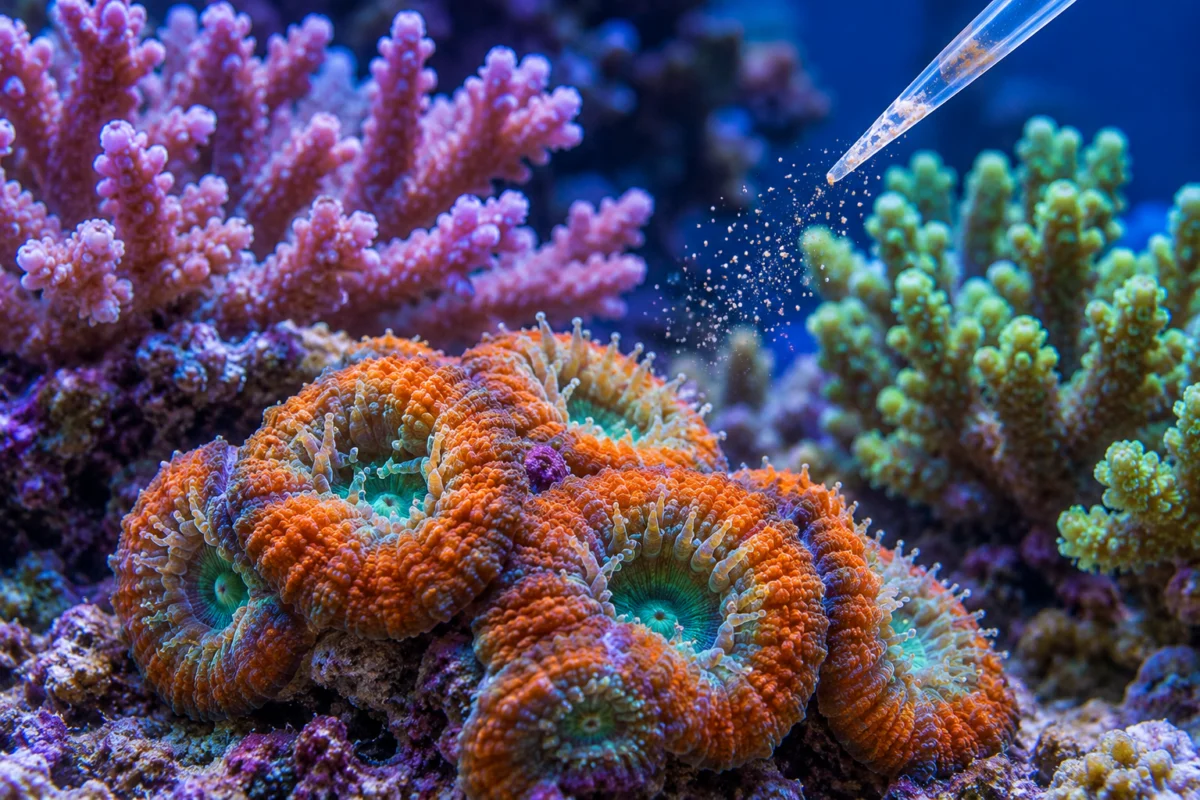
Illustration: gentle target feeding in a reef aquarium.
What the research actually tells us
A 2026 study in Zoological Studies compared two blue-light intensities and two feeding concentrations in Stylophora pistillata and Pocillopora damicornis. Researchers supplied enriched brine shrimp (Artemia) twice a week.
Stylophora grew most under the higher-light, higher-feeding treatment. Pocillopora showed no significant growth differences among treatments. Both species had reduced color scores under higher light. These results illustrate species-specific responses; they do not prove that twice-weekly feeding is ideal for every reef coral.
The useful lesson: more food and brighter light do not produce the same result in every coral. The practical routine below is a cautious husbandry approach, not a feeding protocol validated by that experiment.
1. Identify the coral before choosing its food
Start with the most reliable identification available and look for feeding guidance specific to that coral. Check the food manufacturer’s intended animals, particle size, preparation, storage, and dose. A concentrated liquid supplement, a powdered particulate food, and a meaty food are different products; their serving sizes and instructions are not interchangeable.
If you are unsure what a coral is, ask the seller before choosing a feeding schedule. Do not assume that every product labeled “coral food” meets every coral’s needs.
2. Choose target or broadcast feeding
Target feeding delivers a small amount near an individual coral with a pipette or feeding tool. Release it gently above the animal rather than pressing the tip against its tissue or blasting food into it.
Broadcast feeding distributes food through the aquarium’s water. It may be convenient for feeding multiple animals, but measure the portion rather than pouring until the water looks cloudy.
Equipment settings depend on the product. Follow its directions for any temporary skimmer or return-pump pause, maintain suitable circulation and oxygenation, and set a timer to restore equipment. For example, Red Sea’s Reef Energy Plus instructions specify a brief skimmer pause while retaining gentle circulation; that instruction should not automatically be applied to every food.
3. Start with a measured, repeatable routine
Use the product’s recommended starting amount for your actual system water volume, accounting for rock and other displacement where the instructions require it. Record what you feed, how much, and when. If you already use several foods or supplements, include all of them in the log before adding another.
A simple record is more useful than changing food, lighting, and filtration at the same time. Keep other settings stable while evaluating a feeding adjustment whenever practical.
4. Watch the coral and the nutrient trend
Observe food capture, tissue appearance, and changes over time. Polyp extension alone does not establish that a feeding routine is nutritionally adequate or improving growth.
Track nitrate and phosphate consistently alongside your observations. Red Sea’s own dosing guidance calls for adjusting its product using both coral observations and these nutrient measurements. A rising trend after additional feeding is a reason to review food input and export, rather than automatically increasing the next dose.
If a coral deteriorates, review the wider picture—including water conditions, lighting changes, and pests—instead of assuming that it simply needs more food.
Your next feeding: a quick checklist
- Confirm the coral’s identity and the food’s intended use.
- Measure the portion and record it.
- Feed gently and follow the product’s equipment instructions.
- Restore any paused equipment using a timer.
- Review coral observations and nutrient trends before changing the routine.
Build a routine around your reef.
Explore corals and saltwater aquarium supplies at TropicalFishAndCoral.com. Keep the coral’s identity and your current feeding routine handy when asking for care guidance.
Sources and further reading
- Zhang and colleagues (2026): Effects of Blue Light and Feeding on the Physiological Performance of Reef Corals — peer-reviewed research on two species, not a universal mixed-reef feeding prescription.
- Red Sea: Coral Feeding — Tips & Tricks — manufacturer guidance on feeding methods for its product.
- Red Sea: Reef Energy Plus instructions — product-specific dosing and equipment guidance.
- Red Sea: Reef Energy Plus dosing FAQ — adjusting doses using coral observations and nitrate/phosphate levels.
Published October 24, 2026. The accompanying AI-generated image is an editorial illustration of coral feeding, not a photograph of the cited experiment or store inventory.