

Choosing a Reef Cleanup Crew: Match the Animal to the Job
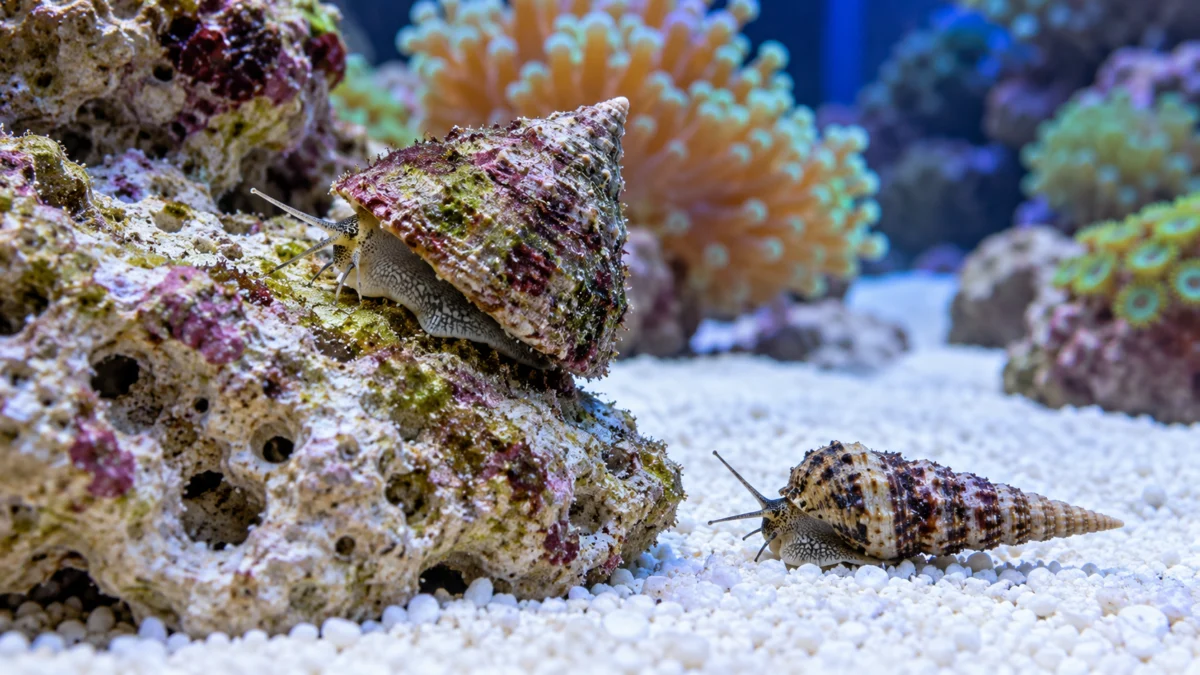
Choose snails and scavengers by their diet, habitat, adult size, and available food instead of relying on a one-animal-per-gallon rule.
About 4 minutes • Practical steps, troubleshooting & checklists
Original AI-generated editorial illustration.
In this guide
- 1. Separate grazers from scavengers
- 2. Make a task-based shortlist
- 3. Add animals when food is available
- 4. Plan compatibility and shelter
- 5. Continue caring for the crew
- A suggested weekly review
- Common mistakes
A cleanup crew is a collection of living animals with different diets. Some graze surfaces, some scavenge leftover food, and some work around the sand. Buying a large assortment does not automatically cover every task, and adding more animals than the aquarium can feed can create another problem.
Start by describing the work you need done. Is the glass covered in film? Is short algae growing on the rocks? Are meaty leftovers reaching the sand? Those questions produce a better shopping list than a tank-volume formula alone.
1. Separate grazers from scavengers
A Nassarius snail is primarily a scavenger; it is not the right choice to solve hair algae on the glass. Trochus snails are commonly selected for grazing rock and glass. Cerith snails can work across surfaces and around the sand, while turbo snails can be useful algae grazers but become relatively large.
Common names can cover different species. Confirm the exact animal, temperature requirements, adult size, and diet with the seller. The label “reef safe” does not tell you whether the aquarium can support it or whether it performs the job you have in mind.
2. Make a task-based shortlist
| Observed task | Animals to research | What to verify |
|---|---|---|
| Film on rock and glass | Trochus or suitable cerith species | Diet, available grazing, and compatibility |
| Short hair algae | Suitable turbo snails or other proven grazers | Adult size and secure coral mounts |
| Meaty food reaches the bottom | Nassarius snails | Adequate appropriate food; not an algae solution |
| Considering hermit crabs | Species identified by the supplier | Behavior, size, and suitable spare shells |
This is a research shortlist, not a promise that every individual will consume a particular growth. Thick mats often need manual removal before grazers can help manage the remaining short growth.
3. Add animals when food is available
A newly completed cycle does not automatically mean abundant grazing exists. Wait for the relevant food source to develop, or have a suitable supplemental-feeding plan. Scavengers also need nutrition; a clean aquarium with little feeding may not sustain them indefinitely.
Add a modest first group matched to visible need and observe it before expanding. For two aquariums with the same capacity, different rock area, feeding, maturity, and algae coverage can mean very different supportable populations. Avoid turning a package size into an obligation to stock that many animals immediately.
4. Plan compatibility and shelter
Review fish and invertebrate compatibility before purchasing. Provide suitable shells if keeping hermits. Extra shells offer choices, but they do not guarantee that a crab will never disturb a snail. Large grazers also make secure frag mounting especially useful.
Inspect new arrivals and follow the supplier’s acclimation procedure for those specific invertebrates. Do not apply coral-dip products to snails, crabs, or other invertebrates unless the product explicitly supports that animal and use.
5. Continue caring for the crew
Watch the animals, not just the algae. Record which surfaces they use, whether food is available, and whether the same areas stay dirty. If scavengers need supplemental food, provide appropriately sized sinking food conservatively and check that it is consumed. Do not scatter excess food to manufacture a reason for a larger crew.
When algae declines, reassess the population’s food supply before adding more. The crew helps redistribute and consume organic material, but it does not make waste disappear from the system. Continue normal filtration and maintenance.
A suggested weekly review
- Photograph the same rock and glass areas.
- Check visible animal activity and any repeated losses.
- Note available grazing and supplemental feeding.
- Confirm that leftover food is being addressed through portions and delivery.
- Expand only when a specific remaining task justifies it.
Common mistakes
Do not buy Nassarius for an algae problem, assume all snails eat the same thing, or replace repeated losses without investigating conditions. A persistent dirty corner may need a maintenance or flow adjustment rather than a larger order of animals.
Build the smallest crew that has suitable work and enough food, then adjust as the reef matures. The animals’ welfare is part of a successful cleanup plan.