

CaribSea Florida Crushed Coral: Setup and Maintenance for Reef Tanks
You'll know how to choose the right depth and placement for crushed coral, set it up without cloudy water, keep it clean, and recognize when it needs refreshing.
Substrate care · Detailed tutorial · About 12 minutes · Beginner friendly
The key habit: Crushed coral makes an ideal and highly efficient denitrifying refugium filter, but success depends on rinsing it well before use and setting it up so water flows through it properly, not around it.
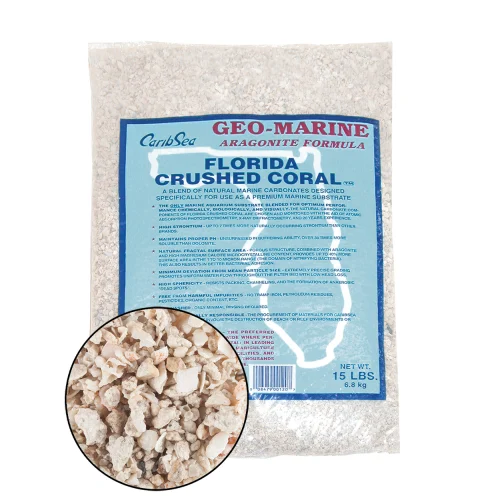
Shop the CaribSea Florida Crushed Coral 15lb
In this guide
- What crushed coral is and why it works
- Choosing the right amount for your tank
- Rinsing before use
- Placement and depth
- Cleaning and maintenance
- Upkeep and replacement
- Common mistakes to avoid
1. What crushed coral is and why it works
Crushed coral is a dry aragonite substrate for marine aquariums with up to 25 times the buffering power of other crushed corals, dolomite, or oyster shell. Unlike sand, which can cloud easily and blow around in strong flow, crushed coral stays stable. In saltwater and reef aquariums, crushed coral works in harmony with the naturally higher pH demands of corals, invertebrates, and marine fish, and its aragonite composition closely mimics the natural seafloor environment, providing a biologically active substrate that supports beneficial bacterial colonies. It also contributes a small but meaningful amount of calcium and carbonates to the water, supplementing the calcium demands of coral skeletons and invertebrate shells.
2. Choosing the right amount for your tank
The general rule of thumb is one to two pounds of rock per gallon of aquarium water, though this number depends on the aquascaping. For crushed coral specifically, spread an even layer at a depth of 1-2 inches. Most modern reef tank owners use no more than 1-2 inches of sand unless you have some special animal that requires a deeper sand bed; deeper sand beds can be tough to keep clean and will trap detritus, making your life harder in the long run.
Plan before you buy: Measure your tank's floor length and width in inches. Multiply length × width × 2 (for 2 inches of depth). Divide by 1,728 to get the cubic feet you need. One pound of crushed coral fills roughly 0.15 cubic feet. For a 40-gallon breeder tank (36" × 18" base), you'd need about 24 pounds for a 2-inch bed.
3. Rinsing before use
Crushed coral is a natural product and may be a little dusty when you first receive it; to prevent cloudy water, pour a handful of crushed coral into a fish net and rinse it thoroughly under running water, continue this process until all of the crushed coral has been rinsed, and then it is ready for use in your aquarium. Plan 15–20 minutes for this step. Rinsing prevents the milky water that clouds tanks and makes monitoring difficult in the first few days after setup.
4. Placement and depth
Gather before you start
- Clean, rinsed crushed coral
- Your display aquarium (preferably filled 75% with prepared saltwater)
- Live rock already in place or ready to position
- A small shovel or measuring cup
- Powerheads positioned for flow
1. Position live rock first. Place rocks securely on the tank bottom or on stable supports before adding sand; this prevents collapses from burrowing animals. This keeps the crushed coral from shifting under rockwork.
2. Spread crushed coral evenly across the tank floor, aiming for 1–2 inches deep. If you're mixing crushed coral with sand, mixing sand with crushed coral is an approach that can help add a more natural look and feel to your reef aquarium and prevent those pesky bald spots from forming in areas of higher flow.
3. Leave gaps behind rock. Leave at least a two-to-three-inch gap between your rock work and all glass panels; this space allows powerheads to push clean water behind the reef structure and gives you room to run an algae scraper along the glass during routine maintenance.
4. Verify flow. Turn on powerheads and watch for settled areas or thin spots where crushed coral has blown away. Move powerheads or add more crushed coral if needed.
5. Cleaning and maintenance
Crushed coral is easier to maintain than fine sand. The pro is that it traps detritus making the tank look super clean; the con is that it traps detritus and you'll have to vacuum it out. However, it is easy to siphon, with no fear of it getting into and destroying pumps.
Weekly: Use a gravel vacuum around the crushed coral, especially in low-flow areas where detritus settles. Move slowly to avoid stirring up clouds.
Monthly: Inspect for bare patches. If crushed coral has blown to one side due to flow, redistribute it gently.
As needed: Remove algae buildup with an algae scraper or cloth. Small algae growth is normal and not cause for concern.
6. Upkeep and replacement
Crushed coral breaks down over time, releasing calcium and possibly other trace elements back into the water column, acting like a giant calcium reactor. This is one of its strengths, but it means the material gradually depletes.
When to refresh: EcoSystem Aquarium recommends changing 50% every 1.5 years. You don't have to wait that long if you notice significant settling or loss of depth.
How to replace:
- Remove 50% of the old crushed coral during a water change.
- Rinse the new crushed coral well.
- Spread it evenly over the remaining layer.
If you run a refugium with crushed coral as well as a display bed, stagger replacements—refresh the refugium first, then the display six months later.
7. Common mistakes to avoid
Pouring directly into the tank without rinsing. This clouds the water for days and can stress livestock. Always rinse first.
Using too much depth. More than 2 inches traps detritus and becomes a nitrate trap rather than a nutrient sink. Shallow is better for beginners.
Placing crushed coral against glass. This restricts water flow and creates dead zones. Always leave a gap.
Not accounting for flow. In high-flow SPS tanks, crushed coral can shift and blow away. In tanks with crushed coral substrate, pH is way more stable and more buffered than in bare-bottom tanks. This stability is worth the extra maintenance.
Expecting it to work without water changes. Crushed coral buffers and provides trace elements, but it is not a substitute for regular tank maintenance and water testing.
What you notice and what to check
| What you notice | What to check next |
|---|---|
| Water is cloudy the first day | Have you rinsed the crushed coral? A handful at a time under running water before adding to the tank |
| Crushed coral piling up on one side | Is your flow balanced? Reposition a powerhead or add more coral to spread it evenly |
| Bare patches appearing in 2–3 weeks | Check your flow rate and powerhead placement; too much flow in one spot scatters the substrate |
| pH rising higher than desired | Are you using crushed coral in a closed system? More frequent water changes help stabilize pH |
| Crushed coral looks smaller or settles lower over months | This is normal breakdown; plan a 50% refresh in 1–2 years |
| White film or algae on surface | This is normal; scrape gently or let herbivorous fish and invertebrates graze |
Your care log
Tank size: ______ gallons
Crushed coral depth: ______ inches
Amount added (lbs): ______
Date of initial setup: ______
Rinsed on: ______
Last vacuum: ______
Last 50% replacement: ______
Next replacement due: ______
Sources
Checked October 9, 2026.
- Bulk Reef Supply, "Best Reef Aquarium Sand," https://www.bulkreefsupply.com/content/post/best-aquarium-sand
- Bulk Reef Supply, "BRStv Buyer's Guide – Dry and Live Sand," https://www.bulkreefsupply.com/content/post/brstv-buyers-guide-aquarium-sand
- Top Shelf Aquatics, "Aquarium Sand for Reef Tanks & Saltwater Aquariums," https://topshelfaquatics.com/collections/aquarium-sand
- Bulk Reef Supply, "Live Sand & Your Reef Tank – What You NEED to Know!," https://www.bulkreefsupply.com/content/post/live-sand-and-your-reef-tank-what-you-need-to-know
- MarineAndReef.com, "Choosing the Best Salt Water, Reef & Freshwater Aquarium Substrate (Gravel & Sand)," https://www.marineandreef.com/Articles.asp?ID=347
- Reef2Reef, "Unveiling the Perfect Bed: Choosing the Right Substrate for Your Saltwater Reef Tank," https://www.reef2reef.com/ams/unveiling-the-perfect-bed-choosing-the-right-substrate-for-your-saltwater-reef-tank.923/
- FishLore, "Reef Tank Aquarium Setup Guide," https://www.fishlore.com/reeftanksetup.htm
- Live Aquaria, "New Aquarium Setup Guide: Reef Aquarium Setup," https://www.liveaquaria.com/blogs/reef-aquarium-care/reef-aquarium-setup
- FancyReef, "Beginner Reef Checklist for a Strong First Setup," https://fancyreef.com/saltwater-aquarium-beginner-setup/
- Petco, "CaribSea Florida Crushed Coral Substrate, 40 lbs.," https://www.petco.com/product/caribsea-florida-crushed-coral-substrate
- Aquarium Co-op, "Crushed Coral, 1 lb.," https://www.aquariumcoop.com/products/crushed-coral-1-pound-bag
- Imagitarium, "Best Crushed Coral Marine Substrate," https://imagitarium.net/build-a-better-reef-from-the-bottom-up-crushed-coral/
- Exotic Pet Hub, "Crushed Coral Aquariums: Benefits and Best Practices," https://exoticpethub.com/crushed-coral-aquarium-benefits-and-best-practices/
- Reef2Reef, "Pros and Cons to Crushed Coral Substrate," https://www.reef2reef.com/threads/pros-and-cons-to-crushed-coral-substrate.605215/