

Blue Leg Reef Hermit Crab Care: Tank Setup, Feeding and Tank Mates
You'll learn how to set up a tank for your blue leg hermit crab, acclimate it safely, feed it properly, and manage its behavior to keep it healthy and thriving.
Invertebrate care · Detailed tutorial · About 12 minutes · Beginner friendly
The key habit: Provide a few extra empty shells in the aquarium to help reduce aggression and allow your hermit crab room to grow. This single step prevents most behavioral problems.
Shop the Blue Leg Reef Hermit Crab
In this guide
- What your hermit crab is and where it comes from
- Tank setup and rockwork
- Tank mates and temperament
- Acclimation
- Feeding
- Water parameters and quality
- What to watch for
1. What your hermit crab is
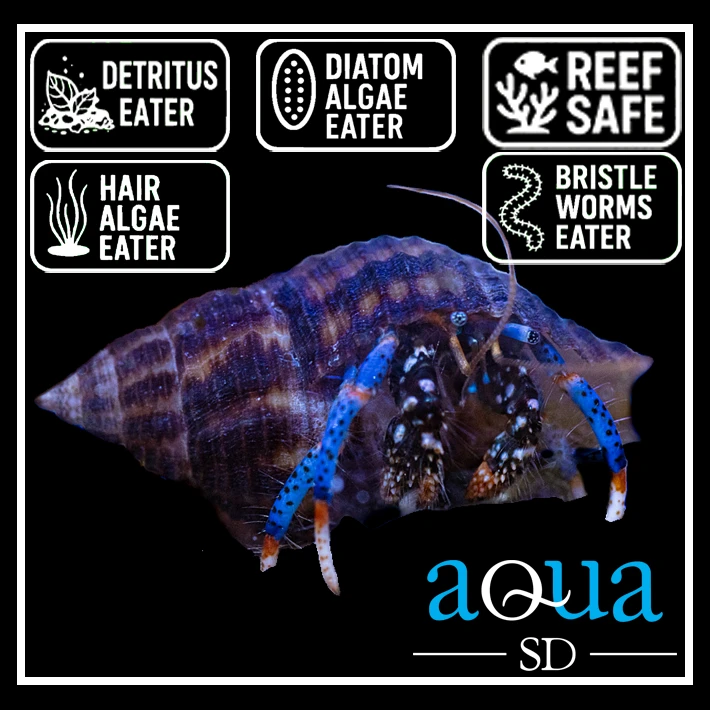
The Blue Leg Hermit Crab is a popular and hardworking member of many saltwater aquarium clean-up crews, recognized by their bright blue legs and active scavenging behavior. These small hermit crabs spend much of their time moving across rockwork and sand in search of algae, leftover food, and organic debris. Unlike true crabs, hermit crabs use empty mollusk shells for protection and change to larger shells as they grow. They are nocturnal by nature, most active during the night.
2. Tank setup and rockwork
A well-established marine aquarium with a minimum size of 5 gallons is recommended. Incorporate live rock structures and provide ample hiding places to mimic their natural environment. A sandy substrate is also preferable, allowing them to burrow and sift through detritus. As they scavenge, they inadvertently aerate your sand substrate, promoting healthy bacterial growth that's essential for a thriving reef environment.
You don't need special lighting or powerful flow—hermit crabs are bottom dwellers and will thrive with standard reef lighting and moderate flow. The most important element is live rock with cracks and crevices for grazing and hiding.
3. Tank mates and temperament
Blue Leg Hermit Crabs are generally reef-safe and can be kept with most peaceful fish, corals, and invertebrates. They are mostly peaceful, but may attempt to steal shells from other crabs or snails in the aquarium. These crabs are generally peaceful but may become aggressive if they are not provided with enough food or shells. Keep them with other peaceful reef inhabitants and away from large, aggressive fish or invertebrates that might predate on small crabs. They are safe around stony and soft corals.
4. Acclimation
Gather before you start
- Acclimation container (a cup or small bowl)
- Airline tubing and air valve (for drip acclimation)
- Thermometer
- Net or container to move the crab
When acclimating Blue Leg Hermit Crabs, try to perform the acclimation process slowly. Drip acclimating is the most effective for this. Take a little more time when acclimating this crab to your tank water to prevent pH shock.
1. Float the shipping bag in your tank for 15–20 minutes so the crab adjusts to the tank's temperature.
2. Set up drip acclimation by placing the open bag in a container and running airline tubing from your tank into the bag with an air valve set to 2–3 drips per second.
3. Drip for 45 minutes to an hour, allowing tank water to gradually mix with the bag's water.
4. Net the crab gently and place it in a shaded area near rockwork and hiding places, away from bright light and strong flow. Do not pour shipping water into your tank.
Let the crab acclimate in place for a few hours before it ventures out to explore.
5. Feeding
In an established tank with healthy algae growth, your hermit crab will rarely need supplemental feeding. In most established tanks, they will find plenty to eat and usually do not require supplemental feeding. Blue Leg Hermit Crabs will feed on algae, such as hair algae and even certain kinds of cyano, as well as other left over foods.
If algae is scarce or your tank is new, provide a varied diet including marine algae, sinking pellets, and other suitable foods, as well as ensuring enough shells of different sizes for them to choose from. If you don't have enough algae in your tank give them dried seaweed. Feed sparingly—overfeeding will degrade water quality and is unnecessary if your cleanup crew finds natural food.
6. Water parameters and quality
Your blue leg hermit crab will thrive in stable reef tank conditions. Maintain water between 72–80°F, with pH 8.0–8.5. The tank should have specific gravity of 1.020–1.025, and hardness between 8–16 dKH. Keep nitrates below 20 ppm and phosphates low. These invertebrates are particularly sensitive to copper-based medications, so never use copper treatments in tanks housing hermit crabs.
For optimal health, ensure your hermit crabs receive calcium supplementation through proper reef tank supplementation programs. Maintain calcium levels between 400–450 ppm and magnesium around 1250–1350 ppm for best results.
7. What to watch for
Hermit crabs molt (shed their exoskeletons) as they grow. During this time they are vulnerable and will hide. If your crab vanishes for a few days, it is likely molting in a safe spot—leave it undisturbed. After molting, it will seek a larger shell. This is why providing extra empty shells of various sizes is so important.
Watch for signs of stress: lack of movement, remaining in the shell for days, or letharness. These may indicate poor water quality, lack of food, or shell scarcity. Respond by checking your parameters and providing extra hiding places and shells.
What you notice and what to check next
| What you notice | What to check next |
|---|---|
| Crab stays hidden for several days | Likely molting; leave undisturbed and check again in 2–3 days |
| Crab active at night but hidden during day | Normal behavior; they are nocturnal scavengers |
| Crab moving between shells frequently | Growth; shells are the right size, continue providing variety |
| Crab sits motionless in shell for days | Poor water quality, hunger, or shell stress; test parameters and provide extra shells |
| Aggressive behavior toward snails or other crabs | Insufficient food or shells; provide extra shells and boost feeding |
| Visible algae still present after weeks | Tank is thriving; hermit is eating well and growing |
Your care log
Placed on: ______ Original shell size: ______ Temperature: ______ Salinity (SG): ______
First molt observed on: ______ New shell size used: ______
Feeding (how often): ______ Food type: ______
Notes: _______________________________________________________________
Sources
Checked October 21, 2026.
- Bulk Reef Supply, "ECC Blue Leg Hermit Crabs – Coral, Fish & Aquarium Supplies – BRS", https://www.bulkreefsupply.com/ecc-blue-leg-hermit-crabs-eye-catching-coral.html
- Aquarium Breeder, "Blue Leg Hermit Crab – Detailed Guide: Care, Diet, and Breeding", https://aquariumbreeder.com/blue-leg-hermit-crab-detailed-guide-care-diet-and-breeding/
- Saltwaterfish.com, "Explore the Blue Leg Hermit Crab (Clibanarius tricolor) for Your Saltwater Marine Aquarium", https://www.saltwaterfish.com/product-blue-leg-hermit-crab
- Tidal Gardens, "Blue Leg Hermit Crab", https://tidalgardens.com/stock-blue-leg-hermit-crab.html
- Fishkeeping.co.uk, "Caresheets – Blue Leg Hermit Crab (Dwarf Blue Hermit Crab / Equal-Handed Hermit Crab) – Clibanarius tricolor", https://www.fishkeeping.co.uk/modules/caresheets/caresheet.php?caresheetID=33
- My Saltwater Fish Store, "Saltwater Hermit Crabs: Complete Care Guide for Your Reef Tank", https://www.mysaltwaterfishstore.com/blogs/crab-resources/saltwater-hermit-crabs-complete-care-guide-for-your-reef-tank
- Fishlore, "Hermit Crab Care (Clibanarius spp.)", https://www.fishlore.com/Profiles-HermitCrab.htm