

Aquarium Maintenance Tutorial: How to Clean Biological Filter Media Without Killing Beneficial Bacteria
Introduction: Are You Accidentally Harming Your Aquarium’s Biological Filter?
One of the most common aquarium maintenance mistakes is cleaning biological filter media the wrong way. A filter may look dirty, but the material inside it supports millions of beneficial bacteria that help keep aquarium water safe for fish and other aquatic life.
Rinsing biological filter media under untreated tap water can expose these bacteria to chlorine or chloramine, chemicals commonly used to disinfect municipal water supplies. Depending on the exposure, these disinfectants can damage beneficial bacteria and reduce the effectiveness of your aquarium’s biological filtration.
The goal of cleaning biological filter media is to remove excess debris while preserving the beneficial bacteria that keep your aquarium’s nitrogen cycle functioning.
This tutorial explains how to clean your biological filter media safely, when cleaning is necessary, and how to avoid common mistakes in both freshwater and saltwater aquariums.
1. Understand What Biological Filter Media Does
Biological filter media provides a surface where beneficial microorganisms can live and grow. These organisms play an essential role in the aquarium nitrogen cycle.
As fish produce waste and uneaten food decomposes, ammonia can accumulate in the water. Ammonia is toxic to fish, even at relatively low concentrations.
Beneficial microorganisms help process this waste through the following stages:
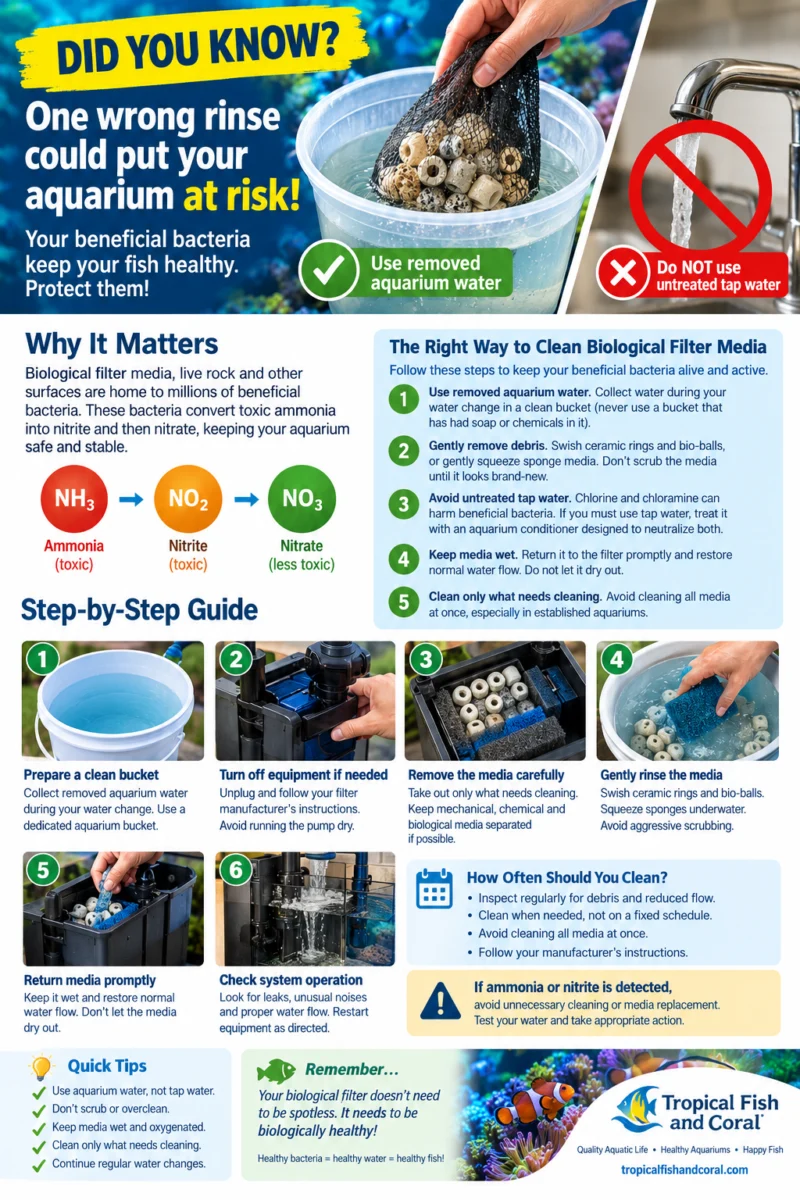
- Ammonia: Produced by fish waste, decomposing food, and other organic matter.
- Nitrite: Formed when ammonia is biologically converted. Nitrite is also toxic to fish.
- Nitrate: Produced through further biological conversion. Nitrate is generally less toxic than ammonia and nitrite, but it still needs to be managed through appropriate aquarium maintenance.
Biological filtration helps prevent ammonia and nitrite from accumulating to dangerous levels. However, it does not eliminate the need for water changes, proper feeding, and routine water testing.
Common types of biological filtration media include:
- Ceramic rings and porous ceramic media
- Sintered glass media
- Bio-balls
- Biological filter blocks and sponges
- Porous rock and live rock in saltwater aquariums
2. Why You Should Avoid Untreated Tap Water
Municipal tap water is treated to make it safe for human use, but that does not automatically make it suitable for rinsing aquarium biological filter media.
Two common disinfectants are chlorine and chloramine.
Chlorine is used to kill harmful microorganisms in drinking water. Exposure can damage aquatic organisms, including beneficial bacteria.
Chloramine is a more stable disinfectant that can remain in water longer. It can also harm fish and beneficial microorganisms if not properly neutralized.
When you rinse biological filter media directly under untreated tap water, you risk exposing the bacterial colonies to these disinfectants. The degree of damage depends on the disinfectant concentration, exposure time, and other conditions.
What water should you use?
For routine filter maintenance, use water removed from your aquarium during a water change. Collect it in a clean bucket that has never been exposed to soap, detergents, or household cleaning chemicals.
This water is a practical choice because it avoids introducing untreated municipal disinfectants while allowing you to loosen and remove accumulated debris.
Properly conditioned tap water can also be suitable when the conditioner is specifically intended to neutralize both chlorine and chloramine and is used according to its directions. However, aquarium water removed during a water change is a simple option for routine cleaning.
3. Step-by-Step: How to Clean Biological Filter Media
Follow these steps when your biological filter media has accumulated enough debris to restrict water flow or interfere with normal filter operation.
Step 1: Prepare a clean bucket
During a scheduled water change, collect enough removed aquarium water to rinse the media.
Use a dedicated aquarium bucket. Never use a bucket that has contained soap, detergent, bleach, or other household cleaning products.
Step 2: Turn off equipment if necessary
If you need to open the filter, turn off and unplug the equipment according to the manufacturer's instructions. Follow the appropriate procedure for your filter type, and avoid allowing the pump to run dry.
For a saltwater aquarium, follow any additional instructions for equipment connected to your sump or return system.
Step 3: Remove the biological media carefully
Take out only the media that needs cleaning. Avoid disturbing the entire biological filtration system unnecessarily.
If your filter contains mechanical, chemical, and biological media, identify each type before cleaning. Mechanical media traps debris, while chemical media is designed to adsorb or otherwise remove particular substances. Each may have different maintenance or replacement requirements.
Step 4: Gently rinse away accumulated debris
Place the biological media in the bucket of removed aquarium water.
- Ceramic rings and porous media: Gently swish the media in the water to loosen trapped debris.
- Bio-balls: Lightly agitate them to release accumulated waste.
- Biological sponges: Gently squeeze and release the sponge underwater until enough debris is removed to restore reasonable flow.
- Porous rock or live rock: Avoid aggressive scrubbing that could damage the rock's surface organisms. Use gentle agitation only when needed.
The water may become cloudy or discolored as debris is released. This is normal.
Do not attempt to make biological media look brand-new. The objective is to remove excess debris without unnecessarily disturbing the biological community.
Step 5: Return the media to the filter promptly
Keep the media wet and minimize the time it spends outside the filter. Return it to its proper location and restore normal water flow.
Biological filtration depends on living microorganisms receiving oxygen and access to the compounds they process. Do not allow the media to dry out or remain without adequate water flow for extended periods.
Step 6: Confirm that the filter is operating properly
Restart the equipment according to the manufacturer's instructions. Check for leaks, unusual noises, airlocks where applicable, and adequate water flow.
If your system uses a sump, verify that the water level and return pump are operating normally.
4. How Often Should You Clean Biological Filter Media?
There is no single cleaning schedule that works for every aquarium. Maintenance frequency depends on the type of filter, the amount of livestock, feeding habits, accumulated debris, and the manufacturer's recommendations.
Use these guidelines:
- Inspect regularly: Check for visible debris, clogged media, and reduced water flow.
- Clean when needed: Gently rinse media when accumulated waste begins to interfere with normal operation.
- Avoid unnecessary cleaning: Do not disturb established biological media simply because it looks discolored.
- Avoid cleaning everything at once: When several sections need maintenance, clean portions at different times where practical to reduce disruption to the established bacterial population.
- Follow manufacturer instructions: Some specialized media and filter systems have specific cleaning or replacement requirements.
Mechanical filter pads and socks may need more frequent cleaning than biological media because their primary purpose is to trap debris. Keeping mechanical filtration maintained can help prevent excess waste from accumulating on biological media.
5. Important Differences Between Freshwater and Saltwater Aquariums
The basic principles of biological filtration apply to both freshwater and saltwater aquariums, but the equipment and maintenance practices may differ.
Freshwater aquariums
In freshwater systems, biological filtration is commonly provided by canister filters, hang-on-back filters, internal filters, sponge filters, and sump systems.
Use removed aquarium water to gently clean biological media when needed. Check ammonia and nitrite if fish show signs of distress or if filtration has been significantly disturbed.
Saltwater and reef aquariums
Saltwater aquariums may use sump-based biological media, live rock, marine filter sponges, ceramic media, and other specialized filtration products.
Avoid unnecessarily disturbing established live rock or biological media. If cleaning a sump or filter, maintain adequate circulation and oxygenation and follow the instructions for specialized equipment.
For reef aquariums, also monitor temperature, salinity, and water flow when performing maintenance. Sudden changes in these conditions can stress corals and other marine organisms.
6. What If You Accidentally Rinse Your Filter Media Under Tap Water?
Do not assume that your entire biological filter has been destroyed. The extent of any damage depends on the disinfectant concentration and the duration of exposure.
Take the following precautions:
- Return the media to the filter and restore normal circulation.
- Avoid additional aggressive cleaning or unnecessary replacement of biological media.
- Test aquarium water for ammonia and nitrite, especially over the following several days.
- If either parameter is detectable, take prompt corrective action appropriate to your aquarium, including a properly prepared partial water change when needed.
- Reduce feeding temporarily if appropriate, remove uneaten food, and avoid adding livestock until water quality is stable.
- If ammonia or nitrite rises or fish show signs of distress, respond promptly rather than waiting for the filter to recover.
For saltwater aquariums, use test methods suitable for marine water. Follow your test kit's instructions when interpreting results.
7. Common Biological Filter Maintenance Mistakes
Avoid these common errors:
Mistake 1: Rinsing biological media under untreated tap water. Chlorine and chloramine can damage beneficial microorganisms.
Mistake 2: Scrubbing media until it looks clean. Aggressive cleaning can unnecessarily disturb the established biological community.
Mistake 3: Replacing all biological media at once. This can remove a substantial portion of the aquarium's established biological filtration capacity.
Mistake 4: Allowing media to dry out. Drying and prolonged loss of adequate water flow can harm the organisms living on the media.
Mistake 5: Ignoring reduced water flow. Excessive debris can interfere with filter operation and oxygen delivery. Clean the affected material as needed.
Mistake 6: Assuming biological filtration eliminates the need for water changes. Biological filtration processes ammonia and nitrite, but it does not replace routine water changes, nutrient management, or water testing.
Frequently Asked Questions
Can I use tap water if I add a water conditioner?
Yes, if the conditioner is designed to neutralize both chlorine and chloramine and is used according to its instructions. For routine cleaning, however, removed aquarium water is a convenient choice.
Should biological filter media be completely clean?
No. Biological media does not need to look spotless. Remove enough debris to maintain appropriate water flow without unnecessarily disturbing the established biological community.
Can I clean all my biological media on the same day?
It is generally better to avoid cleaning all established biological media at once, especially in a mature aquarium. Clean only what needs attention and stagger extensive maintenance when practical.
How do I know if my biological filter is working?
Regular water testing is the best way to assess its performance. In an established aquarium, ammonia and nitrite should generally remain undetectable with an appropriate test kit. Unexpected readings may indicate an issue with filtration, livestock load, water quality, or another part of the aquarium system.
Does this advice apply to live rock?
Yes, the principle of protecting beneficial microorganisms applies to live rock. Avoid untreated tap water, unnecessary aggressive scrubbing, drying, or prolonged loss of circulation. Gentle cleaning with suitable aquarium water is preferable when cleaning is necessary.
Final Thoughts: Protect Your Beneficial Bacteria
Your biological filter is one of the most important parts of your aquarium. It provides a home for microorganisms that help process fish waste and maintain a stable aquatic environment.
By using removed aquarium water for routine cleaning, avoiding untreated tap water, keeping media wet, and cleaning only when necessary, you can help preserve your established biological filtration.
Remember: Clean enough to maintain proper flow, but not so aggressively that you unnecessarily disrupt the beneficial bacteria your aquarium depends on.
For more aquarium maintenance tips, aquatic supplies, and products for freshwater and saltwater aquariums, visit Tropical Fish and Coral.
Tropical Fish and Coral
https://tropicalfishandcoral.com