

API Calcium Test Kit: Weekly Testing for Stony Corals
You'll learn why your reef tank needs calcium, how to use the API Calcium Test Kit to measure it, and when to test.
Water quality · Detailed tutorial · About 8 minutes · Beginner friendly
The key habit: Test your reef tank's calcium level at the same time each week, because calcium drops as corals and coralline algae grow, and you need to know when to dose.
In this guide
- Why calcium matters for your reef
- What the API Calcium Test Kit contains
- Choosing when to test
- How to run the test
- Reading your result
- What to do if calcium is out of range
- Keeping records
1. Why calcium matters for your reef
Calcium is one of the two most important water parameters for growing coral—the other being alkalinity. Without the proper amount of calcium in your reef aquarium, it can be hard for stony corals to form their hard calcium carbonate-based skeletons. Corals and reef invertebrates, such as shrimp, crabs, mollusks, and encrusting algae require calcium to grow and remain healthy. The calcium level drops as it is used by invertebrates or as it reacts with excess phosphate.
Unlike parameters that swing wildly, calcium tends to drop slowly and steadily over time. Your job is to catch the drop and replace it before it gets too low.
2. What the API Calcium Test Kit contains
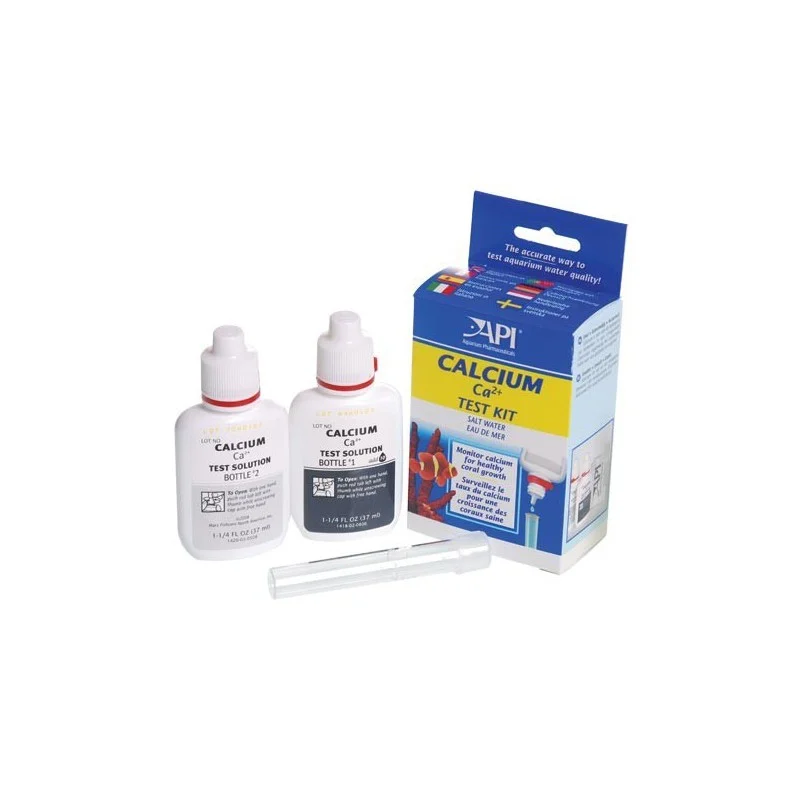
The kit contains two calcium test bottles, capped test tube and instructions. The two bottles are your test reagents. You add them to a sample of your tank water in a specific order, and they react with the calcium. The depth of the color tells you how much calcium is present.
3. Choosing when to test
Calcium should be checked weekly at minimum, and every time you add or remove any organisms from your tank. Photosynthesis and other biological processes in the tank can change your water chemistry and, therefore, your test results throughout the day. The best approach is to pick a time of day, say 7:00 pm, then always perform your regular water testing at 7:00 pm moving forward. Once your tank is stable, you can stick to weekly testing on the same day.
4. How to run the test
Gather before you start
- Sample of tank water
- API Calcium Test Kit
- Test tube (comes with kit)
- Clean, dry workspace
- [Paper towel or lint-free cloth for cleanup]
1. Fill the test tube with tank water to the fill line marked on the tube.
2. Add Reagent Bottle 1 (following the kit instructions for the number of drops).
3. Add Reagent Bottle 2 (again, the number specified in your kit's instructions).
4. Cap the test tube and shake gently for the time the instructions tell you to shake (usually 10–15 seconds).
5. Wait for the color to fully develop—usually 1–2 minutes.
6. Compare the color against the color chart that came with your kit. Hold the test tube up to natural light if possible, as artificial lighting can make colors hard to read.
7. Record the result in your log (see below).
5. Reading your result
We recommend keeping the calcium level in your saltwater aquarium between 380 and 450 ppm. Reef aquariums should have a calcium concentration between 400 to 500 mg/L (ppm). Aim for the middle of that range—around 420 ppm—for steady, healthy growth in most reef tanks.
The API kit color chart shows you the reading in ppm (parts per million, also written as mg/L). Match your tube's color to the closest color block on the card. If your result falls between two blocks, record it as the value between them.
6. What to do if calcium is out of range
Too low (below 380 ppm): Your corals and other reef life are eating calcium faster than it's being replaced. You can restore it by doing a partial water change with quality salt mix, or by dosing a calcium additive. Test again in 3–4 days to see the effect.
Too high (above 500 ppm): This is less common but can happen if you dose too aggressively. Do a partial water change and hold off on further dosing. Test again the next week.
Stable but drifting: Having an adequate calcium level is not enough to achieve healthy coral growth, because the growth of corals is linked to carbonate hardness (often referred to as KH or alkalinity). Testing for both calcium and carbonate hardness is necessary for successful reef keeping. If calcium stays stable, you're good. If it keeps dropping, you'll need to dose or do more frequent water changes.
7. Keeping records
| Test date | Time | Calcium (ppm) | Tank changes or events | Dose added? |
|---|---|---|---|---|
What you notice and what to check next
| What you notice | What to check next |
|---|---|
| Calcium is dropping each week | Check alkalinity and magnesium next; they affect calcium availability |
| Calcium is stable at 420 ppm | Keep testing weekly; your dosing is working |
| Color is hard to read on the chart | Test in natural daylight or by a window; artificial light distorts color |
| Test result is higher than expected | Retest to confirm; high phosphate can interfere with some kits |
| You added a new coral and calcium dropped faster | More corals = more calcium use; consider more frequent testing or higher dosing |
Your care log
Started on: ___________
Target calcium: 400–450 ppm (aim for ~420 ppm)
First test result: ___________ ppm
Testing schedule: Every ___________ (day of week) at ___________ (time)
Reagent bottles expire: ___________
Notes:
Sources
Checked October 8, 2026.
- Bulk Reef Supply, "Calcium Test Kits – Bulk Reef Supply", https://www.bulkreefsupply.com/aquarium-monitors-controllers/testing/calcium-test-kits.html
- API Fish Care, "API Calcium Test Kit", https://www.apifishcare.com/products/api-calcium-test-kit
- Bulk Reef Supply, "Top Tips to Getting the Best Results From Your Red Sea Calcium Test Kit Pro", https://www.bulkreefsupply.com/content/post/top-10-tips-red-sea-calcium-pro-test-kit
- Hanna Instruments, "How to Test Calcium in Your Aquarium", https://blog.hannainst.com/test-calcium-ppm-in-saltwater-aquarium