

Acartia tonsa Copepods: Culture Setup, Temperature and Feeding
Learn how to set up and maintain a culture of Acartia tonsa copepods for your reef tank and breeding projects.
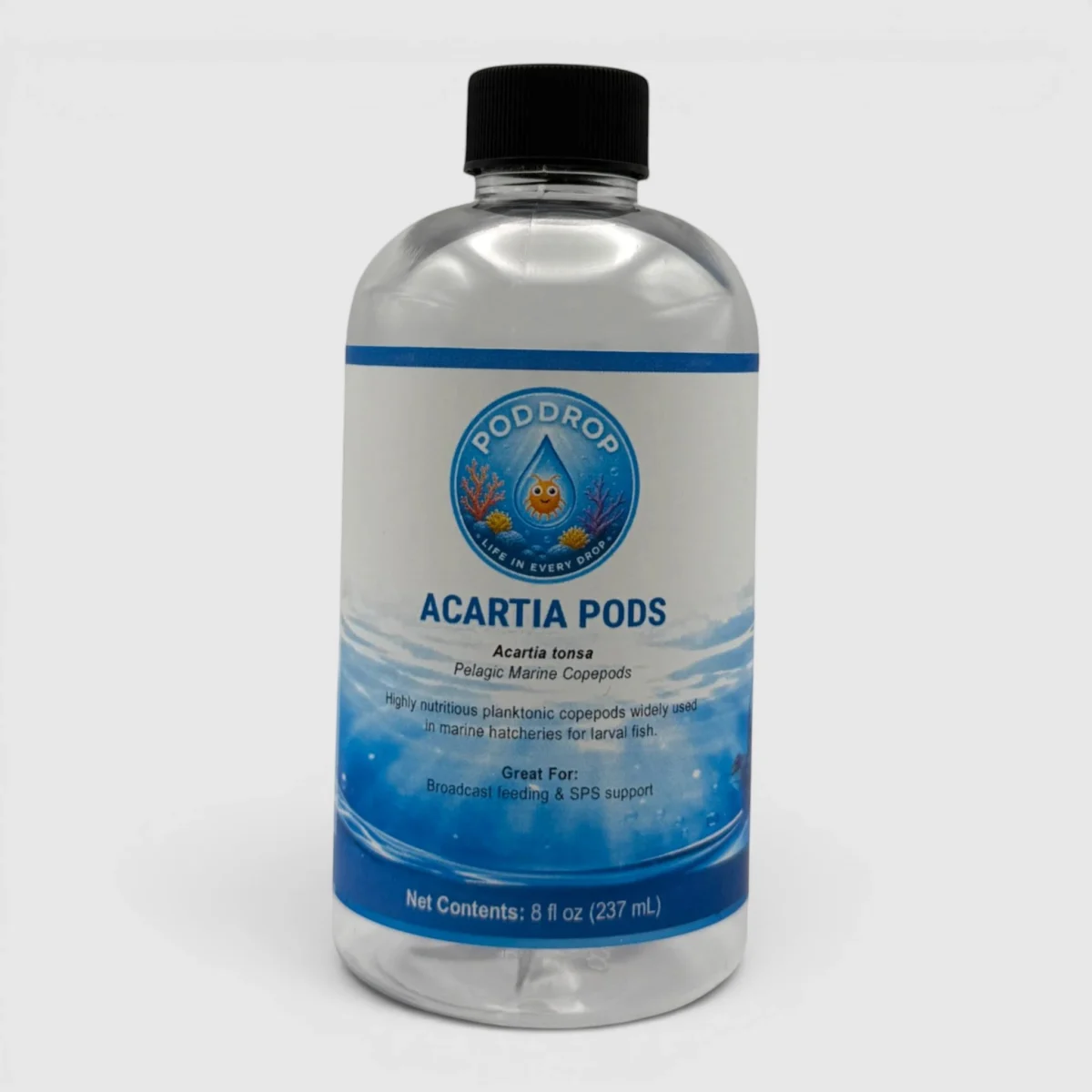
Learn how to set up and maintain a culture of Acartia tonsa copepods for your reef tank and breeding projects.
Acartia tonsa Copepod Culture: Setup, Temperature and Feeding
Acartia tonsa is the cold-water champion copepod for temperate marine systems and seasonal reef applications. Unlike tropical copepods that slow down in cool tanks, Acartia thrives when water temperatures drop—making it ideal if you have chiller systems or keep temperate species. This guide walks you through culturing and maintaining your own population.
Invertebrate care · Detailed tutorial · About 12 minutes · Intermediate
The key habit: Feed your culture daily with high-quality phytoplankton, keep temperature stable between 18–25°C (64–77°F), and collect eggs regularly to maintain a thriving population.
Shop the Acartia tonsa Copepods
In this guide
- What Acartia tonsa is and where to use it
- Setting up your culture tank
- Water parameters: temperature, salinity and pH
- Feeding and water management
- Breeding and egg collection
- Acclimating copepods to your reef tank
- Harvesting and storage
1. What Acartia tonsa is and where to use it
Acartia tonsa are free-swimming, planktonic crustaceans that tolerate a wide range of temperatures and salinities, most commonly found in temperatures of 17–25°C. Acartia exhibits a strictly pelagic (free-swimming) lifestyle, remaining continuously suspended in the water column through constant swimming, which means they move about actively rather than settling on surfaces like harpacticoid copepods (Tigriopus, Tisbe) do.
This swimming motion appeals to fish. Their graceful, hovering swimming motion differs dramatically from the jerky movements of cyclopoids, making them highly attractive to fish. Acartia panamensis are perfect for direct feeding, culturing, or stocking new tanks and refugiums, and are a great food source for finicky fish and invertebrates such as mandarins, pipefish, anthias wrasses, SPS, LPS and soft corals, and other filter feeders.
2. Setting up your culture tank
Gather before you start
- Clean culture tank(s) – 5–10 gallons per small home culture
- Air stone and air pump (with adjustable flow)
- Fine mesh sieve (50–80 micrometers) for egg collection
- Heating system or temperature controller
- Phytoplankton culture or commercial live phyto
- Filtered or UV-treated seawater
- Aquarium salt for water changes
A dedicated culture tank is recommended, ideally between 5 to 10 gallons, with proper aeration to keep water oxygenated without creating excessive turbulence; a sponge filter can be beneficial, helping maintain water quality while preventing copepods from being sucked into the filter.
1. Prepare your tank.
Choose a food-grade plastic container or aquarium. A 10-gallon aquarium or cylindrical container works well for a small home setup. Using live rocks or sand can provide surfaces for the copepods to graze upon and promote a healthy microalgae population, though this is optional.
2. Add aeration.
Aeration should be relatively coarse bubbling and not very intensive (approximately 3–5 bubbles per second). It is important that copepod eggs remain evenly mixed and cannot sediment anywhere, otherwise the hatching rate will be reduced.
3. Set up lighting.
All cultures should be kept on a 12:12 light:dark regime. Indirect fluorescent lighting or ambient room light suffices; Acartia does not require intense illumination.
3. Water parameters: temperature, salinity and pH
Temperature is critical.
The optimum breeding temperature for Acartia tonsa is between 20 and 25°C (68–77°F), and the temperature of 25°C should not be exceeded. A water temperature of at least 10°C is required for successful reproduction. Keep a reliable thermometer on your culture tank and use a heater if your room is cool.
Salinity.
The species does best at salinities between 15 and 22 psu, but in laboratory experiments has survived everything from 0 to 77 psu. For a home culture, aim for 15–22 ppt (approximately 1.011–1.017 specific gravity). Acartia tonsa cultures are reared in salt water with salinity typically between 31 ppt–35 ppt in some sources, but the lower range works well and may reduce osmotic stress in some populations.
pH and water quality.
The optimum pH value should be between 8.0 and 8.3; freshly prepared seawater normally has a pH value of 8.2 at 30 g/l. Use filtered or UV-treated seawater; chlorine will kill your culture.
4. Feeding and water management
No live algae are required to culture Acartia panamensis; Reef Nutrition's RGcomplete™ or one of the other RotiGrow products are perfect for this animal—however, live phytoplankton also works well. Acartia grows well on various foods: Spirulina, Chlorella, Tetrasalmus, and Nannochloropsis.
Daily feeding.
Optimal conditions for Acartia tonsa eggs and hatching success occur at a salinity between 14 and 20 g/L, a low stocking density of 50 individuals per liter, and feed > 50,000 cells/mL of Rhodomonas sp. Feed your culture daily. Overfeeding will result in algae and bacteria sticking to the bodies of the copepods, which creates a lot of drag on the animal resulting in stress and mortality. Start with small amounts of phytoplankton and adjust based on water color; the copepods will be visibly dark if they are well fed and all water quality parameters are stable.
Water changes.
Batch cultures: 30–50% water changes 2–3 times weekly, siphoning the bottom to collect eggs and replacing with filtered seawater matching temperature and salinity. During water changes, use gentle siphoning to avoid harming copepods.
5. Breeding and egg collection
How Acartia reproduces.
Females produce eggs for 3–4 weeks at a time and can release a brood of 20–53 eggs every 5–6 days. Females broadcast spawn 10–40 eggs per clutch into the water column; eggs sink slowly while developing.
Collecting eggs.
Daily or twice-daily siphon bottom water through 50–80μm mesh; eggs are retained while adults wash through, then transfer eggs to separate hatching tanks with fresh water and phytoplankton. Eggs are small enough to pass through fine mesh but large enough to collect on a 50 μm sieve.
Hatching eggs.
Incubate copepod eggs in freshly prepared seawater; the water should be sterilised beforehand and contain 30 to 35 g/l salt. Use 20,000 copepod eggs per litre of seawater. Eggs develop and hatch into nauplii within approximately 48 hours (at 25°C). Maintain the same temperature and light conditions as your culture tank.
6. Acclimating copepods to your reef tank
Gather before you start
- Culture container with copepods
- Destination aquarium (display or refugium)
- Small net or fine siphon
- Floating container or specimen cup
1. Float the container.
Float the bottle in your tank for approximately 15 minutes to match temperature; if salinity differs greatly, slowly mix a bit of tank water into the bottle over 10–15 minutes.
2. Acclimate slowly.
Gradually acclimate harvested copepods to destination aquarium over 10–20 minutes by floating collection container and slowly adding aquarium water.
3. Add to the tank.
Turn off pumps, powerheads, UV sterilizers, and protein skimmers 10–20 minutes before dosing; for best results, add copepods at night or when refugium/display lighting is off. Seed near rockwork or refugium zones for optimal shelter and reproduction.
7. Harvesting and storage
Direct feeding.
Harvest copepods from your culture using a fine net or by siphoning. Copepods can be added directly into the aquarium, or they can be added to a refugium where a population can establish and reproduce to supply the reef with a continuous supply of nutritious copepods; for feeding fish larvae, add copepods to the rearing tank several times daily.
Storing eggs.
The best results for storage were obtained when the temperature was below 5°C, salinity was between 10–20 g/L, and there was no oxygen added to capped vials. Store collected eggs in the refrigerator in sealed, labeled containers. Hatched nauplii should be fed as quickly as possible or kept in a cool place at 10°C; after 24 hours at 25°C, the nauplii have already lost most of their nutritional value.
What you notice and what to check
| What you notice | What to check next |
|---|---|
| Culture smells foul or water is cloudy | Overfed with phytoplankton; reduce feeding and do a 50% water change |
| Copepods appear stressed or dying | Check temperature (should be 18–25°C) and salinity (15–22 ppt); verify aeration is steady |
| Few or no eggs collected | Low population density; reduce water change size, feed more phyto, or check for predators |
| Copepods look pale or translucent | Underfed; copepods should appear dark when well fed; increase phytoplankton dose |
| Population declining | Water quality declining; check for excess waste buildup; perform larger water change and feed less heavily |
| Eggs not hatching | Eggs may need time to mature; keep hatching tanks at 20–25°C and ensure fresh phytoplankton is present |
Your care log
Started on: ______ Initial stocking density (copepods/mL): ______ Tank volume: ______
Temperature set to: ______ °C Salinity: ______ ppt pH: ______
First eggs collected on: ______ Feeding schedule: Daily at ______
Water change schedule: ______ times per week, ______ % volume
Notes: __________________________________________________________________
Sources
Checked November 8, 2026.
[1] Practical Fishkeeping, "Review: Acartia tonsa Live Enriched Copepods from Reefshotz"](https://www.practicalfishkeeping.co.uk/gear/review-acartia-tonsa-live-enriched-copepods-from-reefshotz/)
[2] Plankton Marin, "The Apocyclops Panamensis: Essential Copepods for Your Reef Tank"](https://planktonmarin.com/blog-post41)
[3] GetPodDrop, "Acartia tonsa: Copepod Species & Culture Guide"](https://www.getpoddrop.com/pages/acartia-tonsa)
[4] CORAL Magazine, "New Apocyclops Copepods from Reef Nutrition"](https://www.coralmagazine.com/2018/06/21/new-apocyclops-copepods-from-reef-nutrition/)
[5] Reef Nutrition, "APEX-PODS™"](https://reefnutrition.com/products/apexpods-apocyclops-panamensis)
[6] Aquatic Live Food, "Cyclopoid Copepods (Apocyclops panamensis)"](https://www.aquaticlivefood.com.au/cyclopoid-copepods-apocyclops-panamensis/)
[7] Reed Mariculture, "Parvocalanus crassirostris adult, 2K"](https://reedmariculture.com/products/parvocalanus-copepods)
[8] Animal Diversity Web, "Acartia tonsa"](https://animaldiversity.org/accounts/Acartia_tonsa/)
[9] Algova, "How do you breed copepod eggs of Acartia tonsa?"](https://algova.com/en/blogs/ratgeber/wie-erbrutet-man-copepoden-eier-von-acartia-tonsa)
[10] NOAA, "A Guide to the Meso-Scale Production of the Copepod Acartia tonsa"](https://repository.library.noaa.gov/view/noaa/35372/noaa_35372_DS1.pdf)
[11] ScienceDirect, "Spawning of calanoid copepod Acartia tonsa at low temperature and high salinity improves hatch success for cold-stored egg production"](https://www.sciencedirect.com/science/article/abs/pii/S0044848620307055)
[12] GetPodDrop, "Parvocalanus Crassirostris Live Copepods For Sale"](https://www.getpoddrop.com/pages/parvocalanus-crassirostris)
[13] Sustainable Aquatics, "SA Live Marine Copepods – Parvocalanus crassirostris"](https://sustainableaquatics.com/feeds/sa-live-feeds/sa-live-marine-copepods-parvocalanus-crassirostris/)