

Yellow Boxfish Care: Tank Size, Tank Mates and Toxin Safety
Yellow Boxfish Care: Tank Size, Tank Mates and Toxin Safety
Yellow Boxfish care requires an expert approach, as this species is peaceful but not reef safe. This is an advanced fish for aquarists who can meet its specialized needs. Your patience and attention to water stability will make the difference between a thriving boxfish and a stressed one.
Fish care · Detailed tutorial · About 10 minutes · Expert level
The key habit: Stability is more important than any single water parameter; fluctuations stress boxfish and a stressed boxfish is dangerous.
In this guide
- What the Yellow Boxfish is and where it comes from
- Tank size and setup
- Handling stress and toxin risk
- Water flow and environment
- Tank mates and temperament
- Feeding your Yellow Boxfish
- Water parameters and testing
- Acclimation and quarantine
1. What the Yellow Boxfish is and where it comes from
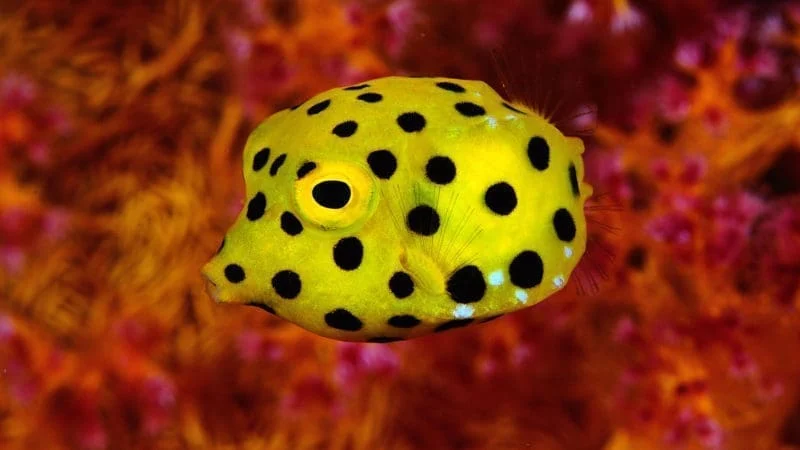
The Yellow Boxfish is one of the most recognisable marine fish in the hobby, especially as a juvenile, when it shows a bright yellow body covered in bold black spots. In the wild it inhabits lagoons, coral reefs and semi-sheltered seaward reef areas across the Indo-Pacific, and adults are usually solitary. It grows to a maximum size of up to 45 cm in length.
As it matures, the colouration darkens and becomes more muted, with older fish taking on a mustard, brownish or bluish appearance. Its scientific name is Ostracion cubicum.
2. Tank size and setup
Yellow Boxfish require a minimum of 180 gallons for adult specimens, with 240+ gallons recommended for better stability and toxin dilution. This is not negotiable. You should start with a tank that caters to that even if your Yellow Boxfish is still a junior.
Provide open sandy areas, secure rock structures, caves, and overhangs where the boxfish can explore and retreat when feeling threatened. Boxfish need generous live rock for feeding and crevices to take refuge. Yellow Boxfish are capable of jumping from open-topped tanks, so tight-fitting coverslides are a must.
3. Handling stress and toxin risk
Ostracion cubicus possesses specialized mucus glands that can release ostracitoxin, a powerful neurotoxin that serves as their primary defense mechanism. Under severe stress it releases ostracitoxin (pahutoxin) from its mucus, which can kill fish in a closed tank within a short time, so avoid shipping stress, netting and aggressive tankmates and keep it alone.
Care must be taken when carrying out maintenance on the aquarium, so as to keep the fish as calm as possible. Ideally, the tank will be situated where there is as little traffic going past as possible. We highly suggest having carbon filtration on the aquarium as well to extract toxin from the water volume.
4. Water flow and environment
Yellow Cubicus Boxfish are relatively weak swimmers and may struggle against powerful directional currents. The Yellow Boxfish prefers moderate water flow and should be kept in tanks with good filtration. The Yellow Boxfish prefers moderate water flow and should be kept in tanks with good filtration. A canister filter or a sump with protein skimmers will work well, as these ensure stable water conditions. While the fish enjoys a calm swimming environment, too much water movement can cause stress, so avoid strong currents.
5. Tank mates and temperament
Keeping a single Yellow Cubicus Boxfish per aquarium is generally recommended. The Yellow Boxfish will generally ignore their tankmates. They should never be kept with other boxfish as they will almost always bomb the tank with their toxins.
Hard shelled inverts are good choices to keep with the Yellow Boxfish as they will often interact as the boxfish scours the sandbed where the inverts are. Generally the Yellow Boxfish will not try to catch any of these quick inverts and will not bother anything with a hard shell. The species is generally peaceful but easily stressed, and not a good choice for aggressive or boisterous tankmates.
6. Feeding your Yellow Boxfish
All foods should be offered towards the bottom of the tank to avoid the boxfish drawing in air when trying to take food from the surface. Boxfish have very small mouths and stomachs and it is of extreme importance that they are fed small amounts throughout the day to prevent starvation.
Cubicus should be offered a variety of high quality frozen meaty foods, enriched shrimps, and foods containing algae such as Spirulina, Chlorella, and pieces of marine sheet algae for variety. It eats slowly; offer bite-sized food in several small feedings. Feed minimum 3 times a day.
When malnourished the Yellow Boxfish is very quick to lose its colors making it easy to know how well they are doing in the tank.
7. Water parameters and testing
Temperature: 72°F to 78°F (22°C to 26°C); pH: 8.1 to 8.4; Salinity: 1.020 to 1.025 Specific Gravity; Ammonia/Nitrite: 0 ppm (These fish are highly sensitive to poor water quality); Nitrate: Below 20 ppm.
Because the Yellow Boxfish is prone to stress, regular water changes (at least 20% weekly) and efficient filtration are critical. Boxfish are more sensitive to ammonia and nitrite than many hardy marine species, and they do not handle large swings in salinity or temperature well.
| What you notice | What to check next |
|---|---|
| Fish hiding more than usual | Temperature, ammonia, nitrite, pH; any disturbances or traffic |
| Colors fading noticeably | Feeding frequency and food variety; water parameters |
| Fish rubbing on rocks or gulping at surface | Ammonia, nitrite levels; check for parasites or disease |
| Fish appears lethargic or won't eat | Temperature stability; check all parameters; isolate if possible |
| Sudden loss of fish or other tank inhabitants | Look for signs of toxin release; check pH, dissolved oxygen |
| Tank water cloudy or odorous | Water parameters; do a large partial water change |
8. Acclimation and quarantine
Gather before you start
- Clean acclimation container with a lid (the lid prevents jumping)
- Air pump, airline tubing, and knot or clip to slow flow
- Ammonia detoxifier (such as Prime or AmGuard)
- Separate quarantine tank (10–20 gallons minimum, with established biological filter)
- Small cup or bowl (for netting is stressful; use a cup instead)
1. Float the bag: Float the bags in the display tank to equalize the temperature between your tank and the bags. Once these temperatures are equalized, (a process that shouldn't take more than 10 – 15 minutes), gently transfer the fish or invertebrate into the small container with all of the water it traveled with.
2. Begin drip acclimation: The drip acclimation method is recommended for most saltwater fish and invertebrates because they can be more sensitive to pH, specific gravity and other water chemistry changes. Run airline tubing from the aquarium to the container, tying a loose knot (or using a plastic drip-valve) to slow the flow to a gentle drip. Let tank water drip into the container until the volume has roughly doubled, adding it gradually rather than all at once so pH, hardness, and salinity equalize slowly instead of all at once.
3. Continue drip acclimation: Remove half of the water and repeat the drip process for 30 more minutes.
4. Transfer to the tank: Net the fish out of the container and into the tank; discard the diluted bag/drip water rather than pouring it into your aquarium.
5. Quarantine period: A commonly cited minimum is around 30 days, and some guidance suggests anywhere from about one to eight weeks depending on the species, its health history, and the diseases of concern. When fish are initially added to the acclimation box, feeding should be minimal if at all for the first day to allow for the fish to first get acclimated to their new surroundings and water chemistry.
Your care log
Tank size: ______ gallons Set up on: ______
Filtration: ______ (Carbon: yes/no) Protein skimmer: yes / no
First feeding started: ______ Foods accepted: ______
Water parameters checked: ______ (Temp: ____, pH: ____, Salinity: ____)
Observations on behavior: ______
Sources
Checked November 3, 2026.
- Top Shelf Aquatics, "Yellow Boxfish – Ostracion cubicum"
- Saltwater Fish, "Yellow Boxfish Care: Tank Size, Toxin Risk & Feeding"
- Fishkeeper UK, "Yellow Boxfish-Ostracion cubicus"
- The Mandarin Garden, "Yellow Boxfish Care Guide"
- Recif Art, "What size tank does a yellow boxfish need for your aquarium?"
- BR Choku, "Yellow Boxfish — Lifespan, Size & Price"
- Aquarium Insiders, "Yellow Boxfish Species Profile: Habitat, Diet, and Care Requirements"
- Connect Fish Friends, "Yellow Boxfish Compatible Tank Mates"
- TFH Magazine, "Ostracion cubicus Species"
- Aquatics Unlimited, "BOXFISH – CUBICUS Ostracion cubicus"
- Recifa Home, "Ostracion cubicus"
- Wikipedia, "Yellow boxfish"
- Quality Marine, "Yellow Boxfish"
- Aqua Group, "Yellow Boxfish – Ostracion cubicus"
- Finest Aquatics, "Boxfish – Yellow"
- Reeflings, "Yellow boxfish (Ostracion cubicus)"
- Dr Reef's Quarantined Fish, "Boxfish"
- Quality Marine, "How to 'Drip Acclimation'"
- Worldwide Corals, "New Fish Acclimation Guidelines"
- Tropical Treasures, "How to Acclimate New Fish"
- Fishlore, "Acclimating Fish to Your Aquarium"
- Aqua Iri, "How to Acclimate New Fish: Drip Method Guide"