

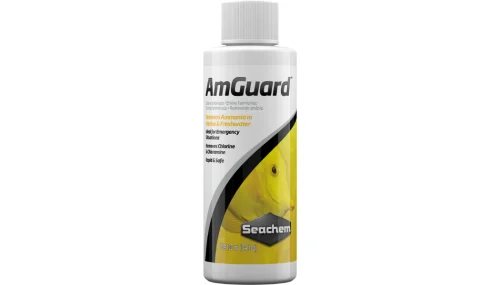
Seachem AmGuard 100ml: Emergency Ammonia Control for Aquariums
You'll be able to detoxify toxic ammonia in your tank within minutes using the correct dose for your tank size.
Water quality · Detailed tutorial · About 5 minutes · Beginner friendly
The key habit: AmGuard reacts with free ammonia within minutes, so dose it as soon as you detect a problem. Don't wait—ammonia stress on fish builds quickly.
Shop the Seachem AmGuard 100ml
In this guide
- When to use AmGuard
- How ammonia appears in your tank
- Choosing the right dose
- How to dose your tank
- What to do after dosing
- Monitoring and testing
- Safety and overdose concerns
1. When to use AmGuard
AmGuard is safe to use during tank cycling and is ideal for treating emergency situations. You'll need it when:
- You set up a new tank and fish are already in the water (before the biological filter colony grows)
- You notice ammonia in a test kit during the cycling phase
- Your tank has been neglected and ammonia has built up
- A filter fails or stops running
- You've overstocked or overfed and ammonia spikes
AmGuard converts ammonia into a safe, non-toxic form that is readily removed by the tank's biofilter. This gives your beneficial bacteria time to catch up and process ammonia on their own.
2. How ammonia appears in your tank
Ammonia can exist in two forms: free and ionized. It is only the free form that is toxic. You won't see ammonia in the water—it's invisible. The signs are behavioral: fish gasp at the surface, hide, stop eating, or their gills turn red. A test kit confirms it.
Important: Traditional ammonia test kits convert all ammonia to free ammonia by raising pH to 12–14; at this pH AmGuard cannot function and thus a false positive reading will result. Use Ammonia Alert™ or MultiTest™: Free & Total Ammonia kits to accurately monitor free ammonia levels.
3. Choosing the right dose
Use 1 capful (5 mL) for every 200 L (50 gallons) daily or as needed to reduce ammonia. The 100 mL bottle includes a measuring cap—each cap thread is approximately 1 mL, so you can measure smaller doses for nano tanks.
If your tank size is not a multiple of 50 gallons, calculate proportionally. For example, a 25-gallon tank gets half a capful (2.5 mL).
4. How to dose your tank
Gather before you start
- Your AmGuard 100 mL bottle
- Measuring cap that came with the product (or a 5 mL syringe if measuring smaller doses)
- Your tank size in gallons or liters
- An ammonia test kit (Ammonia Alert or MultiTest Free & Total recommended)
1. Measure the dose using the cap. Check your tank size and calculate how many milliliters you need.
2. Pour the dose into the tank at a location with good water circulation—near an outlet from a powerhead or filter return, not in a dead spot.
3. Wait 15 minutes for the product to mix through the tank.
4. Turn off any protein skimmers (in saltwater tanks) for the first 2–3 hours if possible, as some water conditioners can reduce oxygen levels temporarily.
5. What to do after dosing
AmGuard does not remove ammonia from the system. It simply binds ammonia making it harmless to the inhabitants and still bioavailable to the beneficial bacteria. This means:
- The ammonia is still there on a test kit, but it's harmless
- Your biofilter can still process and consume it
- You've bought time for the bacteria to do their job
Continue with water changes and maintenance. Repeat the dose daily or as needed. If ammonia is still high after 7 days, do a partial water change (25%), service your filter, and reduce feeding.
6. Monitoring and testing
Use the MultiTest Iron test kit to monitor iron concentrations in the aquarium. Due to rapid utilization, it is important to test the water within 30 minutes. (Note: This applies to the iron product, but the same timing principle holds for ammonia tests after dosing—don't test immediately after adding AmGuard.)
Test every 2–3 days while using AmGuard. Watch your fish behavior: if they stop gasping and return to normal activity, the product is working. Keep dosing until an ammonia test confirms the level is zero using the correct test method.
7. Safety and overdose concerns
AmGuard is very safe and quite difficult to overdose to the point of harming tank inhabitants, but a large enough dose can start to deplete the system of oxygen. Stick to the recommended dose and don't double-dose without guidance from a reef retailer.
AmGuard will have no impact on the pH, KH, or GH of the typical aquarium.
What you notice and what to check
| What you notice | What to check next |
|---|---|
| Fish gasping at the surface | Ammonia level with a free ammonia test kit; perform water change first, then dose |
| Water remains cloudy after dosing | Water circulation; you may not have mixed the product well enough |
| Ammonia still high after 3 days | Whether you're testing with the right kit; switch to Ammonia Alert or MultiTest Free & Total |
| Fish behavior normalizes within 2 hours | Your dose was correct; continue testing every 2–3 days |
| Algae begins growing rapidly after dosing | May indicate an excess of nutrients; do a water change and reduce feeding |
Your care log
Tank size: ______ gallons
Date ammonia was detected: ______
Ammonia test kit used: ______
Dose (mL): ______
Date started using AmGuard: ______
Dosing frequency: ______ (daily, every other day, etc.)
Date ammonia returned to zero: ______
Notes: ____________________________________________________________
Sources
Checked October 29, 2026.
- Seachem, "AmGuard," https://www.seachem.com/amguard.php
- Charterhouse Aquatics, "Seachem AmGuard – Aquarium Ammonia Remover," https://charterhouse-aquatics.com/products/seachem-amguard
- Amazon, "Seachem AmGuard 250ml," https://www.amazon.com/Seachem-116077606-AmGuard-250ml/dp/B0002JEKDC
- Amazon, "Seachem AmGuard 500ml," https://www.amazon.com/Seachem-001343-AmGuard-500ml/dp/B0006JLXGU