

Seachem NutriDiet Marine Flakes: Feeding Marine Fish Daily
You will learn how to choose the right daily portion size, feed your marine fish on a schedule that keeps them healthy, and store your flakes to preserve their nutrients.
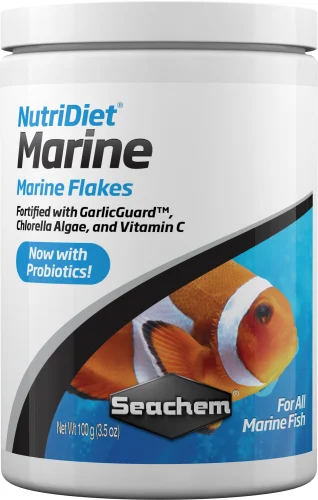
Feeding · Detailed tutorial · About 8 minutes · Beginner friendly
The key habit: Feed your marine fish the same small amount once or twice daily, at the same times each day, watching to make sure they eat it all within three minutes—overfeeding is the most common feeding mistake and degrades water quality.
Shop the Seachem NutriDiet Marine Flakes 100g
In this guide
- Why marine fish need a complete daily food
- Choosing the right portion size
- Setting up a feeding schedule
- How to feed your marine flakes
- Troubleshooting common feeding problems
- Storage and maintaining food quality
- Knowing when to feed other foods alongside flakes
1. Why marine fish need a complete daily food
NutriDiet Marine Flakes is a premium and nutritionally balanced diet formulated to meet the requirements of all marine fish. It contains only the highest quality ingredients including fish, shrimp, and squid without low nutritional value fillers. In a reef or marine aquarium, your fish depend entirely on you for their nutrition. Unlike in the ocean, they cannot hunt live prey or pick algae and plants throughout the day. A complete, high-quality flake food ensures your fish get the protein, fats, vitamins, and minerals they need.
Chlorella Algae serves as an exceptional source of a broad range of vitamins and amino acids, and the probiotics help the digestive system by promoting nutrient uptake, reducing waste, and supporting the immune system. This matters because it means the nutrition your fish eat actually gets absorbed, and less waste ends up in your tank water.
2. Choosing the right portion size
The hardest part of feeding is knowing how much to give. Feed 1–3 times daily, feeding as much as the fish will consume in three minutes.
For most marine fish, start with a pinch—roughly the size of your fish's eye—per fish per feeding. For a 50-gallon tank with 6 to 8 fish of mixed sizes, that is typically a small pinch (about 1/8 teaspoon). Watch your fish while they eat. If all the food is gone in 2–3 minutes and they act hungry but well-fed, that is the right amount. If food sinks to the sand bed after 3 minutes and sits there, you are feeding too much.
The wrong portion size is a major cause of water quality problems. Uneaten food decays, consuming oxygen and raising ammonia and nitrate. Overfeeding also makes fish skip meals and become picky eaters. A common rule: it is better to underfeed slightly and supplement with frozen foods a few times per week than to overfeed daily.
3. Setting up a feeding schedule
Consistency matters. Pick one or two times each day to feed—for example, once in the morning and once in the late afternoon. Feed at the same times each day so your fish learn when to expect food and you do not forget.
You can feed 1–3 times daily, feeding as much as the fish will consume in three minutes. Most marine aquarists find once or twice daily works well:
- Once daily: Works for many established adult fish; simpler schedule; less risk of overfeeding.
- Twice daily: Supports young fish, newly added fish, and fish with higher metabolisms; requires careful portion control.
Start with once daily and watch your fish for 2–3 weeks. If they beg at feeding time or seem hungry, add a second small meal. If they leave food uneaten or the tank water turns yellow or cloudy, move to one larger meal daily or skip a day.
4. How to feed your marine flakes
Gather before you start
- Flake food in the jar
- A small spoon or measuring spoon (the jar cap or 1/8 teaspoon size)
- Aquarium light on (so you can see your fish eat)
- A watch or clock
1. Sprinkle a small pinch of flakes over one spot in the tank, or directly above a feeding area where fish gather. Do not dump the whole jar or spread flakes everywhere.
2. Watch for 3 minutes. Observe your fish eating. They should eagerly take flakes from the water column and off surfaces. Healthy fish recognize the flakes quickly and feed actively.
3. Stop when food disappears. Once all the flakes are eaten or 3 minutes have passed (whichever comes first), stop feeding. Do not add more.
4. Remove uneaten food. If food is still visible after 3 minutes, use a net or siphon to remove it. Decaying food harms water quality.
5. Do this once or twice daily at the same times each day.
The flakes are enhanced with Entice to attract finicky eaters and enhance palatability, and contain GarlicGuard as an appetite stimulant. This means even picky fish usually eat the flakes readily. If a fish does not, it may be stressed, sick, or newly added—watch it for other signs of health or distress.
5. Troubleshooting common feeding problems
| What you notice | What to check next |
|---|---|
| Fish ignore the flakes | Are the fish newly added? (They may need 2–3 days to adjust. Try feeding at different times or feed less so uneaten food does not decompose.) Is the fish sick? (Watch for torn fins, spots, or hiding.) |
| Flakes float too long | This is normal. Marine flakes have a mix of floating and slowly sinking particles. If you have bottom feeders, let the flakes drop; if not, flakes left after 3 minutes should be removed. |
| Water turns cloudy or yellow after feeding | You are overfeeding. Cut the portion in half and feed once daily instead of twice. |
| Fish seem constantly hungry | This is usually a sign of overfeeding (fish learn to beg). Feed the same small amount and watch what they actually eat, not their behavior. |
| Some fish eat all the food before others can feed | Try two feeding spots on opposite sides of the tank, or feed small amounts very slowly so all fish get a chance. |
| Fish have poor color or look thin | Check your feeding frequency and amount. Add frozen foods 2–3 times per week to supplement the flakes. Also test water parameters—poor conditions slow growth. |
6. Storage and maintaining food quality
NutriDiet Marine Flakes contain Chlorella Algae, which is extremely high in enzymes, vitamins and minerals and contains all of the nutrients necessary for animal life. These nutrients degrade over time, especially if the food is exposed to air, heat, or light.
Where to store: Keep the jar in a cool, dark, dry place—a cabinet or drawer, not on a shelf next to the aquarium light or heater. Room temperature (60–75°F) is ideal.
How to store: Close the jar lid tightly after each use. Do not scoop directly from the jar into the tank with a wet spoon (moisture can enter the jar). Dry your hand or spoon first.
How long does it last: Use the flakes within 6–12 months of opening. After this, the vitamin content drops and the food loses nutritional value. Mark the date you opened the jar on the label with a marker.
Signs the food has gone bad: If the flakes look discolored, smell off, or show mold, discard them. Rancid fat (a fishy or stale smell) means the oils have oxidized and the food may harm your fish's health.
7. Knowing when to feed other foods alongside flakes
Flakes alone provide complete daily nutrition for marine fish. However, many aquarists feed a species-appropriate pellet as the base diet once or twice daily, and supplement with frozen foods 2–3 times per week for optimal color and health.
You may want to add other foods if:
- Your fish show poor color despite good feeding and water quality.
- You have herbivores (tangs, surgeonfish) that need seaweed.
- You have large carnivores that need meaty foods like frozen krill or mysis shrimp.
- You want to provide natural variation in diet, as wild fish eat many different foods.
If you add a second food, reduce the amount of flakes so total daily nutrition does not increase. For example: feed flakes once daily + frozen food once daily, rather than flakes twice daily + frozen food twice daily.
What you notice and what to check
| What you notice | What to check next |
|---|---|
| Fish are active, colorful, and eat eagerly | You are doing it right. Maintain the same schedule and portion. |
| Water quality is stable (clear, slight yellow tint okay) | Feeding amount and frequency are correct. No changes needed. |
| Fish fins are frayed or color is pale | Check ammonia and nitrite (should be zero). Increase feeding frequency or add frozen foods. It may also signal disease or poor water quality. |
| Tank water clouds within hours of feeding | Overfeeding. Cut portion size in half and feed once daily until water clears. |
| Food sits on the substrate for hours | Reduce portion size or feed less frequently. Remove visible uneaten food after 3 minutes. |
Your care log
Tank size: ______ gallons
Started feeding on: ______
Feeding time(s): ______ and ______
Portion per feeding (approximate): ______ pinch / 1/8 tsp / 1/4 tsp
Number of fish being fed: ______
Date opened jar: ______
Notes on fish appetite and water quality: ______
Sources
Checked October 28, 2026. Reference addresses are plain text.
- Seachem, "Seachem NutriDiet Marine Flakes Product Information", www.seachem.com
- Saltwater Aquarium, "NutriDiet Marine Plus Flakes w/Probiotics", www.saltwateraquarium.com
- ASAP Aquarium, "Seachem NutriDiet Marine Flakes 30 grams", www.asap-aquarium.com
- Seachem UK, "NutriDiet Marine Flakes", seachem.co.uk
- Tank Zen, "Cichlid Feeding Guide: What to Feed, How Much, and How Often", tankzen.co