

Bumble Bee Snail Care: Feeding, Acclimation and Tank Setup
You'll be able to acclimate your Bumble Bee Snail safely to your reef tank and keep it healthy through proper feeding and water conditions.
Invertebrate care · Detailed tutorial · About 8 minutes · Beginner friendly
The key habit: Stable water parameters are key to your Bumble Bee Snail's health, and any fluctuations will cause problems. Test your calcium and other water chemistry regularly once you add one.
Shop the Bumble Bee Snail – Engina sp.
In this guide
- What is a Bumble Bee Snail and where it comes from
- Tank setup and size
- Feeding your snail
- Water parameters and calcium for shell growth
- Tank mates and temperament
- Acclimation and introduction to your tank
- Signs of a healthy snail
1. What is a Bumble Bee Snail and where it comes from
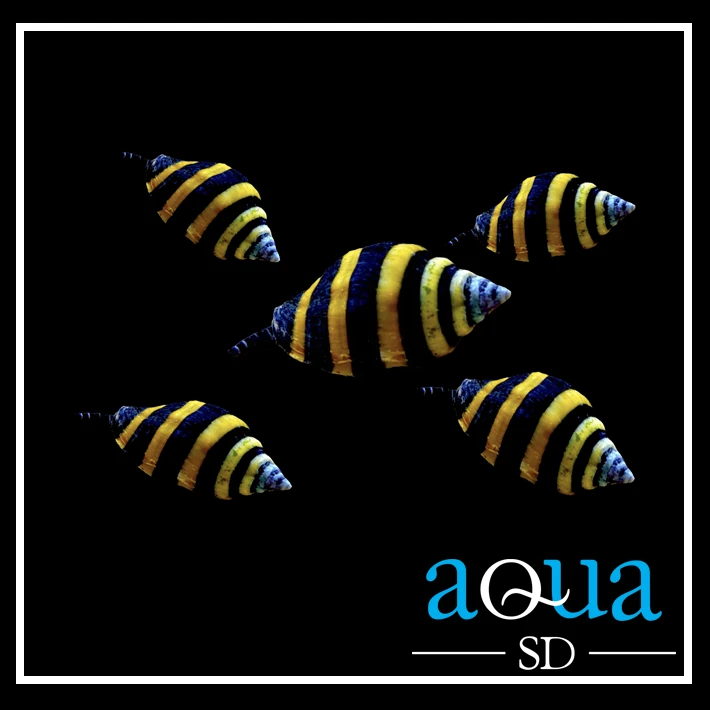
Bumble Bee snails are small saltwater snails known for their bold black-and-yellow striped shells, reminiscent of a bumblebee's coloration. They are found in the Indo-West Pacific Ocean, from the Red Sea to Japan, southeast to the Marshall Islands, and south to Australia. In their natural habitat they inhabit shallow rocky shoreline areas and feed upon detritus and other types of accumulating organic foodstuffs.
They are often added to reef aquarium clean-up crews for their scavenging abilities. They feed on detritus, uneaten food, decaying matter, and small invertebrates like vermetid snails, and are particularly effective at targeting vermetid snails and helping to control their population.
2. Tank setup and size
There is no strict minimum tank size for Bumble Bee snails—they can thrive in anything from a small 5-gallon nano tank up to large 100+ gallon systems. A common guideline is on the order of 1 Bumblebee snail per 5–10 gallons for general detritus control, though you can adjust based on how much leftover food your tank tends to have.
Bumble Bee Snails thrive in reef tanks with a mix of sandy substrate and live rock, with a 1-2 inch sand bed where they can forage and plenty of rocky crevices for daytime hiding. You'll need to monitor the calcium levels once your tank's set up, because that whelk shell is composed of calcium, and if you want your snail to grow, it will need calcium to build the shell.
3. Feeding your snail
Unlike algae-eating snails many aquarists are familiar with, Bumblebee snails require a diet rich in protein, and in established reef tanks, they often find sufficient food through scavenging, but supplemental feeding may be necessary, especially in cleaner systems or those with efficient filtration.
You may supplement the Bumble Bee Snails' diet with mysis shrimp or small bits of meaty food. It's important not to overfeed, as excess food can degrade water quality; start with small amounts and observe how quickly your snails consume the offerings, and if food remains after an hour, you're likely providing too much. In a well-established reef tank with fish and other inhabitants, there's usually enough natural food falling to the substrate to sustain a reasonable population of Bumble Bee snails without additional feeding.
4. Water parameters and calcium for shell growth
Your aquarium should be fully cycled before you introduce a Bumble Bee Snail, as snails have a low tolerance for nitrates, and any fluctuations in your water parameters will cause problems.
Maintain these water parameters [1,3,4]:
| Parameter | Range |
|---|---|
| Temperature | 72–78°F |
| Salinity (specific gravity) | 1.023–1.025 |
| pH | 8.1–8.4 |
| Alkalinity (KH) | 7–12 dKH |
| Calcium | 350–450 ppm |
| Magnesium | 1,260–1,350 ppm |
Calcium is vital for good shell growth. It's essential to ensure all of your invertebrates have enough resources, and when you add these gastropods, increase your testing to double-check that everyone's happy.
5. Tank mates and temperament
Although peaceful, Bumble Bee Snails can nip at other small snails or bristle worms (which might be a good thing) but never corals. They are best kept in tanks with plenty of live rock and away from predatory organisms. Bumblebee snails get along with virtually all reef-safe fish species.
You can house multiple snails together, but you don't want to create a pinch on resources; if a Bumble Bee snail can't find its preferred menu options, it will turn to sources you'd rather not see disappear from the aquarium, and ensuring enough room for everyone prevents that from happening.
6. Acclimation and introduction to your tank
Gather before you start
- Clean container or bucket
- Airline tubing (optional but recommended)
- Adjustable valve or knot for the tubing
- Timer or clock
- Clean net
Snails are pretty sensitive to changes in water parameters, so a drip acclimation is pretty important. Your snail will arrive in a transport bag. Here's how to acclimate it safely:
- Float the bag gently in your tank for 10–15 minutes so the water temperature inside the bag can match your tank temperature.
- Set up a drip line with airline tubing connected to your tank. You can do it with a piece of flexible air line tubing and tie a knot in it so you can control how much water is going through.
- Start the drip into the transport bag at a slow rate, so that tank water enters the bag gradually.
- Continue for 30 to 45 minutes. Drip acclimate over 30 to 45 minutes for best results; this approach has proven successful with inverts. Every time the water in the bag doubles, throw half of it out.
- Gently net the snail and place it in your tank. Carefully pick the snail out of the container one at a time; you don't want to pour in the mixed water from the container, as the transport water might contain some unwanted extras.
- Allow it to settle. Let the snail move into the tank by itself; do not force it in. Sometimes a snail will hide inside its shell for hours or sometimes even days. This is normal.
7. Signs of a healthy snail
A healthy Bumble Bee Snail will:
- Move slowly across rockwork and sand, actively foraging
- Extend its body partially from its shell during activity
- Show a tan or yellowish body color inside the shell
- Graze on biofilm and leftover food
- Grow slowly over months as calcium supports shell development
What you notice and what to check next
| What you notice | What to check next |
|---|---|
| Snail hides for several days without moving | This is normal during acclimation; continue normal feeding and wait |
| Snail's shell becomes thin or chalky in appearance | Test and increase calcium levels (350–450 ppm); ensure alkalinity is 7–12 dKH |
| Snail stops foraging or appears lethargic | Check all water parameters; look for predatory fish or oversized crabs that may harass it |
| Shell shows pitting or erosion | Verify calcium and magnesium are in range; low levels prevent shell repair |
| Multiple snails introduced but some disappear | One may have been eaten by another; ensure adequate tank space and food availability |
Your care log
Placed on: ______ Temperature: ______ °F
Salinity (SG): ______ pH: ______
Calcium level: ______ ppm Date last tested: ______
Feeding schedule: ______ Notes: ______
Sources
Checked October 24, 2026.
- Saltwater Aquarium Blog, "Bumblebee Snail Care Guide: Engina mendicaria", https://www.saltwateraquariumblog.com/bumblebee-snail-care-guide/
- ReefBay, "Bumble Bee Snail Care Guide", https://reefbay.com/invert/bumble-bee-snail
- Saltwater Fish, "Bumble Bee Snail – Snails – Invertebrates", https://www.saltwaterfish.com/product-bumble-bee-snail-54777
- Salt Corner, "Pusiostoma (Engina) mendicaria – Bumble Bee Snail", https://www.saltcorner.com/AquariumLibrary/browsespecies.php?CritterID=2795
- Pod Your Reef, "Bumblebee Snail Care: Best Reef Tank Scavengers & Saltwater Clean-Up Crew Snails", https://www.podyourreef.com/blogs/care/bumblebee-snail-care-best-reef-tank-scavengers-saltwater-clean-up-crew-snails
- Aqua Integrated, "Bumble Bee Snail (Engina sp.)", https://aquaintegrated.com/products/bumble-bee-snail-engina-sp
- Reef Jar, "Bumble Bee Snails: The Good, Bad, And How To Care For Them", https://www.reefjar.com/bumble-bee-snails/
- Aquamarine Power, "Bumblebee Snail Complete Care Guide: Engina Mendicaria Tips", https://www.aquamarinepower.com/bumblebee-snail-care/
- Aquarium Source, "Bumblebee Snail Care: Diet, Mates, Size and Tank", https://www.aquariumsource.com/bumblebee-snail/
- Aquarium Breeder, "Bumble Bee Snail – Detailed Guide: Care, Diet, and Breeding", https://aquariumbreeder.com/bumble-bee-snail-detailed-guide-care-diet-and-breeding/
- Vivid Aquariums, "Bumble Bee Snail", https://vividaquariums.com/products/bumble-bee-snail
- Tidal Gardens, "Tidal Gardens – Bumble Bee Snails", https://tidalgardens.com/stock-bumble-bee-snails.html
- Shrimp Science, "How To Acclimate Snails", https://www.shrimpscience.com/articles/how-to-acclimate-snails/
- Reef Central, "acclimating snail – Reef Central Online Community", https://www.reefcentral.com/forums/showthread.php?p=17711497