

Tisbe biminiensis Copepods: Culturing and Maintaining Your Colony
After reading this tutorial, you'll be able to set up and maintain a healthy culture of Tisbe copepods that reproduces in your tank or a separate vessel and provides ongoing live food for your fish and corals.
Feeding · Detailed tutorial · About 20 minutes · Beginner friendly
The key habit: Copepods need fresh phytoplankton daily. If the water is clear, they're hungry. Consistent feeding and weekly water quality monitoring keep the colony thriving for weeks.
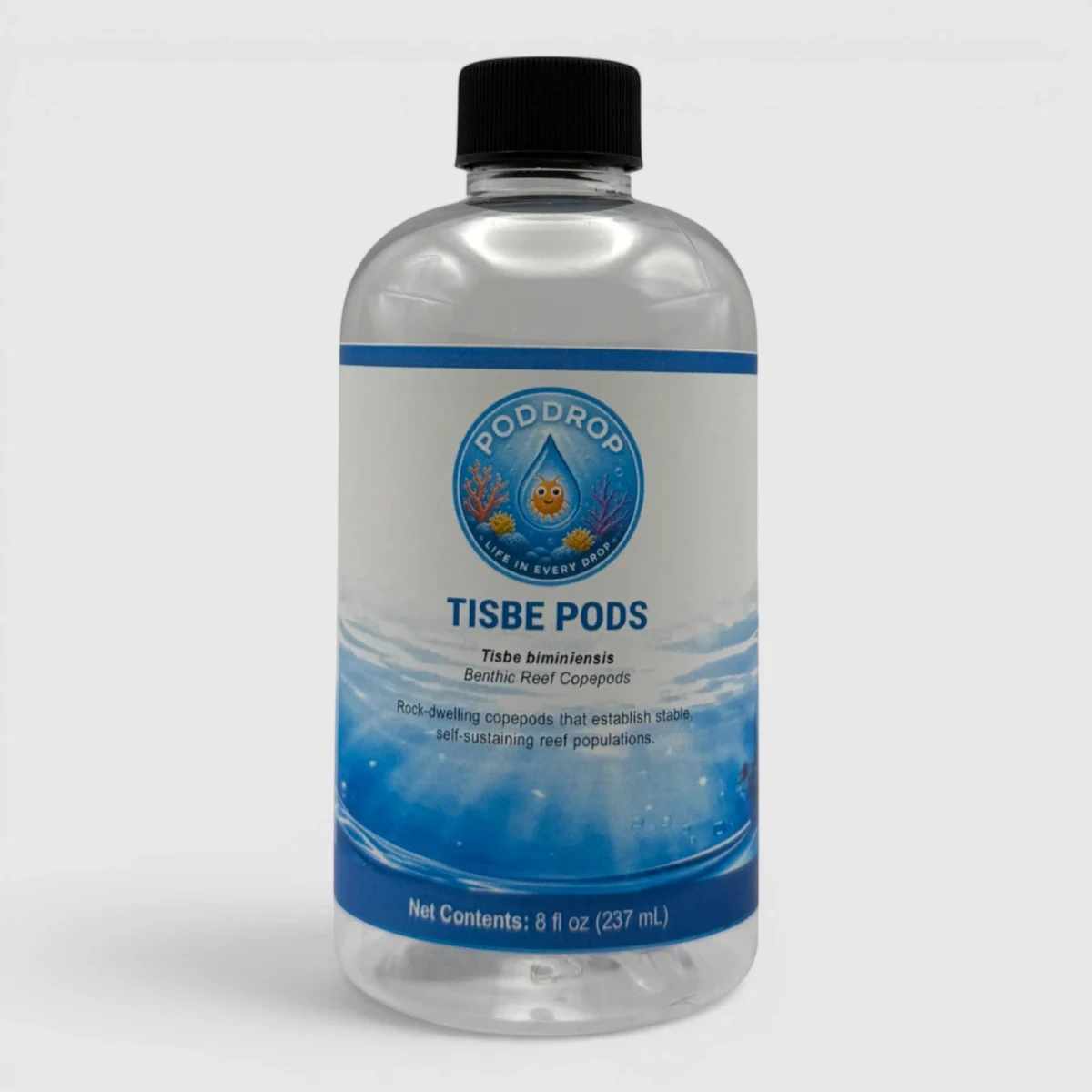
Shop the Tisbe biminiensis Copepods
In this guide
- What Tisbe copepods do and where they fit
- Setting up your culture vessel
- Preparing water and aeration
- Acclimating your copepods to the culture
- Feeding your culture consistently
- Harvesting and introduction to your tank
- Maintaining water quality and preventing crashes
1. What Tisbe Copepods Do and Where They Fit
Copepods are one of the most valuable live foods in a reef aquarium. They're packed with nutrients, perfect for finicky fish and fry, and help clean up detritus and microalgae as they go.
Tisbe are the smallest and most prolific of the common aquaculture copepods. For hobbyists keeping mandarin dragonets, seahorses, or other pod-eating fish, Tisbe biminiensis is often the go-to choice for seeding a tank with a live copepod population. They provide an "endless supply" of food as long as the base population (usually in the refugium or sump) is protected and fed phytoplankton to keep breeding.
While they're alive in the tank, Tisbe are doing janitorial work: their mobility allows them to find and consume bits of waste in places your cleanup crew (snails, crabs, etc.) might miss. They can get into tiny pores and under coral bases to eat decomposing matter, preventing rot and algae blooms.
2. Setting Up Your Culture Vessel
You don't need special equipment. Copepods need a stable, clean environment with consistent conditions. For most home cultures, a 20–40 litre plastic tub or a spare aquarium of similar volume is ideal. This gives you enough water volume to buffer minor parameter fluctuations without taking up excessive space.
You do not need a commercial hatchery buildout to culture copepods well, but you do need dedicated equipment. A simple food-safe container, small air pump, rigid airline or air stone with gentle output, lid or loose cover, and a light source for phyto-fed systems will handle most hobby-scale production.
Tisbe biminiensis are benthic, which is a fancy way of saying they live on surfaces. The more surface area you give them, the bigger and more productive your population will be. A bare-bottom container will work, of course, but adding some structure gives them a world of new real estate to colonize and breed on. Consider adding a piece of filter pad or rough PVC fitting to the bottom.
3. Preparing Water and Aeration
Use reverse osmosis water mixed with quality reef salt as your base. If you're setting up a standalone culture vessel rather than a connected refugium, prepare your saltwater in advance and allow it to age for at least 24 hours before use.
Match the salinity of your culture to your main display tank, which is usually right around 1.025 specific gravity. This makes life easier because the copepods will already be acclimated when you add them to your reef.
Aeration should be light to moderate. You want gas exchange and gentle circulation, not a blender. Heavy turbulence can stress nauplii and keep detritus suspended to the point that water quality becomes harder to manage. The goal is a culture vessel with enough movement to prevent dead zones while still allowing natural feeding behavior. Adjust air flow to a gentle 1 bubble per 3 seconds.
4. Acclimating Your Copepods to the Culture
Gather before you start
- Copepod bottle (already at proper salinity)
- Clean container with aged saltwater at 1.025 specific gravity
- Thermometer
- Live phytoplankton culture
- Gentle aeration set to 1 bubble per 3 seconds
- Container cover (mesh or loose-fitting lid)
1. Float the culture bottle. Float the bottle in your tank or sump for ~15 minutes to match temperature. If salinity differs greatly, slowly mix a bit of tank water into the bottle over 10–15 minutes. Many cultures are already kept at reef salinity (~1.025), so this step is often unnecessary.
2. Tint the water with phytoplankton. Tint the water to a light tea or medium green with phyto before adding animals. This ensures they have food immediately.
3. Pour in the copepods. Gently swirl the bottle to distribute settled copepods. Then pour into high-flow areas near rocks or refugium, or split between the display tank and refugium if possible. If starting a separate culture, pour them gently into your prepared vessel.
4. Allow the culture to stabilize. Expect little visible change for the first 10 days as nauplii grow.
5. Feeding Your Culture Consistently
Add a small amount of phytoplankton (1–2 mL) to some culture water and stir until homogenized. Then gently pour the diluted algae in so that you can see it lightly color the culture tank. Do not add too much, or the water will foul.
Check water clarity to decide whether feeding is needed. If the water is clear, they're hungry. Copepods need fresh phytoplankton daily.
Feed 3–5 times weekly with Nannochloropsis oculata or 2–3 times weekly with Isochrysis galbana or Rhodomonas salina, maintaining a light green tint.
6. Harvesting and Introduction to Your Tank
Wait 5 to 7 days before your first harvest. Use a fine mesh sieve or turkey baster to collect pods. Always leave plenty behind to repopulate the culture.
Take no more than 30 to 50 percent of the visible population at any one time, and leave at least a week between significant harvests.
For your main display tank, introduce copepods in the evening or night when reef tank lights are off and fish are inactive. This gives copepods 8–12 hours to establish in rockwork before predators hunt actively.
7. Maintaining Water Quality and Preventing Crashes
Weekly water change: Partial water changes of 20–30% weekly using aged, quality saltwater prevent ammonia and nitrite buildup. Collect the entire culture with a 55-micron fine mesh screen and place the screen in a separate water-filled container to prevent the copepods from drying out. Clean the container by wiping it with a paper towel and rinsing with water. Refill the container with new saltwater, add algae, then add your pod culture.
Do not dip your strainer in the copepod culture, and then in your aquarium, and then back in your culture vessel without cleaning it first. Do not use water from an existing aquarium or culture as this will contaminate your attempt to start a new culture of copepods.
Temperature and stability: Tisbe do just fine at normal room temperatures, somewhere between 68–82°F (20–28°C). As long as your culture is in a heated room, it'll stay in that sweet spot without the risk of a faulty heater cooking your entire population.
If the culture crashes: If a culture does crash, restart it immediately rather than waiting to see if it recovers. Running two or three small cultures side by side is the most robust protection, because a healthy vessel can reseed a crashed one straight away.
What you notice and what to check
| What you notice | What to check next |
|---|---|
| Clear water | Copepods are hungry; feed phytoplankton daily |
| Light green tint | Culture is well-fed; maintain current feeding schedule |
| Persistent cloudiness | Possible bacterial bloom; do 50% water change |
| Very few visible pods | Check ammonia; do weekly water change immediately |
| Nauplii appearing in tank | Adult population is reproducing; culture is stable |
| Population declining after weeks | May need restart; run backup culture alongside |
Your care log
Vessel size: ______ liters
Started on: ______
Salinity: ______ sg (target 1.025)
Temperature: ______ °F (target 72–82°F)
Aeration rate: ______ bubbles per 3 seconds (target 1)
Phytoplankton species: ______
Last water change: ______ (weekly, 20–30%)
Last full harvest: ______
Notes: ______
Sources
Checked October 23, 2026.
- Aquaculture Kings, "How to Culture Copepods at Home (Reef Tank Live Food)", aquaculturekings.com.au/blogs/articles/how-to-culture-copepods
- Reef Nutrition, "Culturing Tigger-Pods®", reefnutrition.com/pages/culturing-tiggerpods
- Reefphyto, "How to Successfully Culture Copepods: UK Reef Keeper's Guide", reefphyto.co.uk/a/blog/how-to-successfully-culture-copepods
- Riuttareef, "Culturing phytoplankton and copepods at home", riuttareef.com/en/articles/phytoplankton-copepod-culture-practice/
- GetPodDrop, "A Definitive Guide to Culturing Tisbe Biminiensis Copepods", getpoddrop.com/blogs/blog/tisbe-biminiensis
- Topshelf Aquatics, "Live Tisbe Copepods – Reef Genetics", topshelfaquatics.com/products/live-tisbe-copepods-tisbe-biminiensis-reef-genetics
- Pod Your Reef, "Tisbe biminiensis Copepod Guide", podyourreef.com/blogs/care/tisbe-biminiensis-a-complete-guide-for-reef-aquarists-and-researchers
- GetPodDrop, "FAQ – Live Copepods & Phytoplankton", getpoddrop.com/pages/faq
- Algagen, "Tisbe Copepods Care: Temperature & Feeding", algagen.com/blogs/copepods/tisbe-copepods-care-temperature-feeding
- GetPodDrop, "How to Culture Copepods at Home Safely", getpoddrop.com/blogs/blog/how-to-culture-copepods-at-home-safely
- Live Aquaria, "Culture Your Own Copepods at Home", liveaquaria.com/blogs/fish-health-nutrition/culture-your-own-copepods-at-home