

Pithos Crab Care: Algae Control, Tank Setup and Feeding
You'll learn how to set up your tank for a Pithos Crab, feed it properly, and keep it grazing actively on problem algae.
Invertebrate care · Detailed tutorial · About 10 minutes · Beginner friendly
The key habit: In most tanks, the Pithos Crab will find enough natural food to sustain itself, but if algae levels are low, supplemental feeding is recommended. Keep an eye on algae growth and feed regularly to prevent the crab from becoming stressed and nipping at corals.
In this guide
- What is a Pithos Crab and where it comes from
- Setting up a tank for success
- Choosing tank mates
- What to feed your crab
- Acclimating your crab
- Water parameters and stability
- Watching for signs of health
1. What is a Pithos Crab?
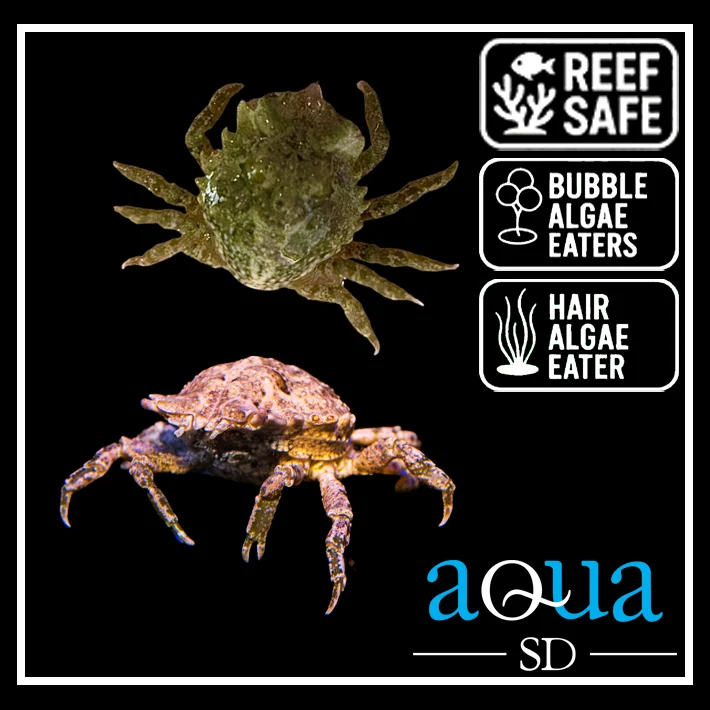
The Pithos Crab is a popular addition to marine aquariums for its enthusiasm to scavenge and control algae such as hair and bubble algae. Originating from the Caribbean, Pithos crabs are often gray to tan in color. A member of the Mithracidae family — the same group that includes the popular Emerald Crab — the Pithos Crab shares a similar body style but offers even greater activity levels and slightly larger adult size.
They are relatively small, but they need enough grazing area to support their feeding behavior. The females grow claws that will be the same size as her body while the males have much smaller claws.
2. Setting Up a Tank for Success
Providing plenty of live rock and hiding spots encourages natural foraging behaviour and helps the crab feel secure. Creating crevices or caves with liverock will mimic the Pithos crab's natural environment.
Pithos Crabs do best in mature saltwater aquariums with plenty of rockwork and natural algae growth. Wait until your tank has been running for at least one month before adding your crab, so that it has a steady supply of algae and detritus to graze on.
Multiple individuals of Pithos crabs can coexist, but be sure there is ample aquarium space to reduce competition. If you plan to keep more than one, provide extra hiding spots and grazing area.
3. Tank Mates and Compatibility
The Pithos Crab is a gentle and reef-safe scavenger that spends most of its time exploring live rock in search of algae and organic matter. While they are generally peaceful, they should still be considered reef safe with caution, as they are opportunistic crabs and may occasionally investigate soft corals, weakened invertebrates, or leftover meaty foods.
They may hide more when kept with aggressive or overly active tankmates, which can reduce how much grazing they do. Choose peaceful fish and invertebrates as companions, and avoid aggressive species that might stress your crab.
4. What to Feed Your Crab
Pithos Crabs are known for their ability to eat several types of problem algae that many aquarists struggle to control. They readily consume bubble algae, hair algae, and film algae, which commonly appear on rocks and aquarium glass. Their natural diet extends to leftover fish food and detritus, helping maintain excellent water quality and reducing nutrient buildup.
In most tanks, the Pithos Crab will find enough natural food to sustain itself. However, if algae levels are low, supplemental feeding is recommended. Offer marine algae sheets, nori, or sinking pellets to ensure proper nutrition.
When food is scarce, crabs become opportunistic feeders and may nip at corals, especially soft corals. It is recommended to supplement sheet algae and algae wafers so crabs remain compatible with the reef environment.
5. Acclimating Your Crab
Gather before you start
- Clean bucket or container
- Airline tubing and valve (or knots to control flow)
- Premixed saltwater matching your tank's salinity
- Small net (optional)
Crabs are much more sensitive to changing water chemistry and should be drip acclimated. You should slow drip these for 45–60 minutes. For hermit crabs drip at a rate of 2–3 drips per second. Pithos Crabs, though not hermits, respond well to this same drip rate.
1. Float the bag
Equalize the temperature between your tank and the bags by floating the bags in the display. Leave the bag floating for 10–15 minutes.
2. Prepare the container
Gently transfer the fish or invertebrate into the small container with all of the water it traveled with. Place a lid loosely over the container for shade and to prevent climb-outs by mobile creatures such as crabs.
3. Start the drip
Start a siphon out of the tank and into the bucket. Use an airline valve or knots to adjust the flow to 2–3 drips per second. Position the airline so water drips slowly into the container with your crab.
4. Watch for equilibrium
Let this volume of water double in the container and measure the salinity of it. If it is the same as the aquarium, you are ready to proceed. If there is still a difference, dump half the water out of the container and continue to drip until the volume is doubled again.
5. Release your crab
Once the salinity of the container matches the salinity of the aquarium, remove the crab from the water and add it to the destination tank. Pour the water out; do not add the water from the container into the aquarium.
6. Water Parameters and Stability
Maintaining stable water parameters is a component to the success of keeping this invertebrate; Pithos crabs are intolerable of high nitrates. Perform regular water changes and keep your test kit handy to monitor levels.
Keep these ranges in mind:
- Temperature: 76–78°F
- pH: 8.1–8.4
- Alkalinity (dKH): 8–12
- Salinity: 1.024–1.026
- Nitrate: As low as possible; high nitrates stress your crab
Like all invertebrates, they are sensitive to copper, so don't treat your aquarium with anything that contains copper in any form.
7. Watching for Signs of Health
| What you notice | What to check next |
|---|---|
| Crab stays hidden most of the day | Check water parameters and tank mate aggression. May be stressed. |
| Crab not eating or grazing | Measure nitrate levels and algae availability. Offer supplemental food. |
| Crab molting (shedding) | Leave the shed shell in the tank; the crab will eat it for nutrients. |
| Crab appears lethargic or weak | Test pH, salinity, and temperature. Ensure no copper-based treatments were used. |
| Crab active and grazing regularly | All systems good. Continue regular maintenance. |
Your care log
Placed on: ______ Tank size: ______ Initial algae level: ______
Light (PAR): ______ Water flow: ______ Feeding frequency: ______
Notes on behavior: ________________________________________________________________
Tank mate list: ________________________________________________________________
Sources
Checked October 16, 2026.
- Aquarium Depot, "Pitho Crab (Pitho mirabilis) Care and Feeding for Canadian Reef Aquariums", https://aquariumdepot.ca/blogs/info/pitho-crab-pitho-mirabilis-care-and-feeding-for-canadian-reef-aquariums
- Top Shelf Aquatics, "Pitho Crab", https://topshelfaquatics.com/products/pithos-crab
- Aquatics Unlimited, "CRAB – PITHO Pitho mirabilis", https://aquaticsunlimited.com/product/crab-pitho-pitho-mirabilis/
- Rock n Critters, "Pitho Crab", https://www.rockncritters.co.uk/critters/pitho-crab/rnc-02905
- Quality Marine, "A Pithy Ally In The Fight Against Algae!", https://www.qualitymarine.com/news/a-pithy-ally-in-the-fight-against-algae/
- Salty Underground, "Pithos Crab", https://www.saltyunderground.com/marine-invertebrates/pithos-crab
- Tropical Fish Plus, "Pitho Crab – Pitho mirabilis", https://www.tropicalfishplus.com/products/pitho-crab-pitho-mirabilis
- Algae Barn, "Acclimating Captive Bred Invertebrates", https://www.algaebarn.com/blog/beginners/how-to-acclimate-your-captive-bred-invertebrates/
- Reef Central, "How to acclimate fish", https://www.reefcentral.com/forums/showthread.php?t=2694286
- Quality Marine, "How to 'Drip Acclimation'", https://www.qualitymarine.com/news/how-to-drip-acclimation/
- The Salty Side, "How to Acclimate Saltwater Fish & Invertebrates: Drip Acclimation Guide", https://www.thesaltyside.com/acclimate-saltwater-fish-and-invertebrates/