

API Phosphate Test Kit: Weekly Testing for Reef Health
You'll be able to measure phosphate levels in your reef tank and understand what action to take when levels are too high.
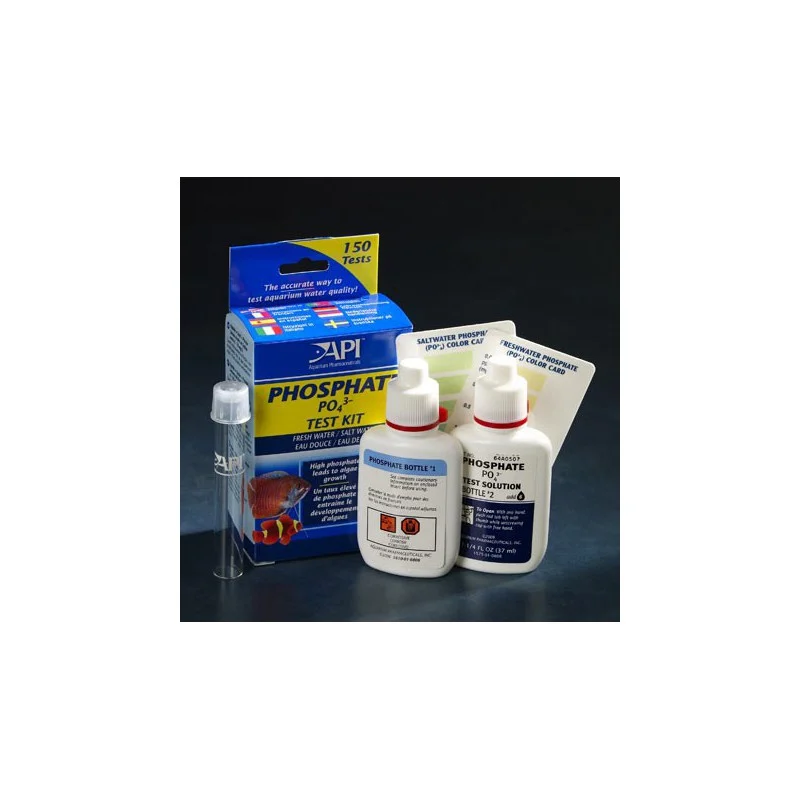
Water quality · Detailed tutorial · About 8 minutes · Beginner friendly
The key habit: Test phosphate once a week in an active reef, and compare the result to your target range to catch problems early before corals fade or algae takes over.
The API Phosphate Test Kit has sold: shop similar Test Kits →
In this guide
- Why phosphate matters in reef tanks
- What your target levels should be
- Gather before you start
- How to perform the test (step by step)
- Understanding and recording your results
- What to do if phosphate is too high
- Storage and reagent care
1. Why phosphate matters in reef tanks
Phosphate enters the aquarium from fish and invertebrate waste and decaying organic matter, such as dead algae and uneaten fish food. Excess phosphate contributes to unsightly algae and green water blooms, and in saltwater, excess phosphate can inhibit the growth of hard corals.
In saltwater aquariums, phosphate precipitates dissolved calcium and magnesium ions, inhibiting the growth of hard corals and other reef-building organisms. Phosphates cause the brown algae inside of a coral to multiply causing it to turn brown instead of its true colors, and it also restricts the intake of calcium carbonate, which corals use to grow their skeletons.
This is why regular testing is essential. Nitrate and phosphate are the two parameters you will end up testing for most often after the tank is cycled and stocked with fish, and the key to good water quality is keeping them in balance, not too high but not too low either.
2. What your target levels should be
The proper phosphate level for a reef tank is 0.02–0.05 ppm, and you should test once a week. Recommended phosphate levels are 0.01–0.03 ppm. (Sources vary slightly within this range; both are acceptable targets.)
If phosphate levels get too high (over 0.05 ppm) it can prevent coral calcification or cause excessive algae growth. The goal is to stay low and stable. Be careful not to lower your phosphate levels too quickly as this can stress out your corals and test your phosphate levels often when attempting to correct a phosphate imbalance.
3. Gather before you start
- The API Phosphate Test Kit (this kit)
- A clean test tube or sample vial (the kit includes one)
- Water from your reef tank (ideally mid-water column, away from the substrate and live rock)
- A well-lit area
- The saltwater color chart (there are two in the kit—use the correct one for your tank type)
- A notebook or digital log to record the date and result
- Paper towels to dry the test tube if needed
4. How to perform the test (step by step)
Gather and prepare your sample
- Rinse the test tube with tank water a couple of times to clear any dust or residue from storage. This prevents false readings.
- Fill the test tube to the line with 5 ml of aquarium water. Always test at the same time of day, and wait 2 hours after feeding to avoid skewed results. Mid-water is best; avoid debris on the bottom.
Add the reagents
- Add 6 drops from Phosphate Test Solution Bottle #1. Hold the bottle vertically and count carefully to ensure accurate drops. Some reagents are thick; apply steady pressure.
- Cap the test tube and shake vigorously for 5 seconds. Mix thoroughly.
- Add 6 drops from Phosphate Test Solution Bottle #2. Note: Bottle #2 contains a very thick solution and may require increased pressure to release drops.
- Cap and shake again for 5 seconds.
- Wait exactly 3 minutes for the color to develop. Do not skip this step; timing is important for accuracy.
Read your result
- Hold the test tube in a well-lit area next to the saltwater color chart. Position the tube against the white area of the card, with the tube's color aligned beside the color swatches.
- Find the closest color match. The matching color on the chart indicates your phosphate level in ppm. If your result falls between two colors, choose the closer one.
- Rinse the test tube thoroughly with clean water and allow it to air dry for the next use.
5. Understanding and recording your results
Once you have your reading, record the date, time, and phosphate level in a notebook or digital app. Getting into the habit of logging these results is one of the most powerful things you can do. Over time, it helps you spot those slow, creeping trends that often signal a problem long before you see the visual signs, like algae outbreaks or unhappy corals.
- 0.00–0.05 ppm: Within target range. No action needed.
- 0.05–0.10 ppm: Rising toward problematic levels. Watch next week's test and consider water changes.
- Above 0.10 ppm: High enough to stress corals and fuel algae. Action needed.
The exact frequency matters less than the consistency—regular tests at the same times give you a trend you can act on.
6. What to do if phosphate is too high
If your phosphate level is climbing or above 0.05 ppm, take action gradually. If you're actively working to bring high phosphate down, testing twice a week is a great rhythm to track your progress, and once your reef's phosphate levels have settled down into your target range, you can usually back off to testing just once a week.
Immediate steps:
- To quickly reduce phosphate, perform a partial water change. Remove any dirt and uneaten fish food from the bottom of the aquarium and change 25–50% of the water, depending on the phosphate concentration.
- Check your tap water and RO/DI water—make sure phosphate isn't being accidentally introduced, and use solutions like phosphate-removing filter media.
- Feed less, and rinse frozen foods in RO water before offering them.
Longer-term solutions:
- Use granular ferric oxide (GFO) in a media reactor for sustained phosphate removal.
- Increase skimming and water flow to reduce organic buildup.
7. Storage and reagent care
- Store the kit in a cool, dry, well-ventilated area and keep containers tightly closed.
- Keep the reagent bottles upright to prevent leaks.
- Check the expiration date on the kit; old reagents give unreliable results.
- The 150 tests in each kit should last several months if you test once weekly. Mark the date you opened each bottle.
- If solution gets on your skin or clothes, rinse immediately with water.
What you notice and what to check next
| What you notice | What to check next |
|---|---|
| Phosphate reading of 0.00–0.05 ppm | Your tank is in good shape. Maintain weekly testing and your current routine. |
| Phosphate reading of 0.05–0.10 ppm | Check your feeding amount, RO/DI water quality, and tap water. Consider a partial water change and retest in 3 days. |
| Phosphate reading above 0.10 ppm, or rising week to week | Perform a 25–50% water change, reduce feeding, increase protein skimming, or start using GFO. Retest after 3 days. |
| Corals losing color or looking pale | Test phosphate (may be too high). Also check alkalinity, calcium, and magnesium—all three interact. |
| New algae blooms or green water | Test phosphate immediately. This is often the first visible sign of a phosphate problem. |
| Test result seems too low (0.00 ppm) for weeks in a row | Verify you are using the saltwater color chart, not the freshwater one. If confirmed, your tank is doing very well; some corals may appreciate a tiny boost from a quality salt mix. |
Your care log
Tested on: ______ Phosphate level (ppm): ______ Tank temp: ______ Notes: ______
Tested on: ______ Phosphate level (ppm): ______ Tank temp: ______ Notes: ______
Tested on: ______ Phosphate level (ppm): ______ Tank temp: ______ Notes: ______
Tested on: ______ Phosphate level (ppm): ______ Tank temp: ______ Notes: ______
Tested on: ______ Phosphate level (ppm): ______ Tank temp: ______ Notes: ______
Sources
Checked October 15, 2026.
- Bulk Reef Supply, Advanced Water Testing Techniques & Tips
https://www.bulkreefsupply.com/content/post/advanced-water-testing-techniques-beginners-guide-ep-41
- Hanna Instruments, How to Test for Phosphate in Your Aquarium
https://blog.hannainst.com/how-to-test-phosphate-in-saltwater-aquarium
- ReefBay, Complete Guide to Phosphate Control in Reef Tanks
https://reefbay.com/guides/complete-guide-to-phosphate-control-in-reef-tanks
- Reef Decks, How Often Should You Test Your Reef Tank? (2026 Schedule)
https://reefdecks.com/guides/how-often-test-reef-tank/
- ATI North America, Water Quality for Reef Tanks (Part 2): The Most Important Tests
Water Quality for Reef Tanks (Part 2): The Most Important Tests
- Manta Systems, Phosphates in Saltwater Aquariums
https://www.mantasystems.net/a/blog/post/Phosphates
- API Fish Care, Phosphate Test Kit
https://apifishcare.com/product/phosphate-test-kit
- The Aquarium Wiki, API Phosphate Test Kit
https://www.theaquariumwiki.com/wiki/API_Phosphate_Test_Kit