

Feather Duster Care: Placement, Flow and Feeding
You'll learn where to place your Feather Duster, how to feed it, and what water conditions it needs to extend its crown and thrive.
Invertebrate care · Detailed tutorial · About 12 minutes · Beginner friendly
The key habit: Set your Feather Duster in a current where it gets steady food drifts and medium water flow—then feed it three to five times a week with liquid plankton to keep it healthy and full-crowned.
Shop the Feather Duster – Sabellastarte sp.
In this guide
- What a Feather Duster is and where it comes from
- Tank size, setup and placement
- Water flow and current
- Feeding and diet
- Water parameters
- Tank mates and temperament
- Acclimation and signs of health
- What you notice and what to check
- Your care log
1. What a Feather Duster is and where it comes from
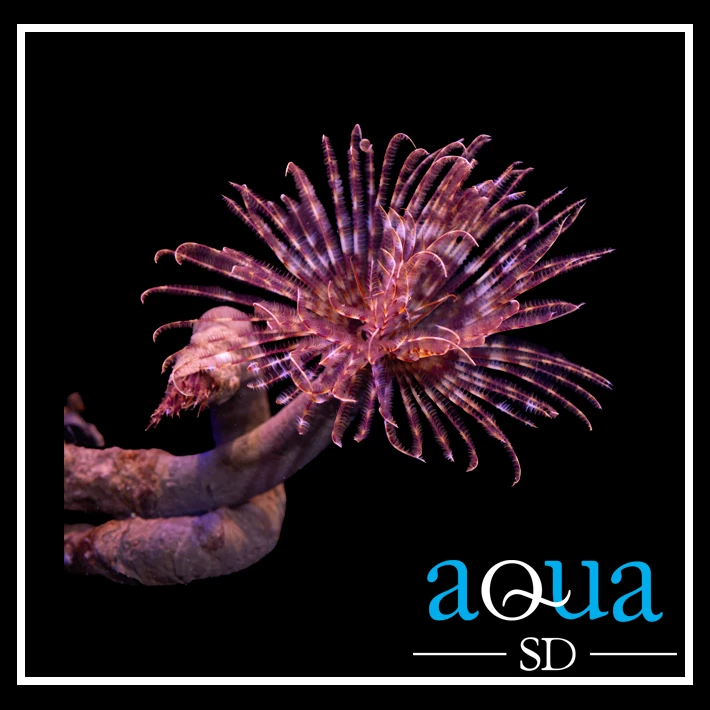
The Feather Duster is a segmented marine worm, not a coral. It constructs a leathery tube, sometimes up to 10 inches in length, from which it extends a single crown of multicolored feather-like filaments (usually a mottled reddish-brown and white) of about 2 to 4 inches in diameter.
The Feather Duster uses its radioles (feathery crown) to filter out small floating organisms, which it directs toward its mouth, located at the center of the crown. It protects its segmented body by secreting a parchment-like tube to cover itself, and when disturbed, it can quickly pull in its radioles into the tube. These radioles serve an important function in filter feeding, as the worm uses them to catch plankton and other small particles from the water column.
The Feather Duster is usually found in the coral rubble at the base of the reef aquarium, with some of the rubble being incorporated into its parchment-like tube.
2. Tank size, setup and placement
The Feather Duster can thrive in a minimum of 20 gallons, and should have its tube wedged into a rock crevice or buried a short way into the sand so it stands upright.
It needs to be housed in a well-established reef system as it is dependent upon plankton for its diet. A well-established tank means one that has been running for several months with live rock and stable bacteria—this allows natural microfauna (copepods, amphipods) to thrive.
Position your tube so the crown extends into an open area where food can drift through it. Giant Feather Dusters generally live in the coral or sand rubble at the base of a reef aquarium, so placing yours in a lower-middle position with nearby rockwork for shelter works well.
3. Water flow and current
Placement of the Feather Duster is very important as it relies on water currents for food; therefore, it should be placed where it will receive a relatively constant medium water flow, and should be placed in the substrate where it will receive a medium water flow in which it can filter food stuffs from the current.
They require moderate to low water flow. This means you want steady circulation, but not a blast directly at the crown. A gyre or return flow that sweeps past it works better than a powerhead pointed straight at it.
4. Feeding and diet
The Feather Duster is dependent upon plankton for its diet, and supplemental feeding of phytoplankton and liquid organic foods should be provided.
Feather Dusters do best in an established aquarium with an abundance of copepods, amphipods and other microfauna, and additionally do best when regularly fed a diet of broadcasted planktonic foods such as phytoplankton, R.O.E. and copepods.
The two ways to feed:
Feather Dusters get food in two ways: naturally from the established tank's microfauna, and from supplemental liquid foods you add. Many keepers feed three to five times a week by broadcasting liquid plankton (phytoplankton, zooplankton, or coral food) upstream of the worm.
Briefly reduce flow and release the food upstream so it drifts through the crown.
A danger: Shedding its crown is a sign it is starving—it will do this if it is starving, may produce a smaller crown, but if it sheds a second time it may not recover, and liquid coral food should be added.
5. Water parameters
Water parameters for the Feather Duster: dKH 8–12, pH 8.1–8.4, specific gravity 1.023–1.025, temperature 72–78°F [1]. It requires calcium and trace elements as supplements.
These match standard reef parameters. If you are already dosing calcium and alkalinity for corals, your Feather Duster will benefit [1].
| Parameter | Range |
|---|---|
| Temperature | 72–78°F (22–26°C) |
| pH | 8.1–8.4 |
| Salinity (SG) | 1.023–1.025 |
| Alkalinity (dKH) | 8–12 |
| Calcium | As dosed for corals (typically 400–450 ppm) |
The Feather Duster is very intolerant of copper-based medications or any level of copper present in the system.
6. Tank mates and temperament
The Feather Duster has a peaceful temperament and will not harm corals or other invertebrates.
However, avoid butterflyfish, large wrasses, some dwarf angelfish, and arrow crabs, which may nip or eat the crown. It's important to ensure that the aquarium is free of predators that may harm these worms, such as certain species of wrasses and large angelfish.
Small, peaceful fish like gobies, cardinals, and clownfish are safe tank mates.
7. Acclimation and signs of health
Gather before you start
- Bucket or container for acclimation
- Airline tubing for drip method
- Dim lighting (reduce main tank lights to 50%)
- Pipette or syringe for feeding
1. Use the drip acclimation method. Proper acclimation is essential when introducing Feather Dusters to your tank—use the drip acclimation method to gradually adjust the animal to the new water conditions, as this process reduces the risk of shock and helps it adapt smoothly to its new environment.
Set up a slow drip from your tank to an acclimation container over 1–2 hours, then gently place the tube into the substrate without damaging it.
2. Reduce flow and lights. For the first few days, keep flow moderate and lower your lighting. Young worms are easily damaged by light, and all sized worms need to be properly acclimated to intense lighting; starting your worm low in the tank and lowering the intensity of lights is a good way to start, and you can ramp lights up and move the worm higher little by little every week until it is fully acclimated.
Signs of a healthy Feather Duster:
- Crown is fully extended for several hours each day
- Radioles are colorful and intact
- Worm responds to shadows by retracting quickly, then re-extending
- No shrinking or partial retraction lasting all day
- Feeding occurs visibly when you add plankton
Signs of stress:
- Crown stays retracted most of the time
- Crown becomes smaller
- Visible damage to radioles
- Worm sheds its crown (sign of starvation)
What you notice and what to check next
| What you notice | What to check next |
|---|---|
| Crown stays hidden in the tube all day | Is flow too strong? Try repositioning. Are you feeding? Add liquid plankton 3–5 times per week. Is water quality stable? Test and do a water change. |
| Crown partially extends but looks dull or damaged | Are predatory fish present? Watch for butterflyfish or wrasses. Is the worm molting? (Natural; it will recover.) Is flow turbulent? Smooth it out with a deflector. |
| Crown shrinks or disappears completely | Likely starvation. Increase feeding frequency and volume. Add phytoplankton or zooplankton twice daily. Consider the tube may be blocked; carefully clear the opening. |
| Worm extends crown, then retracts every few minutes | New to the tank? Give it 3–5 days to adjust. Check for sudden changes in flow or lighting. |
| Sudden death or missing worm | Check for predators (wrasses, triggers). Copper in medication? Verify no medications were used. Water parameter crash? Test alkalinity and pH immediately. |
Your care log
Date placed: ______ Location in tank: ______
Starting flow setting (powerhead or return): ______
Feeding schedule: Food type: ______
First feeding: ______ Frequency: ______ per week
Water parameters checked:
- Temperature: ______
- Salinity (SG): ______
- pH: ______
- Alkalinity (dKH): ______
Notes:
- Month 1 observations: ______
- Crown behavior (extended/shy): ______
- Any problems: ______
- Adjustments made: ______
Sources
Checked October 9, 2026.
- LiveAquaria, "Feather Duster", https://www.liveaquaria.com/product/539/?pcatid=539
- Top Shelf Aquatics, "Feather Duster", https://topshelfaquatics.com/products/feather-duster
- TFH Magazine, "Sabellastarte indica: Feather Duster Aquarium Basics", https://www.tfhmagazine.com/articles/saltwater/sabellastarte-indica
- Fishkeeping.co.uk, "Feather Duster Worm (Sabellastarte sp.) Caresheet", https://www.fishkeeping.co.uk/modules/caresheets/caresheet.php?caresheetID=41
- Reeflings, "feather duster (Sabellastarte magnifica)", https://reeflings.com/species/sabellastarte-magnifica
- AquariumDomain, "Giant Feather Duster (Sabellastarte sp.)", https://www.aquariumdomain.com/SpeciesProfiles/MarineInverts/GiantFeatherDuster.shtml