

Tiger Striped Trachy Care: Light, Flow and Placement
Learn how to keep your Tiger Striped Trachy healthy with proper lighting, gentle water flow, and sand bed placement.
Coral care · Detailed tutorial · About 10 minutes · Beginner friendly
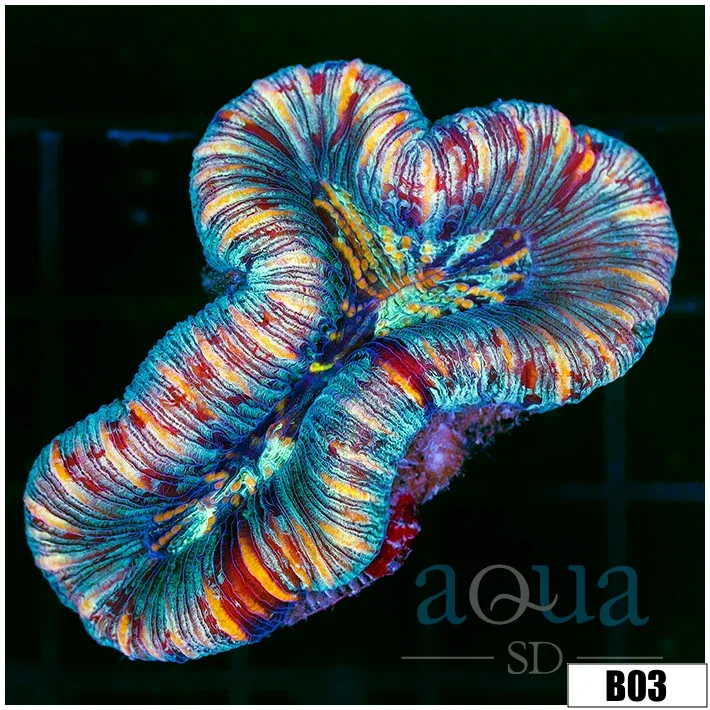
The key habit: Place your Tiger Striped Trachy on soft sand in a low-traffic area of your reef, keep light stable and moderate, and give it gentle water movement—then leave it alone to settle and thrive.
The Tiger Striped Trachy has sold: shop similar LPS Corals →
In this guide
- What is Trachyphyllia and how it grows
- Light and PAR
- Water flow
- Placement on sand
- Feeding
- Water parameters
- Acclimation
1. What is Trachyphyllia and how it grows
Trachyphyllia corals, often called "open brain corals," are known for their large, fleshy polyps and vibrant coloration that can become a focal point in a reef aquarium. These are fleshy LPS (large polyp stony) corals known for their dramatic inflation, vivid coloration, and preference for sand bed placement over traditional rockwork mounting.
Trachyphyllia are secondary free living corals that don't normally colonize; they exist as a single or multi-mouthed, large, fleshy polyp growing from one coralite. Being single, large polyp stony, and slow growing corals, they are not commonly cut and fragged, and are only available as colonies. This means your Tiger Striped Trachy is a complete specimen that should be enjoyed as a long-term centerpiece rather than a coral to propagate.
2. Light and PAR
Trachyphyllia corals thrive under low to moderate lighting in the 50-150 PAR range, with many specimens performing best toward the lower end around 50-100 PAR. Your Tiger Striped Trachy's vibrant coloring will stay rich and deep when kept in this range rather than blasted with bright light.
Excessive lighting causes Trachyphyllia corals to bleach and expel zooxanthellae, leading to tissue recession and potential death if not corrected promptly. If your coral's color appears washed out or pale, it's likely receiving too much light and should be moved to a shadier spot.
New Trachyphyllia specimens should be acclimated in lower light areas and gradually adjusted over 2-3 weeks if higher intensity is desired. Start in a low-light zone and only increase light if the coral's color dulls.
3. Water flow
Low to moderate, indirect flow is ideal; flow should gently move water across the coral without direct force, and strong flow can damage fleshy tissue and prevent full expansion. Think of gentle, circling movement rather than a powerhead pointed directly at your coral.
Low, gentle flow is the key; you want enough water movement to prevent detritus from settling, but not so much that the coral's tissue is constantly moving, as too much flow can cause the tissue to peel back from the skeleton. If you notice the coral's tissue retracting or the mouth shrinking, reduce flow in its area.
4. Placement on sand
Many open brains including Trachyphyllia are naturally occurring on the substrate and should be placed on the bottom assuming there are no aggressively sand sifting tank mates that are likely to bury them. Sand bed placement is critical—avoid sharp rocks that can tear the delicate tissue when the coral inflates and deflates.
Always place Trachyphyllia on soft sand. Space it away from your powerheads and aggressive neighbors. Be sure to provide a little space for your Trachyphyllia corals to grow and thrive. Give it 6-8 inches of clearance from other corals so it can expand without touching them.
5. Feeding
These colonies are fantastic eaters; you should feed your trachy a couple times a week with a mixture of meaty foods like mysis and brine shrimp. They will turn themselves almost inside out to eat with long sticky feeder tentacles, always a fun process to quite literally watch unfold!
Target feed by turning off strong pumps and dropping small pieces of thawed mysis shrimp or other quality coral food directly onto the mouth area. Wait for the coral to slowly fold inward and capture the food. If pieces fall away, they are too large.
6. Water parameters
Trachy do best in systems with the following parameters: 78 degrees, 1.026 specific gravity, Alkalinity (9 dKH), Calcium (450 ppm), Magnesium (1300 ppm), lower Nitrates, Nitrites, and Phosphates.
| Parameter | Range |
|---|---|
| Temperature | 76–80°F |
| Salinity | 1.024–1.026 |
| pH | 8.1–8.4 |
| Alkalinity | 8–10 dKH |
| Calcium | 400–450 ppm |
| Magnesium | 1250–1350 ppm |
| Nitrate | 5–10 ppm |
| Phosphate | 0.03–0.07 ppm |
The best way to ensure their long term success and survival is to strive for stable tank parameters; stable, essential nutrients are the key to keeping healthy corals; do frequent, small water changes to replace nutrients in your aquarium, avoiding large water changes that can swing parameters suddenly, shocking your trachy and other corals.
7. Acclimation and dipping
Gather before you start
- Separate quarantine or acclimation container
- Airline tubing for slow drip acclimation
- Flashlight to inspect for pests and damage
- Coral dip (optional but recommended)
1. Inspect the coral Carefully examine your Tiger Striped Trachy for pests, missing tissue, or loose pieces. Trachyphyllia can have pests, so it's important to carefully inspect your new coral upon arrival; while uncommon, they can have flatworms, which are not always easy to spot.
2. Dip if desired A brief dip in a coral-safe dip solution can reduce pest introduction risk. Follow the dip manufacturer's instructions closely and never exceed the recommended time.
3. Begin acclimation Place your coral in a small container alongside your tank. Use airline tubing to drip your aquarium water into the acclimation container at a rate of one drip every 2 seconds. Over 1–2 hours, the container's water gradually becomes your tank water.
4. Transfer to low light Once acclimated, place the coral on sand in the lowest-light area of your tank. New specimens should be acclimated in lower light areas and gradually adjusted over 2-3 weeks if higher intensity is desired.
5. Observe before moving Leave your coral undisturbed for at least a week before adjusting its position. It needs time to settle and attach to the sand.
What you notice and what to check
| What you notice | What to check next |
|---|---|
| Coral stays contracted and won't expand | Check water parameters, especially salinity; verify flow is not too strong; reduce light slightly and allow more settling time |
| Pale or washed-out coloring | Check PAR reading; move coral to lower-light area; verify you're not blasting it with direct powerhead flow |
| Tissue appears torn or frayed | Move coral away from sharp rocks or aggressive neighbors; check for sponges, feather dusters, or aiptasia on the skeleton |
| Visible bleaching or white spots | Reduce light immediately; verify temperature is stable around 78°F; check for pests like gall crabs |
| Coral moves around the sand bed | Flow is likely too strong in that area; relocate to a lower-flow zone or behind rock |
Your care log
Placed on: ______ Light (PAR): ______
Flow position in tank: ______
First feeding date: ______
Water parameters checked: ______
Notes on expansion: ______
Sources
Checked October 8, 2026. Reference addresses are plain text below.
- Reef Builders, "RB Care Guide: Trachyphyllia", https://reefbuilders.com/2025/11/08/rb-care-guide-trachyphyllia/
- Top Shelf Aquatics, "Rainbow Trachyphyllia Coral Care Guide", https://topshelfaquatics.com/pages/corals/rainbow-trachyphyllia-coral
- Corals.com, "Trachyphyllia Corals", https://www.corals.com/2025/10/04/trachyphyllia-coral/
- Whitlyn Aquatics, "Trachyphyllia Coral Care Guide", https://www.whitlynaquatics.com/blogs/news/trachyphyllia-coral-care-guide-care-feeding-lighting-tips
- Reef Chasers, "Reef Chasers Coral Care Guide: Trachyphyllia Corals", https://reefchasers.com/blogs/reef-chasers-coral-care-guide/trachyphyllia-corals
- Meta Reef, "Trachyphyllia Coral Care Guide", https://metareef.com/corals/trachyphyllia
- iReef, "Trachyphyllia Corals: Feeding and Care", https://ireef.co.uk/trachyphyllia-corals-feeding-and-care/
- Extreme Corals, "Trachyphyllia Care Guide", https://www.extremecorals.com/CoralCare_Trachyphyllia.html
- Extreme Corals, "Care Requirements of Trachyphyllia in Home Reef Aquariums", https://www.extremecorals.com/blog/care-requirements-of-trachyphyllia-in-home-reef-aquariums.html
- Bulk Reef Supply, "ECC Trachyphyllia (Captive Spawned)", https://www.bulkreefsupply.com/ecc-trachyphyllia-eye-catching-coral.html
- AlgaeBarn, "Conservation Week – Frags!", https://www.algaebarn.com/blog/beginners/conservation-week-frags/
- Aquarium Source, "Coral Fragging Guide", https://www.aquariumsource.com/coral-fragging/
- Discover Aquatics Shop, "Tiger Stripe Trachy", https://discoveraquaticsshop.com/products/tiger-stripe-trachy
- Boodleshire Aquatics, "Coral Profile: Trachyphyllia", https://www.boodleshireaquatics.com/post/coral-profile-trachyphyllia
- Pacific East Aquaculture, "Coral Care", https://pacificeastaquaculture.com/pages/coral-care
- All Corals, "How to Frag Coral", https://allcorals.com/guides/coral-fragging