

Bubble Coral Care: Light, Gentle Flow, Space and Feeding
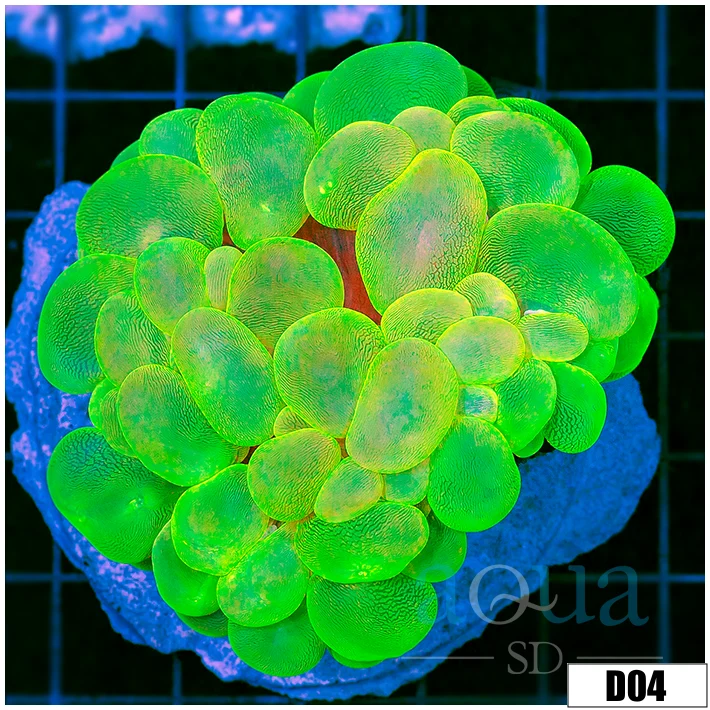
You'll be able to place, light, feed and acclimate your new Indo Nuclear Bubble Coral, and keep its night-time sweeper tentacles away from other corals.
Coral care · Detailed tutorial · About 8 minutes · Beginner friendly
The key habit: Give your bubble coral its own space low in the tank, in gentle flow that doesn't hit it directly. Most problems come from strong flow, harsh light, rough handling or neighbors that are too close [8,10].
The Indo Nuclear Bubble Coral has sold: shop similar LPS Corals →
In this guide
- What this coral is and how it grows
- Light
- Water flow
- Placement and handling
- Feeding
- Water parameters
- Acclimation and dipping
1. What this coral is and how it grows
The Indo Nuclear Bubble Coral is a bubble coral. The species most often sold under that name is Plerogyra sinuosa, which is also called pearl coral. It is a large polyp stony (LPS) coral: soft, fleshy tissue over a hard skeleton [1,2]. Other Plerogyra and Physogyra species are sometimes sold as bubble corals too. Sources agree that they all need about the same care [1,2].
During the day the coral fills its "bubbles" (called vesicles). At night they shrink, and thin feeding tentacles show [2]. After dark it can also put out long sweeper tentacles. These carry stinging cells and are used to fight nearby corals. One source puts their length at 3 to 4 inches (7.5 to 10 cm) [2,4].
The coral is photosynthetic, which means tiny algae living in its tissue make food from light. It will also catch and eat small foods [4]. Sources disagree on how fast it grows: one farm calls it slow [3], and another reference calls it moderate, with regular feeding helping growth [13]. Several sources call it a hardy coral that suits beginners [2,3,6]. Others rate it as moderate care that needs a stable tank [10,13].
2. Light
Most sources suggest moderate light, but the numbers vary:
- 50–150 PAR, with too much light leading to tissue damage or the coral pulling in [8]
- About 100–150 PAR [3,12,13]
- Low to high light is tolerated, according to one coral farm [6]
PAR is a measure of how much usable light reaches the coral. A middle value of about 100 PAR is a reasonable place to start. One farm's advice on lighting LPS corals is that less is often more [12].
If you plan to put it somewhere bright, start it lower down or in shade. Then move it into brighter spots over at least a couple of weeks [11].
3. Water flow
Sources agree that bubble coral wants low to moderate, indirect flow [3,7,8,12].
- Don't point a powerhead straight at it. In direct current the bubbles can deflate and stay closed until conditions settle [5,7].
- Strong flow can also tear the soft tissue [9].
- Flow that is too weak lets sediment settle on the coral, so aim for gentle movement rather than none [13].
4. Placement and handling
- Go low. Sources recommend the sand bed or low rockwork [3,8,13]. One farm suggests the sand bed at about 100–150 PAR [3].
- Make it stable. On rock, use a flat spot where it can't fall over. You can glue or epoxy the base in place if you prefer [3].
- Leave plenty of room. The bubbles need space to open fully, and the night-time sweepers can sting corals within reach [4,6,8]. Keep in mind that at 3 to 4 inches long, the sweepers can reach corals downstream or close by [4]. Check after lights-out to see how far they actually reach.
- Handle it by the skeleton, gently. The bubbles puncture easily and the skeleton under them can be sharp [10,12]. This coral can also sting skin or irritate your hands, so wear gloves [4,12].
5. Feeding
Feeding isn't required, but it helps. Sources say bubble coral grows better when it doesn't rely on light alone [5,8].
What to feed: Meaty foods such as mysis or brine shrimp, plankton, or pellets [5,9].
How often: Sources disagree. Some suggest about once a week [5,12], and one suggests 2–3 times a week [8,9]. Starting at once a week is the cautious choice. The same source that suggests 2–3 times a week also warns that overfeeding can lower water quality [9].
- Thaw a small amount of frozen food in some tank water [5].
- Choose the time. Feed when the feeding tentacles are showing, often after the lights go off [4,9].
- Release it gently onto the coral with a turkey baster or pipette [5,12].
- Watch it eat. The bubbles slowly part to show the mouth, and it pulls the food in [5].
- Keep fish off the food. Feeding the fish at the same time helps the coral eat without them stealing it [3].
For more, see our tutorial "How to Feed Corals Without Overfeeding Your Reef."
6. Water parameters
Stable water matters more than hitting one exact number [3,13]. Ranges from our sources:
| Parameter | Range in sources |
|---|---|
| Temperature | 74–83°F (23–28°C) [4]; 75–82°F (24–28°C) [13] |
| Salinity | 1.023–1.026 SG [13]; about 1.025 [4] to 1.026 [3] |
| Alkalinity | About 8 dKH [3] to 3.5 meq/L, roughly 9.8 dKH [4] |
| Calcium | 380–430 ppm [4]; about 450 ppm [3] |
| Magnesium | About 1272 ppm, adjusted for salinity [4], to 1400 ppm [3] |
| Nitrate | None of our sources gave a number. One farm says this coral tolerates higher-than-ideal nitrate [3] |
| Phosphate | About 0.05 ppm [4]. One farm says it tolerates higher-than-ideal phosphate [3] |
| pH | 8.1–8.2 [4]; 8.0–8.4 [13] |
Bubble coral tolerating some nutrients is not a reason to let them rise. One farm recommends keeping the tank close to natural seawater [3]. If the bubbles stay shrunken, unstable water is one of the usual causes [8].
7. Acclimation and dipping
Gather before you start
- Your usual acclimation container and some tank water
- A coral dip, such as Coral RX or Two Little Fishies Revive [3]
- Gloves (the coral can sting skin) [4,12]
- Reef-safe glue or epoxy, if you're attaching it to rock [3]
- A chosen spot, low and in gentle flow, with room around it
- Acclimate as usual. Match temperature and salinity using the steps in our "Coral Dipping and Quarantine: A Careful Workflow for New Frags" tutorial.
- Dip it. Bubble coral isn't known for pest problems, but one farm still advises dipping, as you should with any new coral [3]. Follow the dip maker's label directions.
- Handle the skeleton, not the bubbles. Torn tissue can lead to infections such as brown jelly [8].
- Place it low, in gentle flow and lower light. If you want it brighter later, move it up slowly over at least a couple of weeks [11].
- Give it time. Stress from light, flow or unstable water can keep it from opening [8]. Change one thing at a time and give the coral a few days to respond.
What you notice and what to check
| What you notice | What to check next |
|---|---|
| Bubbles stay shrunken during the day | Direct flow, light that's too strong, unstable alkalinity or salinity [5,8] |
| Torn or punctured bubbles | Flow that's too strong, sharp rock nearby, rough handling, fish picking at it [9,10] |
| A nearby coral is damaged or pulling back | Sweeper tentacles reaching it at night; check after lights-out and move them apart [4,8] |
| Brown, jelly-like tissue | Recent injury; brown jelly infections are linked to damaged tissue [8] |
| Sediment collecting on the coral | Flow that's too weak around it [13] |
| Fish steal the food | Feed the fish at the same time, then target-feed the coral [3] |
Your care log
Placed on: ______ Spot in tank: ______
Light (PAR): ______ Flow (gentle / indirect?): ______
Distance to nearest coral: ______ Sweeper reach seen at night: ______
Dip used and date: ______
Feeding (food / day): ______
Temp: ______ Salinity: ______ Alk: ______ Ca: ______ Mg: ______
Nitrate: ______ Phosphate: ______
Notes on bubble size: ______
Sources
Checked October 8, 2026. Reference addresses are plain text.
- Tidal Gardens, "Bubble Coral Colony," https://tidalgardens.com/wysiwyg-bubble-coral-colony.html
- Reef Builders, "The Beautiful, Beginner-Friendly Bubble Coral," https://reefbuilders.com/2014/02/17/bubble-coral-plerogyra-sinuosa-beginner-friendly/
- Frag Box Corals, "Bubble Coral Care," https://fragbox.ca/coral-care/bubble-coral-care/
- Tropical Fish Hobbyist Magazine, "Plerogyra sinuosa," https://www.tfhmagazine.com/articles/saltwater/plerogyra-sinuosa
- Tropical Fish Hobbyist Magazine, "Bubble Coral Care," https://www.tfhmagazine.com/articles/saltwater/give-your-minireef-a-bit-of-the-bubbly
- ORA (Oceans, Reefs & Aquariums), "MIMF Bubble Coral," https://www.orafarm.com/product/bubble-coral/
- Algae Barn, "Keeping the Bubble Coral," https://www.algaebarn.com/blog/corals/coral-care/keeping-the-bubble-coral/
- Extreme Corals, "Coral Care Info: Bubble," https://www.extremecorals.com/CoralCare_Bubble.html
- Extreme Corals, "Bubble Coral Care Guide: Lighting, Flow, Feeding and Placement in Home Reef Aquariums," https://www.extremecorals.com/blog/care-requirements-of-bubble-coral-in-home-reef-aquariums.html
- Extreme Corals, "Bubble Coral Care Guide: How to Keep Plerogyra Healthy, Inflated and Thriving in Reef Tanks," https://www.extremecorals.com/blog/5-reasons-why-bubble-coral-should-be-your-next-aquarium-addition.html
- Reefs.com, "Aquarium Corals: The Bubble Corals: Species of the Genera Plerogyra and Physogyra," https://reefs.com/magazine/aquarium-corals-the-bubble-corals-species-of-the-genera-plerogyra-and-physogyra/
- Reef Chasers, "Bubble Coral Care Overview," https://reefchasers.com/blogs/reef-chasers-coral-care-guide/pearl-bubble-coral-care-guide
- Reeflings, "Bubble Coral (Plerogyra sinuosa)," https://reeflings.com/species/plerogyra-sinuosa