

Alkalinity Dosing
Reef keeping • Detailed tip
Alkalinity Dosing: Measure Demand Before Setting the Pump
Learn to distinguish corrections from daily maintenance, calculate alkalinity demand, choose the right product conversion, and verify dosing pump output.
About 4 minutes • Practical steps, troubleshooting & checklists
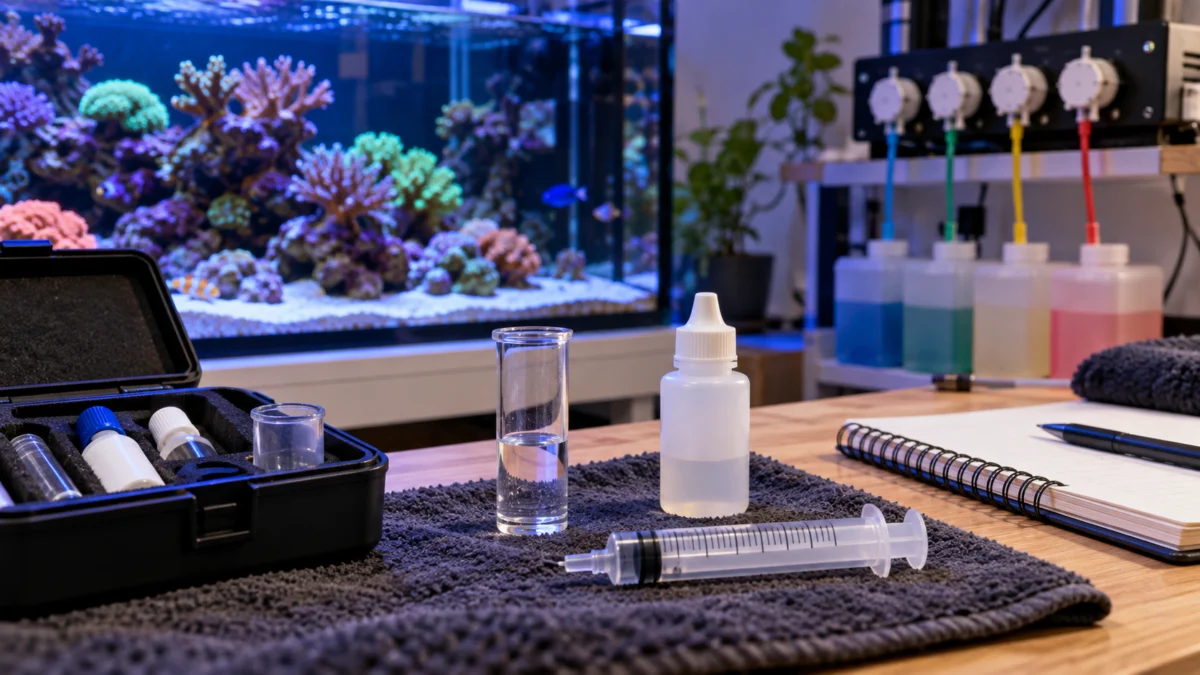
Original AI-generated editorial illustration.
In this guide
- 1. Separate correction from maintenance
- 2. Measure a trend at a consistent time
- 3. Work through the arithmetic
- 4. Verify delivery before automating
- 5. Respect the dosing system’s design
- Troubleshooting a changing trend
A dosing pump makes additions convenient, but it cannot determine what your reef needs. The right starting point is a trustworthy test, an appropriate target, and an estimate of how quickly alkalinity changes in your particular system.
Alkalinity is commonly reported in dKH in reef keeping. It is related to the water’s buffering capacity, but it is not the same measurement as pH. Avoid adding an alkalinity product simply because a pH number looks lower than you expected.
1. Separate correction from maintenance
A correction moves a confirmed result toward a chosen target. Maintenance dosing replaces ongoing demand. Confusing the two can lead to repeating a one-time correction every day.
Choose a target appropriate to the animals and the system’s broader chemistry. Verify salinity and test technique before interpreting an unexpected result. Repeat a surprising alkalinity test with a clean vial and the kit’s specified sample volume. Do not chase tiny differences within normal test variability.
2. Measure a trend at a consistent time
Record alkalinity at approximately the same time on consecutive days. Note dosing, water changes, and other events. If the aquarium is already on established dosing, do not abruptly stop a necessary routine just to measure demand. A brief undosed observation is only suitable when the expected decline remains within an acceptable range.
For a system without dosing during the observation interval, the decline divided by elapsed days gives an estimate of net daily demand. It can reflect biological use and other losses; it is not a direct coral-growth measurement.
3. Work through the arithmetic
| Time | Illustrative alkalinity |
|---|---|
| Monday, 7 p.m. | 8.4 dKH |
| Tuesday, 7 p.m. | 8.2 dKH |
| Wednesday, 7 p.m. | 8.0 dKH |
There are two elapsed days between the first and final reading. The estimated net demand is (8.4 − 8.0) ÷ 2 = 0.2 dKH per day. Three readings do not mean three elapsed days. Repeat observations help show whether that rate is representative.
Now use the manufacturer’s calculator for your exact additive concentration and estimated operating water volume. Include relevant sump water and account for displacement. Do not borrow a milliliter dose from another aquarium or switch products while keeping the old conversion.
Illustrative conversion only: Suppose the correctly selected calculator reports that 20 mL raises your system by 1 dKH. Replacing 0.2 dKH would then require 20 × 0.2 = 4 mL daily. Those numbers demonstrate the method; they are not a dose for your tank.
4. Verify delivery before automating
Calibrate the dosing head using its manual, the intended tubing arrangement, and a suitable measuring container. Check that a commanded volume produces a matching measured volume. Secure the intake and outlet, label the line, and inspect for leaks, air gaps, or unintended siphoning.
Follow the additive instructions for location, timing, and maximum individual additions. Slow delivery into a well-mixed area helps avoid concentrated exposure. Separate incompatible additions as directed. Never mix concentrated calcium and alkalinity supplements together in a storage bottle.
5. Respect the dosing system’s design
Independent two-part dosing and balanced multi-component systems do not share one universal adjustment rule. Some products require linked or equal maintenance additions. Follow the particular system’s instructions and monitor calcium and magnesium alongside alkalinity when appropriate.
A pump set to the right daily total can still deliver incorrectly if a line clogs or its calibration changes. Check actual output after tubing maintenance. Keep initial changes modest and retest consistently while establishing the schedule.
Troubleshooting a changing trend
- Alkalinity rises: Verify tests, product concentration, programmed total, and actual delivery before reducing the schedule.
- Alkalinity falls: Check an empty container, clogged line, pump operation, and changing demand.
- Results alternate: Standardize testing time and account for the timing of individual doses.
- Clouding or deposits increase: Review precipitation risk, dosing location, and chemistry before adding more product.
Keep a record of measured demand, the selected product, the calculator result, and verified pump output. Reassess after growth, livestock changes, or maintenance; a successful starting dose is not a permanent setting.
References & further reading
- Measuring demand over repeated days
- Product-specific alkalinity dosing
- Balanced-component dosing example
- Delivery, timing, and product selection
Tropical Fish & Coral • Tips & Tutorials